John, Joseph, and their brother Charles removed to Kentucky, then still part of Virginia. It should be mentioned that the biracial brothers passed for white in Kentucky. No one mentioned their racial mix. In census records, they were listed as “White” rather than “Free Negroes.” The latter designation would have caused hardships for he and his family, as free blacks were not treated much better than slaves. And in 1808 the Kentucky legislature passed a law prohibiting the “migration of Free Negroes and Mulattoes to this State.”[19]
Joseph Sidebottom married in Lincoln County in 1784, according to Agnes, his widow, who received Joseph’s pension after died.[20] It seems likely that his brothers came out with him, but I could not find John in county records until he shows up in Madison County in 1789.[21]
A few years later we find John operating the first ferry established in Kentucky. Richard Callaway received the license in 1779 from the Virginia Assembly, then was killed by Indians in 1780 while building a ferry boat. It is unclear exactly when the ferry was put into operation by his heirs or who the operator was, but the first one we know of is John Sidebottom.

The first piece of information tying Sidebottom to the ferry comes from a complicated series of lawsuits initiated by an heir of Richard Callaway that began in 1798.[23]
It is agreed that John Sydebottom is in possession of the said Ferry, and the land used therefor on both sides of the said River under titles derived from the said Caleb Calloway & others and William Bush.
It is agreed that part of the grantees under the orders of Maddison Court of March 1788 & October 1791, Caleb Calloway & others, have sold their Interest in the said ferry to Robert Clarke & Robert Clarke Junior, under whom Sydebottom claims.[24]
Pushing the date back a bit further, we find that the Fayette County Court awarded Capt. Billy Bush the ferry rights at Boonesborough in 1787.[25] Bush later hired John Sidebottom to operate his ferry. It seems that John was already operating the ferry for Robert Clark, so Bush and Clark must have come to an arrangement. An early map of the Boonesborough area shows “Sidebottoms Ferry house.”
John married Jane McCarthy in 1792. Jane, or Jenny, was a member of Providence Baptist Church, and their marriage was officiated by Rev. Robert Elkin. She later submitted proof of her marriage to the pension office, a page from the family bible that read
John Sydebothom & Jenny his wife was joined in holy matrimoney May the 28th 1792.[26]
She stated that the bible was owned by her husband, who did not record the information himself, as he “was not a Scholar [and] could not more than write his name.”[27]

John joined Providence Baptist Church by experience in 1797, was appointed a trustee, and took an active role in church affairs until he was dismissed by letter in 1804.[28]
In 1805, “John Sydebothom,” then still a resident of Madison, purchased a large tract of rough land on the waters of Upper Howard’s Creek in Clark County from John Wilkerson. He moved his growing family to Clark and went to farming in the Ruckerville area. [29]
Things did not always go well. He was destitute when he applied for a military pension in 1819, stating that “he is in reduced circumstances and stands in need of the assistance of his Country for his support.”[30] He was awarded a pension of 8 dollars a month. John submitted an annex to the pension in 1820 listing his assets as
about one hundred and eight acres of poor hilly land worth four dollars per acre ($432), 2 horses, 10 head of cattle, a stock of hogs and sheep—all totaling $592. I owe debts, the whole amounting to $208.[31]
To this he added a narrative description of his circumstances.
I am by profession a farmer. From age and bad health I am incapable of supporting myself by labour and this year have hired a new man to work my land for me. I have a wife aged about forty three years and the following children who reside with me and are supported by me, to wit, twelve in number.
Sally Sidebottom aged about twenty years; she is sickly and incapable of supporting herself by her labour.
Jane Sidebottom aged about 18 years is healthy and able to labour.
Rebecca Sidebottom aged about 15 years and 6 months; a weak constitution and not able to do much labour.
Franky Sidebottom aged about 14 years and six months; healthy and able to labour.
Ruth Sidebottom aged about 12 years; healthy and able to do as much labour as ordinary girls of her age.
Milly Sidebottom aged about 10 years; healthy but two young to labour to any profit.
Mourning Sidebottom aged about 8 years and four months; sickly and unable to labour.
Cynthy Sidebottom aged 7 years 3 months; too young to labour.
Polly Sidebottom aged 6 years next August; too young to labour.
John Sidebottom aged 4 years and 2 months; too young to labour.
Peter Sidebottom aged 3 years; too young to labour.
James C. Sidebottom aged 1 year next August; too young to labour.
Nancy Sullivan is a daughter of mine. She married a lazy prodigal man who abandoned her in extreme poverty about six months since. She is now living with me with two small children and are dependent upon me entirely for support.
I therefore without hesitation swear that I stand in need of the assistance of my country for support.[32]
We count a wife, 13 children, and two grandchildren relying on his support. John’s luck did not improve. He died on April 28, 1823. His widow stated that the death
was Occasioned by a wound on his head Received by the hand of his nephew Joseph Sydebothom, from which wound he lingered about sixteen months and by the effects of the said wound he was thrown into fits which ultimately produced his death.[33]
John Sidebottom’s war service has been known for well over a century. His feat of rescuing future President James Monroe was also known, as was John’s African heritage. Why has it been ignored so long? And why is John Sidebottom unheard of until recently in Kentucky? It is difficult to say. However, it is a fact that historians of the war have long given scant notice of black veterans of the American Revolution.
The first book about African Americans in the Revolutionary War was written by William C. Nell, Colored Patriots of the American Revolution, and published in 1855. A long dry spell followed. Within the last few decades recognition is finally coming to those who helped their country achieve independence.
The 21st century has witnessed a surge of interest in African-American history in general and their service in America’s wars in particular. A massive 874-page compendium—Forgotten Patriots: African American and American Indian Patriots in the Revolutionary War—identifies over 6,600 names of African Americans and American Indians who contributed to American Independence.[34] John Sidebottom’s is one of those names.
That year also saw publication of Joan Peters’ Third Virginia Regiment of Foot, 1776–1778. Her Volume 2 consists of individual biographies, and includes 13 pages of detailed material on the brothers John and Joseph Sidebottom.[35] And in 2011 Prince William County honored their patriot John Sidebottom who helped carry the wounded 18-year-old James Monroe off the battlefield at Trenton.[36]
On June 28, 2017, the Majority Leader of the U.S. Senate, Mitch McConnell, opened the day’s session with a “Tribute to Kentucky’s African-American Revolutionary War Patriots.”
I rise today to remember one group of Revolutionary War patriots who are too often overlooked. I am speaking of the African-American soldiers who served in the American Revolution. In particular, I would like to recognize the service of men who fought for our independence and who would later become Kentuckians.
In the 1770s and 1780s, African Americans throughout the young Nation joined the Revolutionary War effort. Like so many other patriots, they volunteered to fight for American independence. Many fought under the command of some of the most notable Revolutionary War heroes, including George Washington.
I would like to focus on 11 soldiers who, after enduring the pains of war and traveling across much of the new Nation, decided to make a new home for themselves in the area that would later join the Union as the Commonwealth of Kentucky.[37]
We are thankful that McConnell chose to honor John Sidebottom:
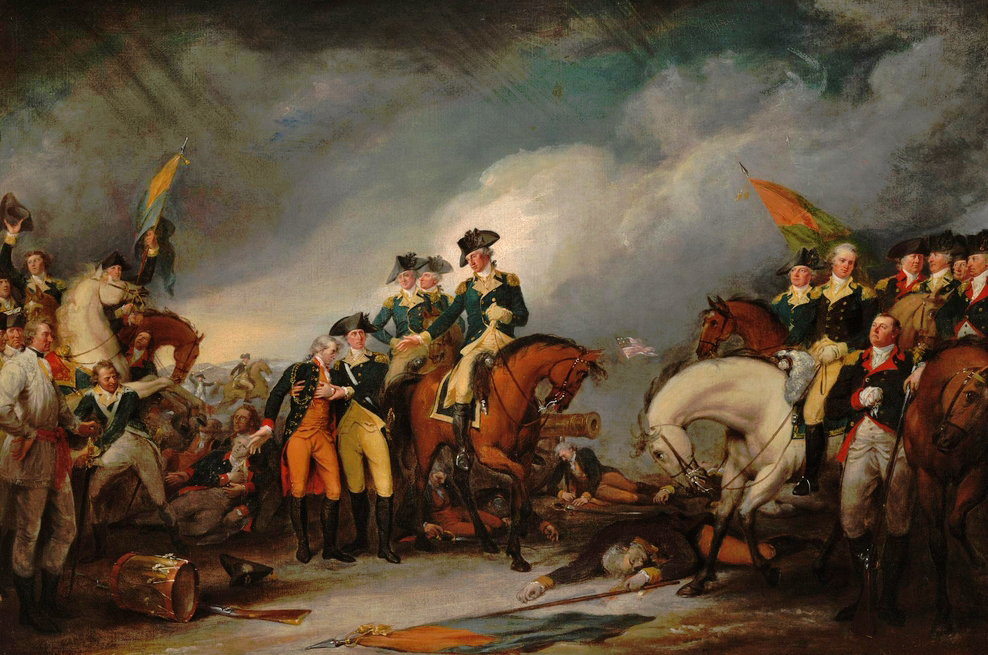
John Sidebottom, of Prince William County, VA, served for 1 year. In the course of his service, Sidebottom fought in the Battle of Trenton in December 1776, an historic battle in which General Washington led the crossing of the Delaware River on Christmas night to launch a surprise attack against a Hessian garrison.
Sidebottom settled in Clark County, KY. A man who knew him stated that during the Trenton battle, Sidebottom was one of the men who carried a wounded soldier from the battlefield to safety. That soldier was James Monroe, the future President of the United States, who survived the battle, in part, because of Sidebottom’s actions.[38]
None of this would have made life any easier for John Sidebottom. But it is fitting that he is finally receiving the recognition he deserves.
Acknowledgements
In writing about John Sidebottom I relied heavily on records uncovered by Donald Wilson, historian and librarian at the Prince William County (VA) Public Library, and the publications of Joan Peters, as well as Nancy O’Malley for helping me unravel the mysteries of the Boonesborough Ferry. Also thanks also to Kevin Grout, speech writer for Senator Mitch McConnell, for his Sidebottom contribution, to Vicki Whitaker for sharing historical records of the Sidebottom family, and to my collaborator Anne Crabb.
Endnotes
[19] William Littell, Statute Law of Kentucky, Vol. 3 (Frankfort, KY, 1811), 499–500.
[20] Joseph Sidebottom’s Revolutionary War pension folder.
[21] Jackie Couture, Madison County, Kentucky, Court Order Book A, 1787–1791 (Bowie, MD, 1996), 67.
[22] This undated Thomas Y. Hinde map was discovered by Nancy O’Malley and appears on the cover of her book, Searching for Boonesborough (Lexington, KY, 1989).
[23] John Patrick & wife v. Robert Clarke Jr. & John Sidebottom, In Ejectment, Lexington District Court, July 1798; and Clarke and Sidebottom v. Calloway’s Heirs, Kentucky Court of Appeals, July 1801.
[24] John Patrick & wife v. Robert Clarke Jr. & John Sidebottom, 1798.
[25] Ibid.
[26] John Sidebottom’s Revolutionary War pension folder.
[27] Ibid.
[28] John Sidebottom’s Revolutionary War pension folder; George F. Doyle, Transcript of the First Record Book of Providence Church, Clark County, Kentucky (Winchester, KY 1924), 29, 43, 47, 50.
[29] Clark County Deed Book 5:295.
[30] John Sidebottom’s Revolutionary War pension folder.
[31] Ibid.
[32] Ibid.
[33] Ibid.
Never miss a thing with our FREE weekly newsletter.
[34] Eric G. Grundset, editor, Forgotten Patriots: African American and American Indian Patriots in the Revolutionary War (Washington, DC, 2008, 2nd edition), 503, 526.
[35] Joan W. Peters, Third Virginia Regiment of Foot, 1776–1778, Vol. 2: Biographies (Bowie, MD, 2008), 372–382, 397–398.
[36] “Our National Independence: African Americans in the Revolutionary War,” Maurice A. Barboza, Founder, Liberty Fund D.C., Speaking Before The Alexandria Tea Party, July 4, 2012, online at www.potomacteaparty.com/forgotten-black-patriots.html.
[37] Congressional Record—Senate, June 28, 2017, S3828.
[38] Ibid.