
Fierce storms that tore through Kentucky last month left a fifty-five-mile path of destruction and twenty fatalities. Laurel and Pulaski Counties were the hardest hit: more than 1,500 homes were damaged or destroyed by an EF‑4 tornado (windspeeds of 166 to 200 miles per hour). The devastated communities have begun a long-term course of cleanup and rebuilding.
Reports of tornadoes in Kentucky always remind me of the storms of April 3, 1974. Termed a “super outbreak,” it marked one of the worst tornado outbreaks in United States history. A powerful springtime low-pressure system developed across the Great Plains on April 2. As it moved into the Ohio Valley, a surge of moist air from the Gulf intensified the storm. Sharp temperature differences between the two sides of the system created a very unstable atmosphere.
Those weather conditions resulted in 148 confirmed tornadoes in thirteen states, including 26 in Kentucky alone. The storms caused 335 fatalities and approximately $3.8 billion in property losses (inflation-adjusted).
One of the worst-hit places was Xenia, Ohio, which suffered 32 deaths and 1,150 injuries. Roughly half the town was damaged or destroyed. In Kentucky, Brandenburg, an Ohio River town of 1,600, was devastated. Winds in excess of 260 miles per hour, the strongest ever recorded in Kentucky, took 31 lives. Other Kentucky communities experiencing serious damage included Louisville, Jett (near Frankfort), and Great Crossing (Scott County).
Clark County, also hit by a tornado that day, escaped with no fatalities and only fifteen treated for minor injuries. One resident described the eerie conditions before the storms hit. “The air was unusually still, and the sky was a weird yellow or greenish color.”

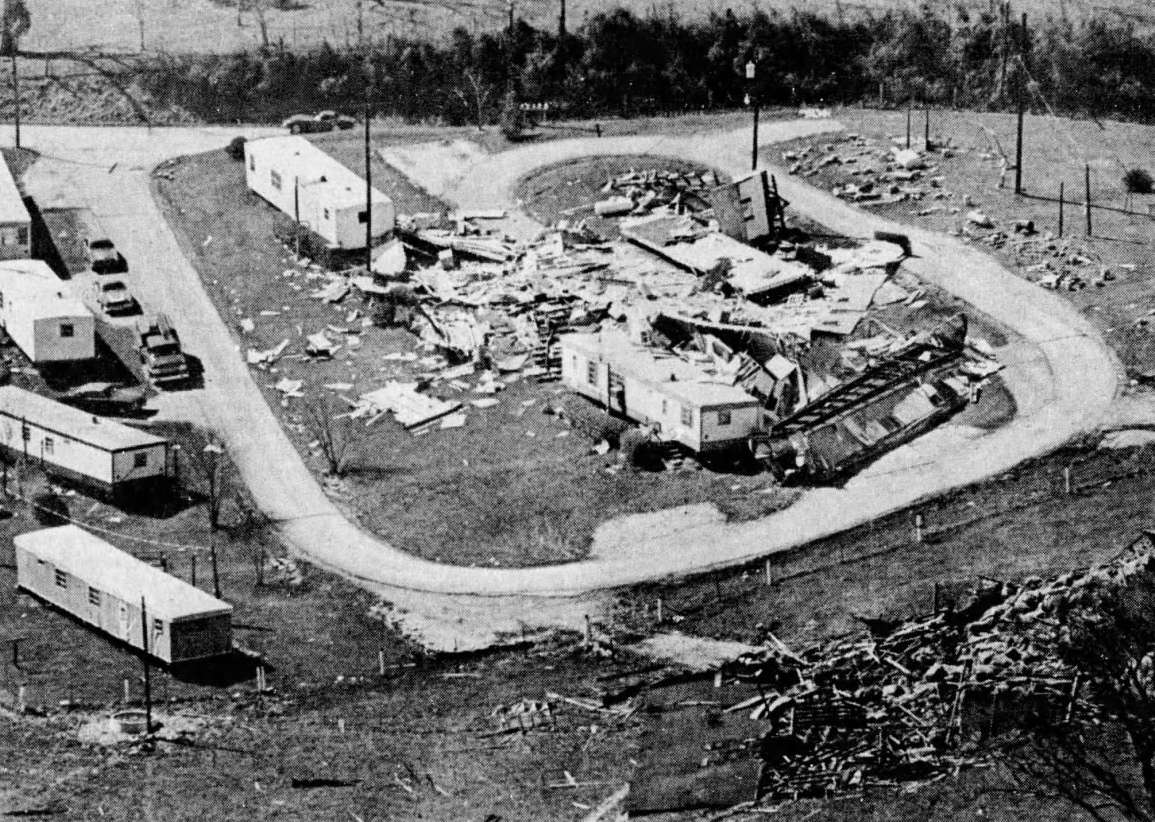
Then, according to the National Weather Service, an F‑4 tornado entered the county at 7:30 PM just west of Jackson Ferry Road, causing considerable damage there and on Sie Shearer Road, before continuing on a northeast course all the way to the Montgomery County line. Hardest hit were Dry Fork Road and the area near the junction of Old Ruckerville Road and Logan Lick Road. Wills Trailer Park, on Ironworks Road, saw most of its mobile homes destroyed.
Never miss a thing with our FREE weekly newsletter.
According to the damage reports, it appears that there were at least two other possible tornadoes on separate paths, which have not been confirmed by the NWS. One crossed Redwing Road, Cardinal Lane, Quick Shop Trailer Park, and Bön Haven Avenue; the other hit Boonesboro Road, George Rogers Clark High School, French Avenue, Patio, Shearer School, and GTE Sylvania. Both followed a northeasterly path.
After County Judge Dorsey Curtis made an aerial survey of the county, he reported that “while the damage looks bad from the ground, it looks much worse from the air.” A survey completed the following week reported 105 homes, 32 mobile homes, and 115 barns and other farm buildings damaged or destroyed. Total losses were estimated to be $8–10 million ($52–65 million in today’s dollars).
Sun columnist Betty Ratliff Smith often recalled and wrote about the worst storm in Clark County’s history. The disaster occurred on March 24, 1937, when a tornado tore a fourteen-mile path through the county, leaving 3 dead and 50 injured. Beginning at 4:30 in the afternoon, the trail of damage began on Boonesboro Road and continued on to Two Mile, Muddy Creek, Irvine, and Ironworks Roads. Four houses were swept away on Muddy Creek and seven in Patio, which suffered the most injuries. Twenty-six families were left homeless. Days later, personal effects were recovered 33 miles away in Bath County.
Another unforgettable storm occurred near midnight on Sunday, March 11, 1923. Winds destroyed the south wall of the Washington Street School at the southeast corner of Highland. The building, already in bad shape at the time, had to be razed. It was replaced by Victory Heights School. Only one injury was reported and the storm damage, though widespread throughout the county, mostly involved roofs being ripped off houses and barns.
Thanks to Chuck Witt for suggesting this topic.