The first settlers in this area came out from Virginia and North Carolina in 1775. Led by Daniel Boone under the banner of the Transylvania Company, they formed a pioneer community on the Kentucky River at Fort Boonesborough. Settlement on the east side of the river, now Clark County, began in 1779 with the establishment of John Strode’s and David McGee’s stations. Kentucky separated from Virginia in 1792, and Clark County was created that December, the 14th out of an eventual 120 counties, and named in honor of Revolutionary War hero Gen. George Rogers Clark.
First Courthouse
The county court justices appointed by Gov. Isaac Shelby met for the first time in March 1793, at the house of John Strode. At their November session the court voted to erect the public buildings—a courthouse, jail, stocks, and stray pen—on land owned by John Baker. The court directed the sheriff to let a construct contract to the low bidder for “a cabbin with two rooms, one 20 feet square and the other 10 by Twenty, one story high...of good oak or ash logs. The Flowers below to be laid with good sound puncheons, and the floor above to be laid of good sound plank loose laid down.”


John Baker was awarded the privilege of naming the county seat, which he called Winchester after his hometown in Virginia. On July 22, 1794, the court met for the first time in the new courthouse. Although there are no drawings of first courthouse, detailed sketches were recorded for the jail and stocks. Several Clark County pioneers left descriptions.
“Winchester had a courthouse like a Tobacco house of open round logs in the midst of the cane.” James Stevenson
“The Court House was of open round logs on the hill with a cabin roof and a log partition for a jury room. Old Judge Robert Clarke, the Governor’s father, undertook the public buildings. A man that went to Virginia, talking with someone there, said he would bet him a treat he couldn’t tell how much Clarke Court House cost. The person was guessing $2,000 and $3,000. It cost just $16.” Benjamin Allen
It was said that people outside could watch the court proceedings by “peeking through the cracks between the logs.”
Second Courthouse
By 1795 the cabin court house could no longer meet the county’s needs. The justices adopted detailed plans for construction of a new building. It was to be “42 Feet long and 30 wide; the foundation walls of which to be two feet thick of Stone laid 18 Inches below the surface of the ground and 18 Inches above, from thence of Brick 14 Inches thick, two stories of 9 feet high each; a Chimney in the end of said House, with two fire places therein suitable for Jury rooms; the Roof sheeted & Shingled with walnut or poplar hearted Shingles one Inch thick.”
The court room was to have a lobby with benches for the public and steps to a gallery, a bar for the lawyers, a box for the sheriff, and stairs to the seats for the justices. There were to be two jury rooms upstairs. An advertisement for contractors was placed in the state newspaper of record, the Kentucky Gazette. The contract went to Josias Bullock, brother of the first county clerk, David Bullock.
The court held its initial session in the new building in October 1797. It was in this courthouse that Henry Clay began his law practice. He settled in Lexington in the winter of 1797, then on February 27, 1798, the 21-year-old Clay was admitted to the Clark County bar. This predated his license to practice in Fayette, obtained on March 20.
Clay also served as the deputy state’s attorney for Clark County, equivalent to today’s county attorney. Appointed to the post in April 1801, he prosecuted criminal and civil cases before the county justices—Robert Clark, John Martin and Original Young. He resigned the post in March 1802.
Third Courthouse
The May 1818 minutes of the county court stated that the second courthouse had been razed. “The County Court House of Clark County having been demolished by the order of this Court, it is ordered That this Court and the Clark Circuit Court hold sessions of Court in the house occupied by John Ward as a Tavern.”
Then at their July 1819 meeting, the county court “Ordered that this Court and the Clarke Circuit Court hold their sessions at the new Courthouse on the public square untill further orders of this Court.”
Their first session at the new courthouse was held August 23, 1819, although the building was not completely finished at the time. While few details have been found in the minutes of the county court, it appears that the courthouse was completed by November 1821, when the following item was listed in the county levy.
“For finishing the new Courthouse, putting gutters and pipes of Copper to said Courthouse, enclosing the Courthouse yard with a fence—to be paid to Thomas G. Jones, Samuel M. Taylor, Chilton Allan & Samuel Hanson who are hereby appointed Commissioners to superintend the same—$800.”
Soon afterwards, small brick buildings were put up on each side of the courthouse, one for the county clerk and one for the circuit clerk. I. N. Massie gave a vivid description of the third courthouse in his recollections, “Winchester in Olden Times.”
“In my vision I see the old square brick Court House, with its one story brick offices for the clerks. Sam Taylor was Circuit Clerk and James Bullock was County Clerk. The first floor, or standing room, was paved with brick. The next room, about one-third of the court room, was fenced off with a paling fence to keep the people out of the jury rooms. Four large columns supported the upper floor, which was divided by a large hall, on both sides of which were rooms for juries to retire to make a verdict.”
Henry Clay made his last speech here in 1847 in the celebrated will contest of Joel Quisenberry’s heirs. After the wealthy Quisenberry died, his daughters brought suit to break his will on grounds of incompetence and undue influence by his sons. A veritable Who’s Who of attorneys represented the parties. Henry Clay appeared for the plaintiffs (daughters). In his opening speech, Clay “alluded feelingly to the fact that fifty years before he had made his debut as an attorney at the bar of Winchester.”
Another Winchester native, I. N. Massie, recalled that when he was a boy “Alfred Bowren was jailor and did all of the public whipping in front of the Court House. There was a block in front of the Courthouse where the owners of slaves put up and sold them to the highest bidder at public outcry.”
Fourth Courthouse
In the spring of 1852, a special committee—composed of “practical Mechanics, Stone masons, Brick masons, and house Carpenters”—inspected the courthouse. Their report stated that they “found it to be in a dangerous and dilapidated condition, with faulty foundation and bad superstructure.”

They concluded that repairs were impractical and recommended “that the present building be taken down and a new courthouse erected.” The court appointed commissioners to receive proposals for a new building, and ordered that the courthouse walls be suitably propped up in the interim. That November the court accepted the plans submitted by John McMurtry.
McMurtry’s work is well known in Kentucky today. Both an architect and a builder, he designed and/or constructed over 200 buildings, including Lexington’s Botherum, Christ Church Episcopal, Elley Villa, Floral Hall, Sayre Female Institute and Loudoun House, just to name a few. He has been called the man whose work is most representative of 19th century architecture of central Kentucky.

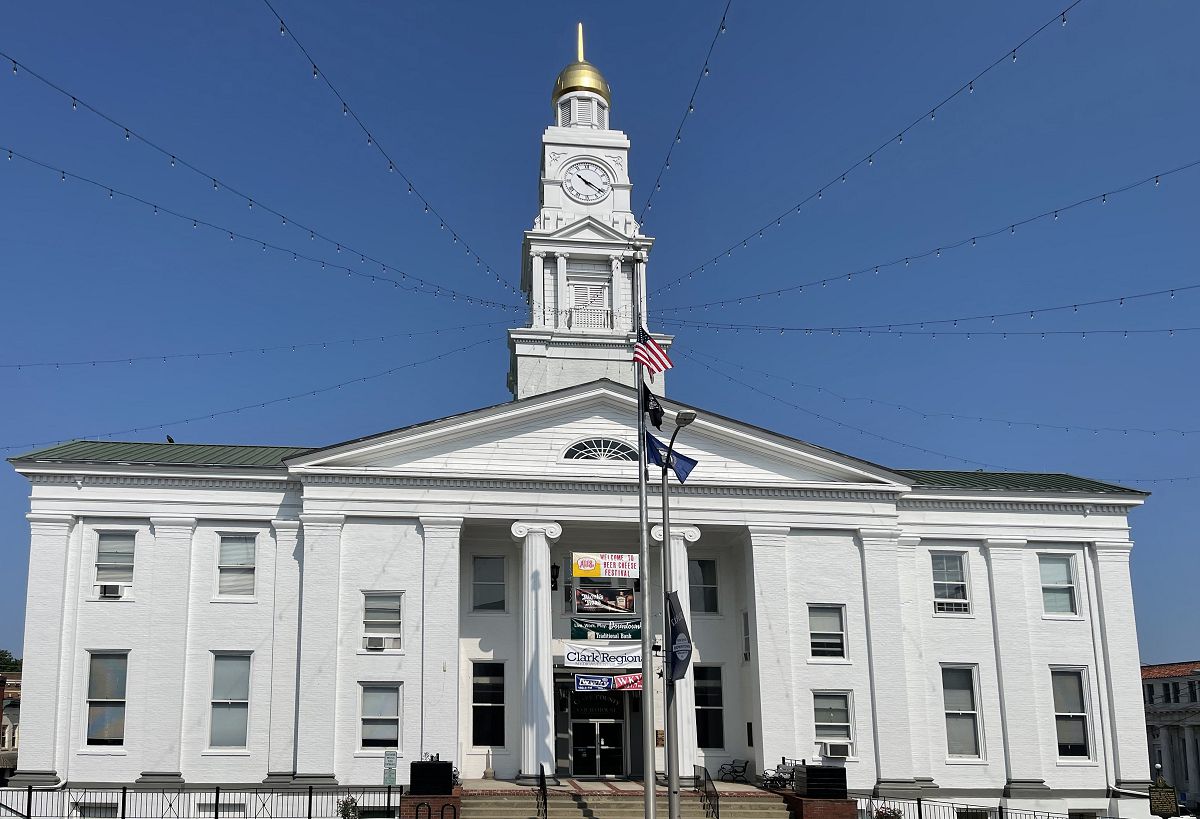
The court also hired McMurtry to construct the building, which was to be topped with a bell tower, clock and cupola. McMurtry finished the new courthouse in the fall of 1855. It was said that he undertook the work for the sum of $25,000, but it ultimately cost him over $40,000 to complete. The county awarded him an additional $10,000, which still left him with a heavy loss.
The building has a stone foundation with brick masonry bearing walls supporting a wood-framed floor and roof system. There is a finished sandstone cap on top of the foundation. The original building was T‑shaped (before a 1938 addition) with the main entrance facing Main Street.
The county jail stood behind the courthouse. The stone jail was surrounded by an 18-foot-tall stone wall that gave the name to the adjacent Wall Alley. The jail was located here until a new jail was built across Wall Alley in 1912. A sad affair occurred in March 1880 when “Ben Johnson, of color, alias Plunkton, was taken from jail at midnight and hanged to a maple tree in the Courthouse yard.”
In 1923, the Clark County Historical Society published a description in the Winchester Sun.
“The present building, up till the time of its remodeling about thirty-four years ago, was surrounded in front and on the north and south sides by a tall iron fence with a double iron gate in front, swung on heavy concrete pillars. This fence and the gates and pillars now adorn the front of the residence and grounds of Mrs. Susan G. Anderson. [The fence stands today at 245 S. Main St.]
“In one corner of the Court House yard was located the public well and in the other corner a large cistern, both of which were freely used by the general public.
“Shortly after the completion of the present building William Lindsay and Daniel Scott planted maple trees in the front yard of the Court House and they soon attained large size and afforded grateful shade in the warm months to the citizens and officials who were wont to congregate around the Court House and discuss the events of the day.
“Up to and including the year 1877, theatrical entertainments were frequently held in the court room on a temporary stage erected each time for the performance, on the south side of the court room.
“In the year 1889 it was decided by the Justices to remodel the building and place the court room upstairs where it is now located, the second story before that having been occupied by jury rooms and rooms for the clerks of the County and Circuit court.
“The original tower or cupola on the present building was an additional story taller than it is now and was surmounted by a large gilded globe or ball about two feet in diameter, though it appeared from the street to be only about the size of an orange, and this in turn was surmounted by a large weather vane which all the older inhabitants observed daily for indications of a change in weather.
“Clark county was noted throughout all Eastern and Central Kentucky as having the finest public building in the State, outside of Louisville.”

As mentioned above, the original tower was replaced in 1889 with one designed by E. N. Lamm. The position of the clock was raised to provide better visibility from the ground. The tower had a brick base, a louvered column surround section, a clock section and finally the cupola.
In 1938 the courthouse was remodeled under the direction of John Gillig, one of the best architects then practicing in Kentucky. Gillig’s large addition on the west side of the courthouse turned the T‑plan into an H‑plan. The design and materials match the old section, and with the brick painted white the addition is not readily apparent. A new basement entry was added along with a twin curved staircase to the first floor.
Over the years the courthouse was the home for a number of local agencies, including the health department, coöperative extension office, emergency services and a library. The courthouse was listed on the National Register of Historic Places in 1974.
Never miss a thing with our FREE weekly newsletter.
In 2017 Clark County Fiscal Court approved a measure to replace the clock tower that had become unstable over the years. The following year a new clock tower was raised—topped by a gilded dome.
The Courthouse Today
The historic courthouse today houses offices of the Clark County Judge Executive, Treasurer, County Clerk, PVA, and Geographic Information Services. The Fiscal Court Room, on the first floor, is lined with portraits of our past county judges. Circuit Court Room, jury room, law library and circuit judge offices are on the second floor. The walls of the Circuit Court Room are graced with a portrait gallery of notable persons—Gen. George Rogers Clark, Gov. James Clark, Chief Justice James Simpson, sculptor Joel Tanner Hart and numerous others.

The first floor hallway has a bust of Daniel Boone and a portrait of Boone at Pilot Knob, both by Jack Hodgkin. At the front entrance are plaques commemorating Clark County Revolutionary War veterans and the City-County Joint Resolution on Racial Harmony. The courthouse lawn is home to three Kentucky Historical Markers (Clark County Courthouse, County Named 1793, Confederate Raids in Kentucky), a Doughboy monument, a Vietnam Memorial, the old courthouse bell, and a map of the Winchester African American Heritage Trail.
The county has never suffered the loss of a courthouse by fire and, thus, county records—from the beginning in 1793 until today—are essentially intact, surprising given that that recordkeeping began in a log cabin.