
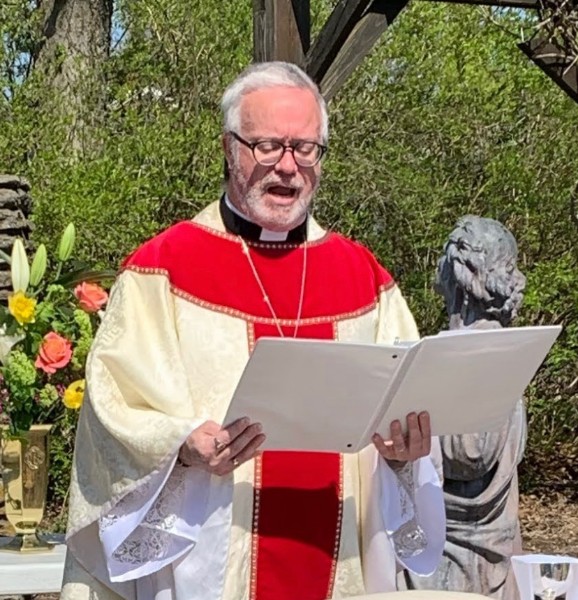
“Christianity is a lifestyle – a way of being in the world that is simple, non-violent, shared and loving. However, we made it into an ‘established’ religion…and avoided the lifestyle change itself.” — Richard Rohr
Rohr, a Roman Catholic monk and priest, is founding director of the Center for Action and Contemplation. I was honored to meet him while in seminary, and am always intrigued by his writings. I posted this quote on my Facebook Page a few weeks ago and it truly stuck with me. It’s the “lifestyle change” that haunts me and calls me to task.
Most religions — or faith traditions — at their core are designed to be practiced by individuals to support a change in heart, mind, and soul — to do good in the world and to direct our actions toward peace and justice. Buddhism, for example, is not necessarily a religion as we know it, but a practice and, as Rohr says, a way of being in the world.
My particular Christian faith tradition is The Episcopal Church, of Anglican origin, and one way of following the teachings and walking alongside Jesus of Nazareth, who we consider God’s Son. This way of living boils down to “loving God and loving your neighbor.” All the stories from the Bible, the preaching from my faithful ancestors, and the spiritual disciplines of prayer and piety should be directing me to act in that way: to love God and neighbor.
That’s it. That’s as simple as we can get it, and it should be the bedrock, for Christians, that holds up all else.
“However, we have made it into an established religion.” That’s the thin veil, the liminal place, at which I find myself. I have spent the last 20 years on a whole different journey of that way of being — I am a professional Christian. I get paid for helping other folks walk that path of “loving God and loving neighbor.”
I serve a congregation of faithful followers of the Jesus Movement on a campus covering many acres with four separate buildings, including a beautiful sanctuary, with paved parking lots and lush gardens, high utility bills, and pretty good wireless internet. I am thankful for a good salary with health benefits and a remarkable retirement plan (Rockefeller modeled his on the Episcopal Church Pension Group), a nice study with plenty of reading material, and quality vestments that serve as my liturgical uniforms. I also pay taxes. The church doesn’t, but I do.
All that sounds pretty “established” to me. When our founder, a brown-skinned Middle Eastern itinerant rabbi, wandered around the area of Palestine many centuries ago, he was trying to get folks to embrace a new lifestyle change and, at the same time, to call out the Jewish faith and traditions as being too established and forgetting the primary goal — to love God and love neighbor. Part of his work was to delineate personal religion from the governing state. It’s amazing that we’re still dealing with that issue today here in the United States.
This journey as an Episcopal priest is one of balance. While I acknowledge that my faith practice is part of an established religion with a hierarchy of officers and members (bishops, priests, deacons, laity), campuses all over the country, an official seal, and the aforementioned pension plan, I must strive always to turn my heart and live my life to reflect the simple shared, non-violent, and loving example of Jesus and the great cloud of witnesses who followed.
