
Imagine this: A major storm has hit Clark County. Thousands of homes are without electricity. Several cell towers have been knocked out. Landlines are down. Internet connectivity is spotty. Even the local radio stations are struggling to stay on the air.
With no outside communication, where do you turn for news and official announcements? Besides first responders and emergency management personnel—who have their hands full dealing with the disaster—who can communicate with the outside world and keep local residents informed with important updates?
It can be hard to imagine in this age, when we carry around devices that allow instant communication worldwide, but when we lose Internet connectivity, our smartphones and other connected devices become useless. In this scenario, it’s a technology over 100 years old that can come to the rescue and provide critical communications that can save lives.
It’s called amateur (ham) radio.
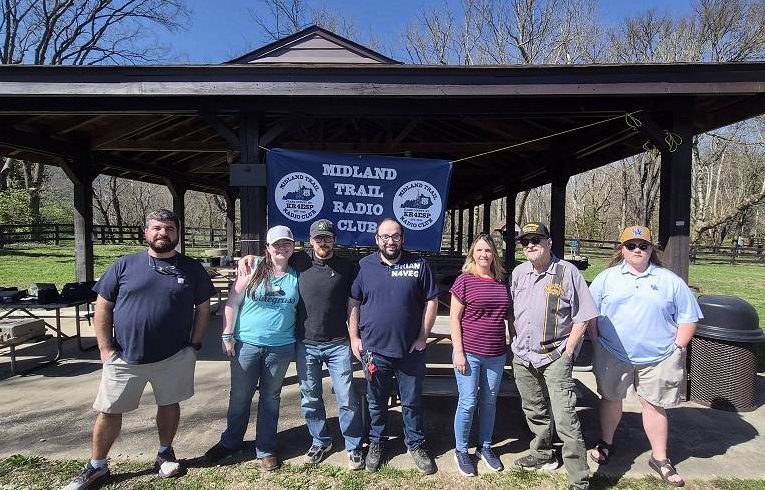
Here in Clark County, the recently formed Midland Trail Radio Club is a group of ham radio enthusiasts who meet monthly and conduct field days and other activities related to the hobby.
Last year, the club held its first American Radio League (ARRL) field day event. Demonstrating their ability to communicate over long distances when no electric service is available, club members contacted over 200 fellow ham operators across the continental U.S., Canada, Puerto Rico, and Alaska, using battery-powered equipment and portable antennas.

WinCity Voices recently met with two members of the club, Brian Phillips and Austin Parsons. The first thing we wanted to know is this: what exactly is ham radio, and how does it differ from the other well-known form of amateur radio communications, CB (citizen’s band) radio?
It turns out that the key differences are participant requirements and the scope of communication.
Obtaining an amateur radio license requires passing an FCC test with a score of 75% or greater, with 3 levels: Technician, General, and Extra. Ham radio utilizes digital modes, HF, VHF, and UHF, and is distinct from simpler communication methods like CB or walkie-talkies. As such, there are more modes of communication and much longer ranges with ham radio.
The license requirement is tied to amateur radio’s role in emergency services and to power limitations, with the club serving as the county’s ARES (Amateur Radio Emergency Service) coördinator.
The club has individuals trained as Sky Warn spotters through the National Weather Service and is FEMA-trained to deploy in situations like the Eastern Kentucky flooding, where ham radio operators were essential for communication after cell towers failed.
But even unlicensed citizens can listen to amateur radio broadcasts using inexpensive, readily available radios. This can become crucial in emergencies such as the one described at the start of this article.

Formed in June 2025 at an ARRL Field Day event, the club’s main purposes are to foster fun, education, and community service. In addition to its regular membership, it offers an unlicensed membership category for those who plan to obtain their license within one year.
The club is working to establish a private station to link directly to the Emergency Operations Center in Frankfort.
Never miss a thing with our FREE weekly newsletter.
Phillips noted that Winchester mayor Jo Ellen Reed was impressed by their public Field Day event, leading to a request that the club present to city and county leaders on how it can serve the county, particularly the Emergency Management Agency and the EOC. Phillips is also involved with the EOC as an EFS2 (Communication Specialist) in a neighboring county and hopes to establish a similar group in Clark County to provide backup communication if phone lines fail.
Parsons told us about plans to offer public classes on general ham radio and emergency communications in the near future.
The club meets monthly on the second Monday at 6:30 PM at Rosemary Brooks Place, and any interested residents are invited to attend. The group has obtained 501(c)(3) nonprofit status and accepts public donations to support its activities. Donors may send checks payable to “Midland Trail Radio Club” either mailed to 7904 Ironworks Road, Winchester, KY 40391, or in person at any meeting.
The club has a website and Facebook page where contact information and more details can be found.

