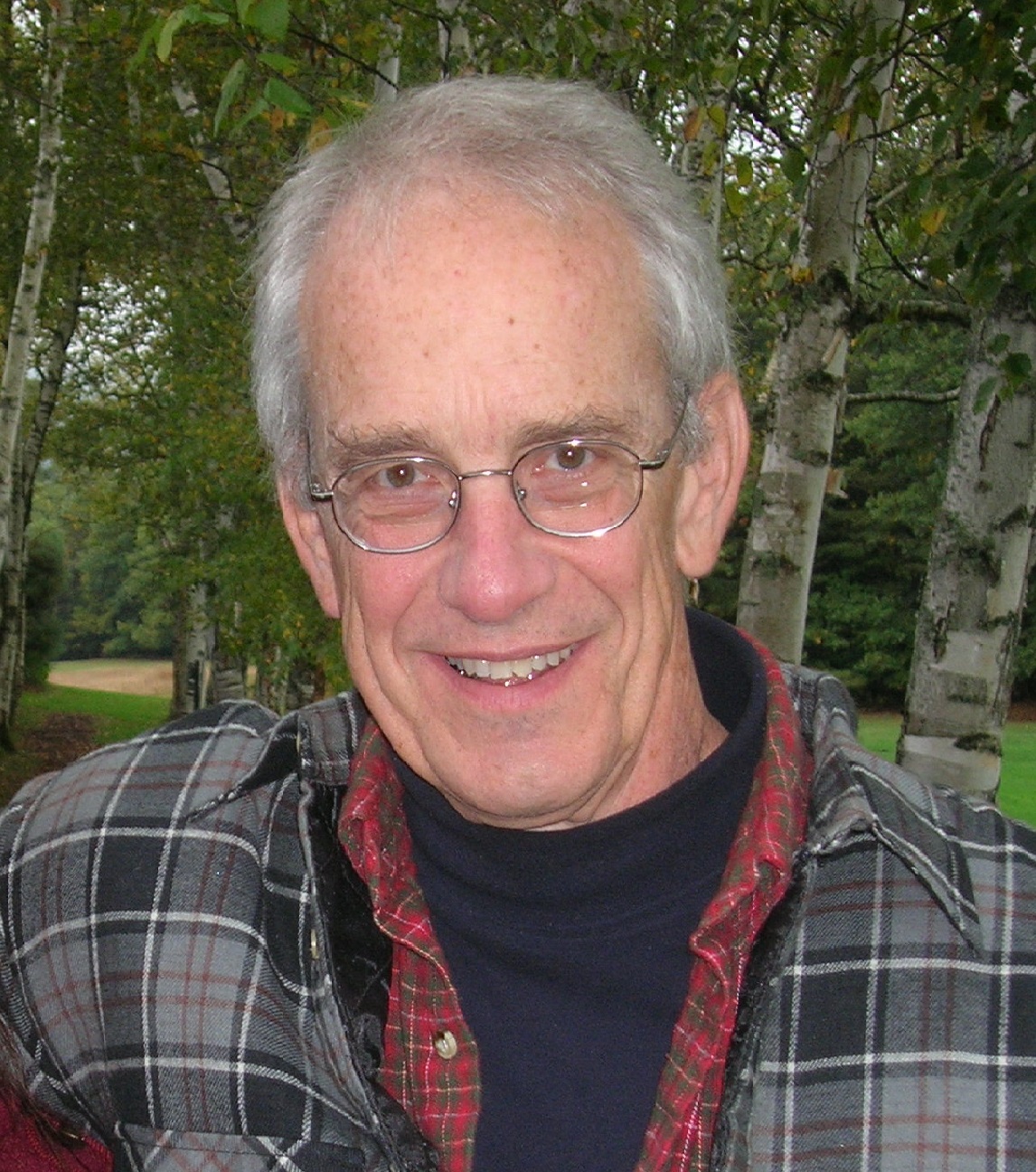

To get away from Lexington’s awful traffic, I ventured to Clark County in the fall of 1999, looking for “a place in the country” that had some mature trees. Boy, did I luck out. Glenn “Red” Wilson and his wife, Frieda, were selling their home at Forest Grove and moving to Arizona. Their house was situated in the middle of an eleven-acre woods. It was perfect. I moved in that November.
While waiting for the usual rigmarole associated with closing, I asked Red to give me a tour of the place. It had been a tobacco farm before he built here in 1971, the first house in a new subdivision. He spent the next twenty years or more planting native trees, shrubs, and wildflowers until the place became a magnet for garden clubs, scout groups, and school children. His exhaustive tour only managed to get about a hundred feet from the house, as he had a story and a botany lesson for each plant. A second tour only covered his wildflower garden.

Along the way, I learned a lot about Red and decided that his story needed to be told.
Glenn Wilson (1916−2004) was born in Owsley County and grew up on Cow Creek, about two miles outside Booneville (population 150). His parents were poor, and most of their food came from the garden. He walked to the one-room schoolhouse in town every day.
In high school, he wanted to play basketball but didn’t make the team because he was too short. He showed up for practice anyway. He kept it up until the coach finally gave him a uniform and let him sit on the bench at games. In one game, they had so many players out sick that the coach had to start Red. He scored 29 points, and they won. He got playing time after that. As a senior, he received several basketball scholarship offers, but chose to attend Berea College. (Berea did not give athletic scholarships.)
He didn’t get picked for Berea’s basketball team either. When he continued to show up for practice, the coach said, “Can’t take a hint?” Undeterred, Red kept coming back and even got some playing time in that year’s games. By the time he was a senior, he was captain of the team. He had a great game against Transylvania University, in which Berea won, 38–32. The following story appeared in the paper the next day.
“Berea College’s rolling basketball players staged a two-act performance of ‘The Phantom of the Hoopers” in the Transylvania gym Wednesday. Leading man of the piece was Capt. Glenn Wilson of Berea, one of the busiest men ever to tread the Transy boards. Playing without the benefit of sleeves or mirrors, he phantomed 13 points into the hoop while the local boys fanned, fizzed, and fumed.
“The Bereans really played six-man basketball when Wilson was in the game since he frequently managed to be in two places at once.”
Alex Bower, Lexington Leader, January 18, 1940
After the game, the coach said to him, “I can’t believe how much you’ve improved.” Red turned to one of the other guys and said, “It helps if you get to play.”
After graduating, Red married fellow student Frieda Ray Begley and took a job with the Farm Security Administration in Barbourville. His work required a car, and Red didn’t even know how to drive. A local dealer found him a Model A Ford for $25 and took him to a cow pasture for two or three hours to teach him how to drive.
When the war started, Red enlisted in the Navy to become a pilot. He went to Iowa State University for training, then got assigned to a branch conducting anti-submarine warfare. He found himself stationed on the aircraft carrier Ranger and flying an A‑24 Douglas Dauntless, a two-seat, open-cockpit dive bomber. On one mission, he got shot down and had to find a place to land in the dark. And he did, as he said, “Thanks to my terrific night vision.”
Never miss a thing with our FREE weekly newsletter.
The Navy moved Red to another carrier-based plane, the PBM Mariner, a seaplane that could stay in the air for eleven hours. He was later assigned to the Pacific Theater and flew till the end of the war. He spent 30 years in the Navy flying 263 missions in World War II, Korea, and Vietnam, before retiring to his place in Clark County.
When I moved here, I was surprised to find dozens of birdhouses and stands of ginseng and pink lady slippers. Neighbors told me that Red, at age 83, still spent every day working outside on his place. They said it was not unusual to find him up way up in a tree trimming limbs.
I was sad to learn that Freida passed away only two months after they moved away, and Red followed her four years later. I attended his memorial service at Berea College. His sons brought Red’s ashes here to scatter on this place that he loved so much.
Sources: Winchester Sun back issues; Tom Chase, B for Berea, Volume 1: Triumph and Toil, 1895-1969 (2000).