There are just four kinds of people. You don’t have to take my word for it. Go to the library and grab ahold of William Irwin Thompson’s At the Edge of History. He tells you what’s what about tribal society. Full disclosure: the book was written in 1972. We have become considerably more enlightened since then, haven’t we.
Thompson presents the idea that humanity can be understood as four architypes – Headman, Hunter, Shaman, Clown. Each architype plays a pivotal role in a tribe by owning complementary skills. The Headman shows the way. The Hunter has muscle to stalk and bag food. The Shaman provides a spiritual compass. The Clown keeps everyone entertained.
Thompson suggests that tribal evolution created feudal society – Headman to King, Shaman to Priest, Hunter to Soldier, Clown to Poet. Further, those feudal structures evolved into institutions we know today – King to State to Government, Priest to Religion to Education, Soldier to Army to Industry, Poet to Arts to Media.
If you consider Thompson’s paradigm, it’s easy to see how once simple and contributary roles became much more diffuse and complex as society evolved. A Headman could be very satisfied when the Shaman said stars aligned for the Hunter’s kill and the Clown opined about the taste of the roasted beast. But wow, put university students at odds about the Middle East in a crucible with politicians and the news media and 21st century life gets messy.
The common narrative is that we are getting more tribal. I submit that we are becoming more confused.
Never miss a thing with our FREE weekly newsletter.
In spite of complex blame games that plague today’s society, I think it is still possible to witness our tribal selves in action during the weekly grocery store run. Headmen probably don’t even go to the grocery store. They use Instacart. It’s left up to the Hunters, those people blocking aisles with rolling shelves, to bag and deliver dinner for Headmen and/or Headwomen.
Hunters who do shop for themselves are easy to spot. They are people who do not observe shopping cart speed limits. They will run over your toes to grab a box of refrigerated mashed potatoes out of the cooler.
Shamans usually loiter at the produce aisle. I think they are getting celestial messages from vegetables. They experience something spiritually anointing about intermittent misting. I have never seen a Shaman weigh anything in the produce section. This tells me two things: 1) weights and measures do not concern beings connected to a more spiritual mathematics, 2) combining recently harvested organisms to make food is more alchemy than science; Shamans would never be caught dead using a measuring cup. Think of a big black cauldron steaming on a campfire; a pinch of newt, some mandrake, a little bitterroot, etc.
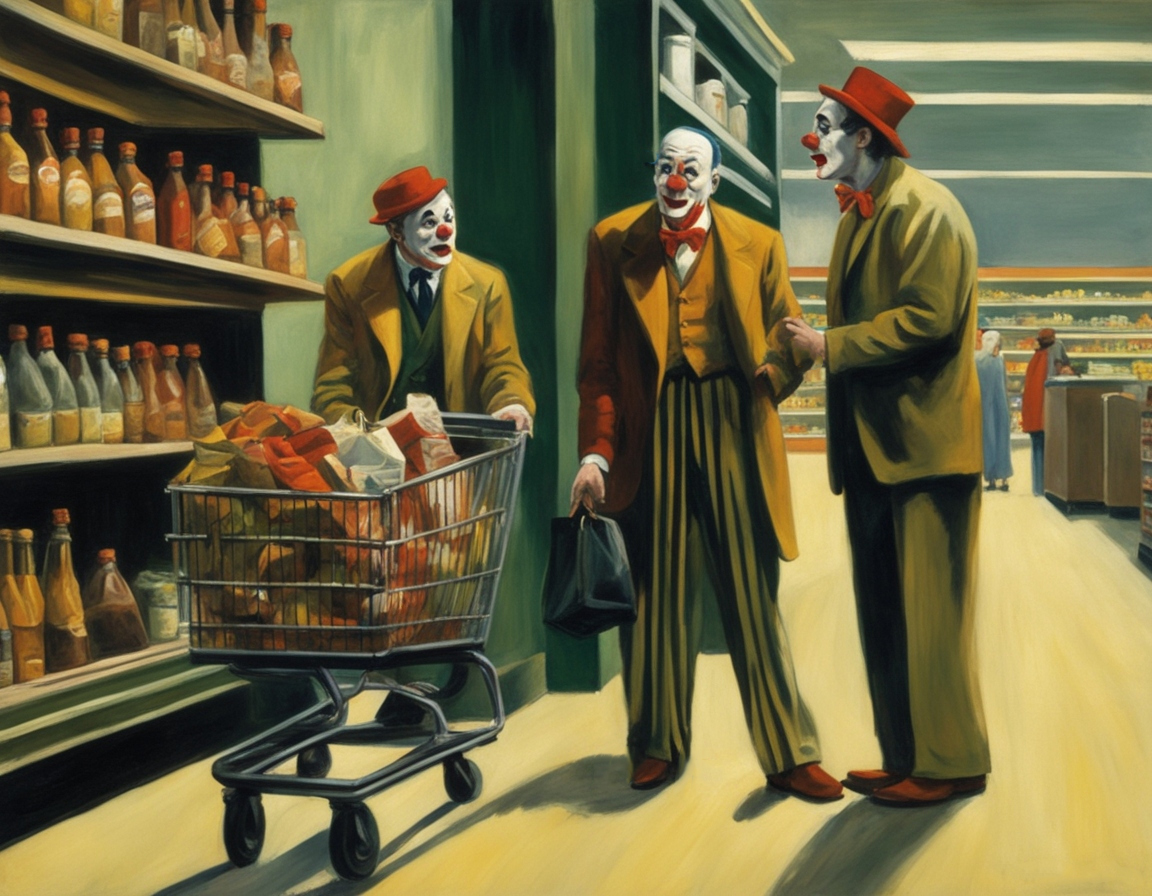
Clowns are easiest to spot. They usually aggregate in twos or threes. Clowns have forgotten where they are, and why they are there, but they enjoy the moment. Typically, Clowns park their carts in front of the spice rack to talk about Aunt Mildred’s new hair color or pressure washers they found on swap and shop. What was once a symbiotic relationship between Hunters and Clowns (when funny songs about roasted Yak were de rigueur) has devolved into disharmony because in today’s grab-and-go world, Hunters just want to snatch a vial of Mrs. Dash and dash.
I hope this explanation of the cosmos calms your ragged, modern heart. If you do go for groceries, notice whether you collide or coöperate. It may give you a clue about your role in Thompson’s tribe.