
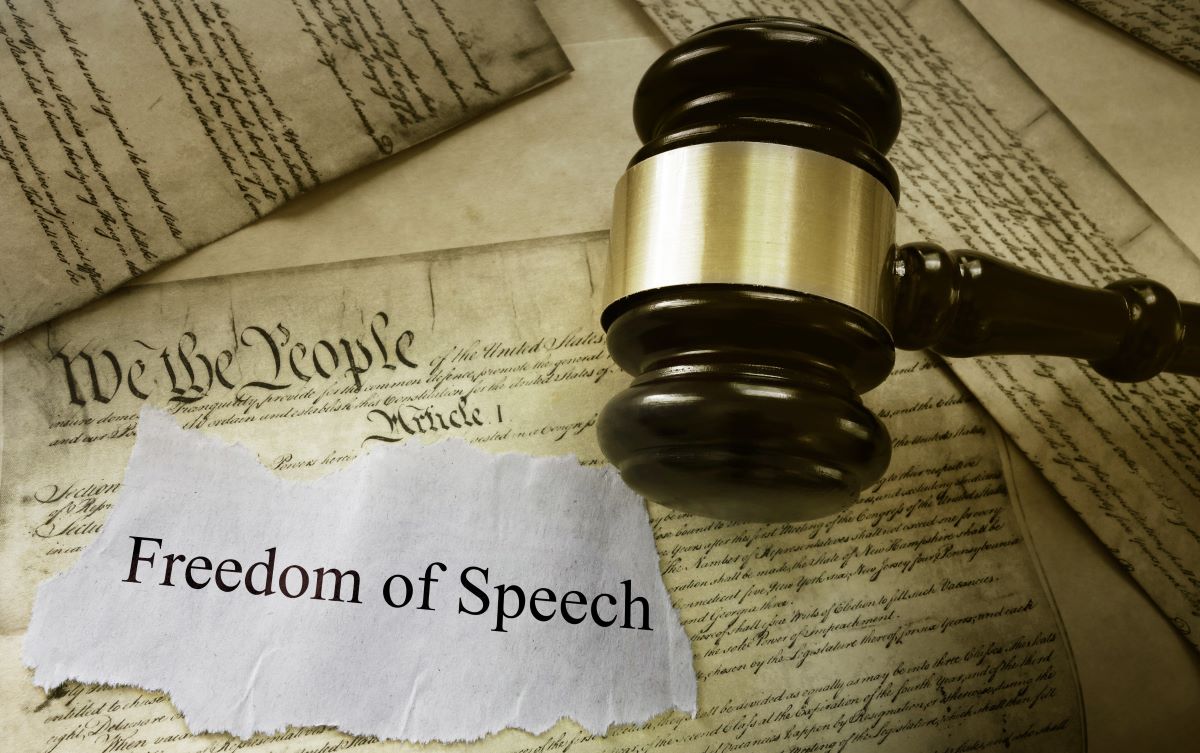
In Cult of the Constitution, Mary Anne Franks discusses “Constitutional fundamentalism” a condition she describes as a strict adherence to the text of the Constitution without regard to the changing societal norms which may – and do – affect the application of the document.
Given the changing conditions in American society at present, it is perhaps appropriate to consider some alterations in our laws and separate them – with the utmost caution and consideration – from the strict interpretations of the Constitution.
The First Amendment deserves some profound attention. The First Amendment is very explicit about speech: “Congress shall make no law….abridging the freedom of speech…or the right of the people peaceably [emphasis added] to assemble… ” Pretty emphatic.
However, total freedom of speech and assembly have been limited numerous times in the United States, most notably during the times when sedition laws were enacted at the beginning of the 19th century and during World War I. In 1919 the Supreme Court opinion in Schenck v. United States was that free speech in opposition to the war was not protected. It was in this decision that Justice Holmes proclaimed that shouting fire in a crowded theater was not protected free speech.
In 1969 the decision in Brandenburg v. Ohio limited the scope of banned speech to that which would be directed to and likely to incite imminent lawless action. The distinctions of “peaceably” and “incitement” are especially important because they go to the very heart of past declarations which have placed limits on both.
Even during the American Civil War, President Lincoln suspended the writ of habeas corpus, and those who spoke out against the war were subject to arrest.
Following World War II the German penal code prohibited publicly denying the Holocaust, disseminating Nazi propaganda both off and online, including images of swastikas, wearing an SS uniform, or making statements in support of Hitler. Admittedly this is all related to Germany, uninhibited by our Constitution strictures, but the German republic understood the extent to which hate speech, fostered in the decade before the start of the war, can fester and foment the most horrendous actions.
So, maybe it’s time for America to consider the possibility of enacting laws that prohibit the formation of groups that consistently espouse violence against those who disagree with them. Any such prohibitions would undoubtedly be challenged in the Supreme Court as exercises in abridging free speech and assembly, but isn’t there some balance to be achieved between this unfettered speech and the safety and welfare of the average individual? Must Jews, Muslims, Asians, LGBTQ+, and numerous other minorities be continuously fearful because of the unrestrained hate speech so prevalent today and the multiplying hate groups targeting them?
There has been a troubling rise in hate groups in recent years, and they seem to be getting more violent, so following Germany’s lead could potentially allow this country to curtail events similar to those which resulted in the destruction of that country and, to be blunt, the events of January 6, 2021.
Never miss a thing with our FREE weekly newsletter.
And all this leads back to a discussion about “Constitutional fundamentalism” because if the courts of this country adhere to the strict interpretation of that portion of the First Amendment we may never have a method of restraining the hate and violence that is so readily available, especially now through its widespread dissemination on the internet.
The process will undoubtedly be described as a “slippery slope,” and so it may be, which is why extreme diligence must be exercised and thoughtful discourse applied to it. But even a skier, traveling at breakneck speed down a snowy slope has the opportunity to stop his downhill race or to change course. So too are there various and numerous options available to assure that any restrictions do not become hammers with which to pummel groups that pose no imminent threat to the peace and welfare of citizens. They cannot become a cudgel to be used against dissent strictly for the sake of silencing opposition views.
But Constitutional fundamentalism does not allow us the luxury of applying the high-minded propositions of the founders to the changed circumstances of today — and our founders certainly were not possessive of the prescience necessary to predict the circumstances facing this country today.
The point of all this is that this country needs some method of prohibiting the formation of, or continuation of, clearly defined hate groups and their ability to use the dissemination of messages that promote hate and violence to achieve their aims.
Otherwise, we may find ourselves on the path that destroyed a country and millions of people.
