
All the recent furor about the new Pope piqued my interest in the history of popes. Even if one is not Catholic, that history has many interesting aspects.
So, here’s a short Popery potpourri. (Sorry ‘bout that.)
The first Pope is reputed to be Peter, who allegedly served for 38 years, beginning in 30 CE. Early records of the Church are questionable, so dates may be uncertain. In fact, the list of popes was not written before the late second century, with the first written dates going back to 222 CE.
Of the 267 popes, Leo XIV being the 267th, only one has assumed the name Peter, and he was born Simon. The fact that no other Popes have taken the name Peter may be a recognition of his place as the first and the veneration of him as the first leader of the Church.
A great many popes have taken names of previous popes, including John (23 times), Gregory (16 times), Benedict (16 times), Clement (14 times), Leo (14 times), Innocent (13 times), and Pius (12 times).
Forty-four popes’ names occur only once in the 2000-year history of the Church, including Linus, Hilarius, and Simplicius.
The longest-serving popes — after Peter — were: Pius IX, 1846–1878 (31 years, 7 months, 23 days); John Paul II, 1978–2005 (26 years, 5 months, 17 days); Leo VII, 1878–1903 (25 years, 5 months, 1 day).
The popes who served for the shortest period include: Urban VII, 13 days in 1590; Boniface VI, 16 days in 896, and Celestine IV, 17 days in 1241. A good many other popes served for less than a full year.
Prior to the 21st Century, only five popes had resigned their position, with historical certainty, all between the 10th and 15th centuries. The latest pope to resign was Benedict XVI in 2013. Prior to his resignation, the last pope to do so was Gregory XII in 1415.
There is some indication that some popes may have been deposed, but the records are uncertain, and it’s possible that some of those who faced being forcibly removed chose resignation.
Though the vast majority of popes have come from Italy (217), many other countries and regions are represented in the history of the papacy including France (17), Greece (9), Syria/Lebanon (7), Germany (4), Africa (3), Spain (2) and Portugal (2). England, Poland, Argentina, and the United States have each provided one pope.
Wikipediaoffers a wealth of information about the lineage of the popes, including the years they reigned, their origins, and more.
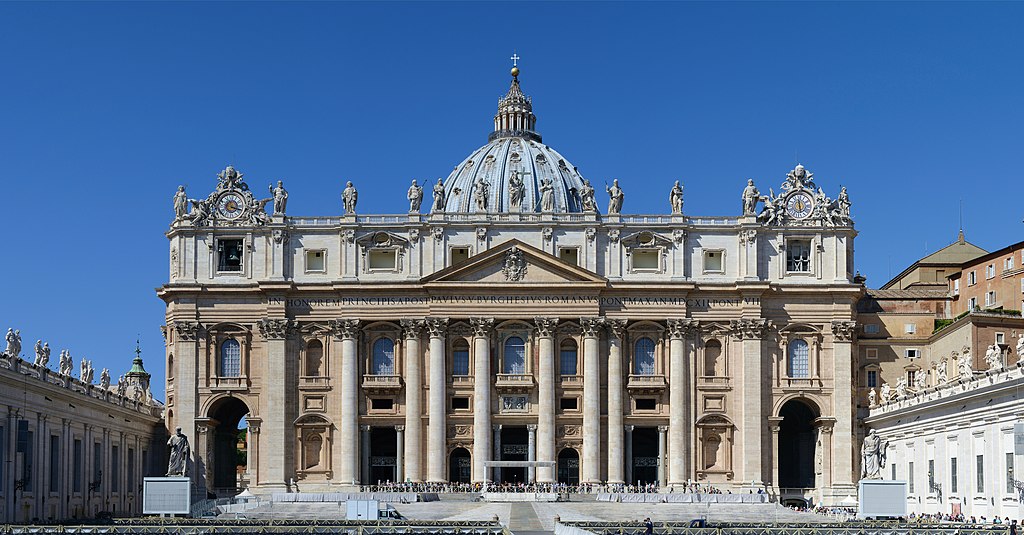
While researching information about the popes, some questions arose about the history of the popes, the Vatican, and most especially St. Peter’s Basilica. The current edifice was begun in 1506 and completed in 1626, replacing the old St. Peter’s, which was built under the reign of Constantine the Great in the fourth century. The design of the newer basilica is credited to Bramante, although fourteen other architects are listed as part of its construction, including Michelangelo (who can ever forget Charlton Heston and Rex Harrison in The Agony and the Ecstasy?) Since its construction lasted some 120 years, it’s easy to see why so many architects may have come and gone during the period.
Michelangelo’s contribution to the building included the statue of the Pieta, the design of the dome, and, of course, the painting of the ceiling of the Sistine Chapel.
