
Editor’s note: This article is a companion piece to another article written by Harry, The Colored Paupers, which provides brief glimpses into the people interred in the graveyard. In the interest of historical accuracy, we have chosen to leave anachronisms such as the words “colored” and “pauper,” as well as other potentially awkward or painful language.
Summary
In 1879 the Clark County Court purchased a 9‑acre tract of land on Muddy Creek Turnpike (now Old Muddy Creek Road) for “the use and benefit of the Poor of Clark County.” The northern portion of this land was used to bury the county’s “colored paupers.”
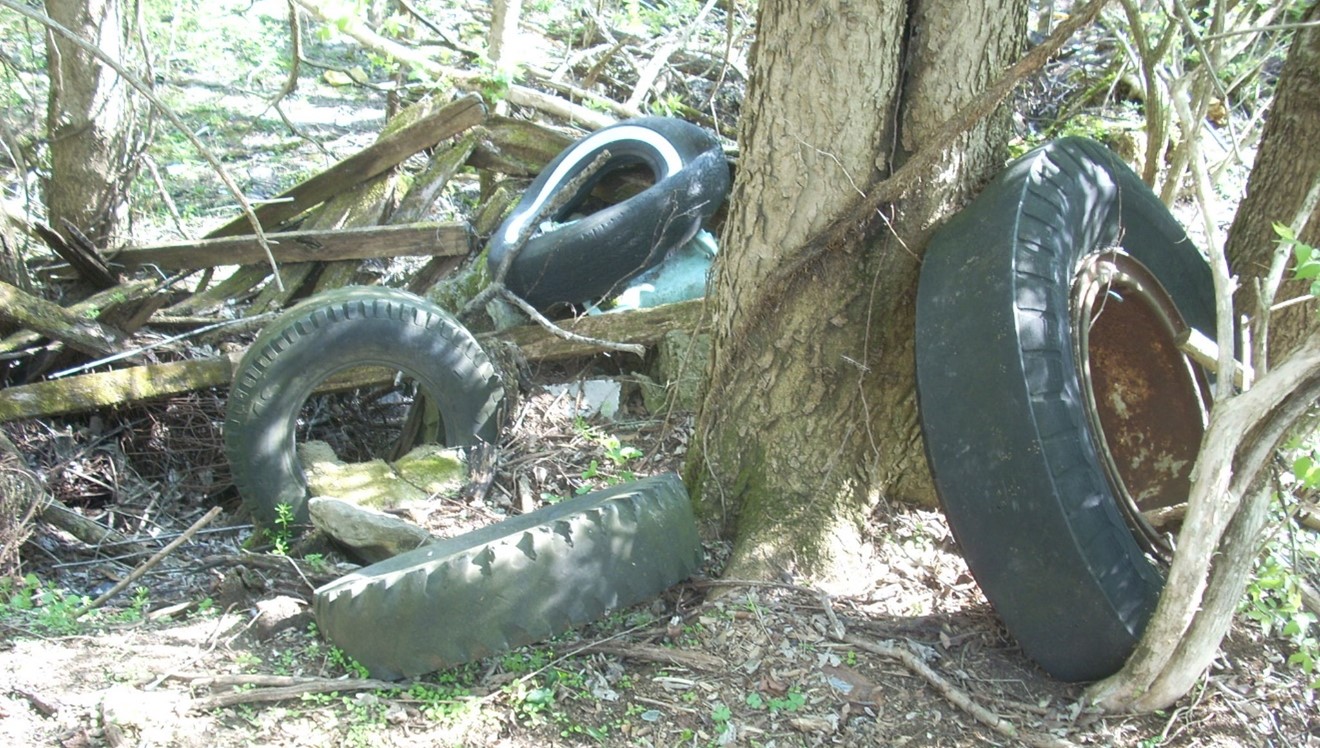
The Colored Paupers Graveyard is located at the northern end of Reeves Memorial Park and across the road from Daniel Grove Cemetery. All three are African American cemeteries. Today, the long-forgotten “paupers” burial ground is completely overgrown with trees, brush, and weeds — and is the site of several illegal dumps. No gravestones or markers have been found.
The purpose of this study is to document the history of this cemetery and to find the names of the men, women, and children buried there. Death certificates were used to identify 84 burials that took place from 1911 through 1928.
The Colored Paupers Graveyard is no longer owned by the county. It is now in the hands of a private owner. Kentucky state law requires owners to keep cemeteries “free of growth of weeds, free from accumulated debris, displaced tombstones, or other signs and indication of vandalism or gross neglect.” As of this date, the county has not succeeded in getting this out-of-state owner to comply with the law.
Introduction

In 1870 the county court formed a committee to find “a suitable parcel of land adjacent to the town of Winchester for a burial place for paupers both black and white of Clark County.” In 1872 the county paid $100 to purchase four lots in the Winchester Cemetery to be used “as a negro pauper burial ground.”
By 1879 those lots must have been filled, as the county that year executed a deed to purchase 9‑acres of land from W. H. Garner and wife for “the use and benefit of the Poor of Clark County.” This tract was situated on Muddy Creek Turnpike near the city limits and adjacent to the L&N Railroad.
The “Pauper Grave Yard” is shown below on a 1919 plat found in the county clerk’s office. The county then owned all the land shown on the plat, including the Pauper Grave Yard. The burial ground went by several other names, but was most commonly referred to as the “Colored Paupers Graveyard.” No record has been found of any white persons buried there.
Since the property was purchased for the burial of paupers, one presumes that burials there began in 1879 or soon after. If records were kept of burials, they have since been lost. The earliest record possibly referring to this cemetery is dated October 1903, when the fiscal court awarded a contract for providing “pauper coffins” to Winn Furniture Company. Then in October 1907, the court instructed the county judge to build or repair “the fence that surrounds the County Cemetery located on the Muddy Creek Pike.”
When these grounds on Muddy Creek Road were purchased, the county also operated a poorhouse on Ironworks Road (now the site of the County Fairgrounds and the County Farm). Both blacks and whites were taken in at the poorhouse, and all residents who died there were buried on the property. Blacks who died in Winchester or elsewhere in the county were buried at the Colored Paupers Graveyard. Evidence from death certificates indicates that burials there ended by 1928. After that time, all paupers would be buried at the County Farm on Ironworks Road.

In 1939 Luther Reeves purchased the property shown on the plat as lot numbers 1 through 4 (Figure 1). On this land, he opened a cemetery, Reeves Memorial Park, for blacks in competition with Daniel Grove, located across the road. One year later, Reeves paid $50 for the Colored Paupers Graveyard, which the county had stopped using. The 1940 deed included the following stipulation:
“It is understood that this land was used by Clark County as a burial ground or cemetery at one time and the second party agrees that the graves now on said property shall not be disturbed.”
There is no evidence that Reeves ever used this land for burials.
The Colored Paupers Graveyard on Old Muddy Creek Road has been completely forgotten as a burial ground. Now in private ownership, it is totally overgrown with weeds and brush.
Method of Identifying Burials
No grave markers have been found in the Colored Paupers Graveyard. Since burial records were either not kept or subsequently lost, another method had to be used to identify the names of people buried there. Kentucky death certificates proved useful for that purpose.

Kentucky began requiring death certificates to be recorded for all deaths beginning in the year 1911. Standardized forms were filled out at the county level then collected and archived by the state. The forms have a box to enter the “Place of Burial.”
Kentucky death certificates from 1911 to 1965 are available on Ancestry.com. These records were searched one year at a time to find all Clark County deaths. Each certificate that listed Negro, Black, or Colored for “Race” was checked for the “Place of Burial.” Unfortunately, this method misses all the burials that occurred before 1911, for which there are no records.
The burial place name was usually given as the “Colored Paupers Graveyard” or “Colored Paupers Cemetery.” Other synonyms were used in a few instances. These names included Winchester Paupers Graveyard, Winchester Colored Cemetery, Colored Graveyard, Potters Field, Winchester Potters Field, and Negro Potters Field.

The only other place where colored paupers were buried was at the county poorhouse. On death certificates, burials there were usually listed as the County Farm, but sometimes called the Clark County Farm, Clark County Cemetery, Clark County Graveyard, or simply the County Cemetery or County Graveyard.
Burials in the Colored Paupers Graveyard
| Name | Year | Age | Occupation | Cause of death | Burial Code |
| Floyd Gheens | 1911 | 40 | laborer | homicide-gunshot wound | 0 |
| Newton Hood* | 1911 | 58 | laborer | tuberculosis | 0 |
| Hanna Lou Keys | 1911 | 5 mo. | “always delicate, no physician” | 0 | |
| Charles Lane | 1911 | stillborn | 0 | ||
| Murry baby | 1911 | stillborn | 0 | ||
| Alexander Vivion | 1911 | ~50 | farm laborer | paralysis | 0 |
| Selda Haggard* | 1911 | ~73 | farmhand | old age | 2 |
| Henry Bennison | 1912 | R.R. laborer | pneumonia | 0 | |
| Henry Broadhurst* | 1912 | ~56 | farm hand | kidney disease | 0 |
| Alfred Brooks | 1912 | R.R. laborer | homicide-throat cut | 0 | |
| Lane baby | 1912 | stillborn | 0 | ||
| Joseph Morris | 1912 | 28 | public work | tuberculosis | 0 |
| Lena Johnson | 1912 | ~40 | housekeeper | homicide-knife stab | 4 |
| John Davis | 1913 | R.R. laborer | tetanus | 0 | |
| Didley Dee | 1913 | R.R. laborer | homicide-stab wound | 0 | |
| Thomas Edgington* | 1913 | ~50 | R.R. laborer | meningitis | 0 |
| Will Gains | 1913 | ~40 | laborer | alcoholism | 0 |
| Charley Jackson | 1913 | R.R. laborer | homicide-shot in head | 0 | |
| Charlie Jackson | 1913 | R.R. laborer | homicide-gunshot wound | 0 | |
| Sam Jones | 1913 | tuberculosis | 0 | ||
| William “Euchre” Jones | 1913 | 35 | R.R. laborer | homicide-gunshot wound | 0 |
| Sam Keys | 1913 | 2 mo. | acute indigestion | 0 | |
| James Messenger | 1913 | laborer | acute indigestion | 0 | |
| William Moody | 1913 | 25 | R.R. laborer | homicide-gunshot wound | 0 |
| M. M. Mosely | 1913 | homicide-gunshot wound | 0 | ||
| Asa Nichols | 1913 | 32 | laborer | epilepsy | 0 |
| Jim Preston | 1913 | laborer | homicide-gunshot wound | 0 | |
| Joe Shepherd | 1913 | laborer | homicide-gunshot | 0 | |
| William Smith | 1913 | ~30 | R.R. laborer | pneumonia | 0 |
| Clay Wilson | 1913 | laborer | accident-tunnel cave in | 0 | |
| Sarah Goodloe Rutledge | 1913 | 4 mo. | inanition | 4 | |
| Ed Brooks | 1914 | 32 | R.R. laborer | homicide-gunshot wound | 0 |
| George Cofer | 1914 | 30 | R.R. laborer | accident-broken back | 0 |
| Sunny Jones | 1914 | 30 | accident-hit by C&O train | 0 | |
| Will Keese | 1914 | 42 | farm laborer | peritonitis | 0 |
| William Turner | 1914 | 27 | R.R. laborer | froze to death | 0 |
| unknown | 1914 | ~25 | drowned | 0 | |
| Courtland Waller | 1914 | 29 | alcoholism | 0 | |
| William Johnson* | 1914 | 54 | laborer | heart failure | 1 |
| Will Miller | 1914 | ~22 | laborer | natural causes | 1 |
| Jim Neale | 1914 | laborer | pneumonia | 5 | |
| Joe Smith | 1914 | 24 | laborer | Bright’s disease | 1 |
| Emma Virginia Botts | 1915 | 1 | “summer complaint” | 0 | |
| Davis Chick | 1915 | ~37 | R.R. laborer | homicide-gunshot wound | 0 |
| Clark baby | 1915 | stillborn | 0 | ||
| Charles E. Clone | 1915 | 10 days | bronchitis | 0 | |
| Martha Dodge | 1915 | 37 | housekeeping | neurasthenia | 0 |
| William Hill | 1915 | ~30 | pneumonia | 0 | |
| William Jones | 1915 | ~35 | R.R. laborer | homicide-gunshot wound | 0 |
| Mae Alice Fields | 1916 | 1 | convulsions | 0 | |
| Hawkins baby | 1916 | 7 days | acute indigestion | 0 | |
| Arthur Johnson | 1916 | ~35 | R.R. laborer | accident-dynamite explosion | 0 |
| Parkins baby | 1916 | stillborn | 0 | ||
| Skinner baby | 1916 | 1 mo. | chronic constipation | 0 | |
| unknown | 1916 | ~30 | accident-hit by L&N train | 0 | |
| Willie Green | 1917 | ~25 | R.R. laborer | homicide-gunshot wound | 0 |
| George K. Harvey | 1917 | 3 days | premature birth | 0 | |
| Andy Mitchell | 1917 | 39 | laborer | pneumonia | 0 |
| unknown | 1917 | 25–30 | froze to death | 0 | |
| Phil Wilkinson* | 1917 | ~65 | exposure | 0 | |
| Will Sneed* | 1917 | ~55 | R.R. cook | heart disease | 5 |
| R. C. “Arcey” Banks | 1918 | 17 | R.R. laborer | pneumonia | 0 |
| Fannie Messenger | 1918 | ~45 | housekeeping | tuberculosis | 0 |
| Dane Wilson | 1918 | ~38 | laborer | typhoid fever | 0 |
| John Williams | 1919 | ~35 | unknown | 0 | |
| Charles Hudson | 1919 | ~35 | laborer | pneumonia | 3 |
| Henry Johnson* | 1919 | ~65 | neurasthenia | 3 | |
| Bud Candy* | 1920 | ~60 | pneumonia | 0 | |
| Robert Guy* | 1920 | 66 | laborer | suppurative arthritis | 0 |
| William Guy | 1920 | ~40 | laborer | heart disease | 0 |
| Charley Nelson* | 1920 | 66 | coal merchant | suicide-poison | 6 |
| Paul Evans | 1921 | ~35 | homicide-gunshot wound | 0 | |
| John Williams* | 1921 | ~96 | farm laborer | gangrene | 0 |
| L. E. Williams | 1921 | heart disease | 0 | ||
| Dave Moore | 1923 | ~40 | farmhand | homicide-knife wound | 4 |
| Roy Moreland | 1923 | ~25 | R.R. laborer | homicide-shot in head | 4 |
| Henry Bonner Jr. | 1924 | 2 days | premature birth | 0 | |
| Carrie F. Washington | 1924 | 5 days | underfed | 0 | |
| Julius Austen | 1924 | ~55 | laborer | heart trouble | 1 |
| Henry Bonner | 1925 | 52 | laborer | tuberculosis | 0 |
| McCaffrey baby | 1925 | stillborn | 0 | ||
| Will Bush | 1926 | 39 | R.R. helper | ruptured ulcer | 1 |
| Lawson Vowel | 1927 | ~55 | R.R. laborer | accident-hit by train | 1 |
| Sarah Elizabeth Bybee | 1928 | 13 days | gastrointestinal disorder | 1 |
* Formerly enslaved persons
Burial codes
0 — Colored Paupers Graveyard
1 — Potters Field
2 — Colored Graveyard
3 — Winchester Paupers Graveyard
4 — Winchester Colored Cemetery
5 — Winchester Potters Field
6 — Negro Potters Field
Conclusions
The 84 deaths from 1911 to 1928 included 65 men, 3 women and 16 children. There were 18 homicides, 6 died by accident, 2 froze to death, 1 died from exposure, and 2 from alcoholism.
Railroad workers accounted for 22 of those deaths. Of these, 10 were homicides, 3 were accidents and 1 froze to death—dangerous work. During that time period, the L&N Railroad began construction of a new line from Winchester to Irvine. Work was completed by 1914 except for bridges over Upper Howard’s Creek and Red River. The line was finally put into service in 1916. And it has not escaped notice that the railroad formed the east boundary of the Colored Paupers Graveyard.
Never miss a thing with our FREE weekly newsletter.
It should be recognized that the 84 burials only cover the last 18 years the cemetery was in use. The cemetery was active for 50 years, so it is likely that the majority of burials have still not been identified.

Little is known about the individuals buried in the Colored Paupers Graveyard. Some were born into slavery. Most lived desperate lives of extreme poverty. Some suffered from alcoholism or drug abuse. We know that at life’s end, they did not have the resources or family to pay for a burial coffin. Sadly, for many that life would end in violence. Regardless of their unfortunate plights, these poor souls deserve to be treated better in death. Society did little for them when they were living, and now their final resting place has become a forgotten wilderness.
We conclude this study with two significant points to consider. The fate of the Colored Paupers Graveyard mirrors that of African American cemeteries all across this country: They are an endangered species. In Kentucky, before state and federal laws were passed to protect cemeteries, private cemetery companies often went out of business leaving their cemeteries abandoned, which were then soon overtaken by the elements.
Finally, it should be pointed out that the Colored Paupers Graveyard is in a special category in that it was initially owned and operated by local government. After it was no longer needed, the county, attempting to shed its responsibility, took the unusual step of selling this public burial ground to a private owner. That owner sold it to a second who, shortly after, went out of business. An heir now owns the cemetery, but living out of state they have not maintained the property.
Cemeteries are said to be sacred spaces, and our society recognizes some obligation to preserve and care for them. Kentucky lawmakers have set minimal standards to protect cemeteries. In the case of the Colored Paupers Graveyard, it appears those laws have not been enforced.