
Free public libraries like those of today were rare until the late 19th century. The earliest libraries were funded by subscription. One of the first in America was the Library Company of Philadelphia, established by Benjamin Franklin in 1731.
In Kentucky, library companies were authorized by the General Assembly. On December 27, 1810, they passed an Act incorporating the Winchester Library Company and appointed William N. Lane, James Simpson, James Clark, Chilton Allan, and Samuel Hanson as its first directors. The library sold shares, using the proceeds to purchase books for members’ use only. No information could be found concerning its location or the number of members, and it is uncertain how long the library remained in business.
We find the next library located at the fire department. William M. Beckner’s “Winchester Handbook” stated that there was a library of sorts located in the Engine House on Lexington Avenue (later home of Bob Tabor’s Engine House Deli).
“The two-story brick building has an elegantly furnished room containing a library of over 800 volumes donated by citizens.”
Local papers mentioned the Firemen’s Library from 1887 to 1894. One of the stories suggests that the books were for the use of firemen:
“This enterprise was money well spent and is highly appreciated by the boys.”
The first free community library in Winchester was on the campus of Kentucky Wesleyan College. It came with the college when it moved here in 1890 and allowed public access. It was lost when the Administration Building burned in 1905.
That year, William Beckner and college president John L. Weber traveled to New York to visit Andrew Carnegie, the wealthy industrialist who funded library construction across America. Carnegie agreed to provide $15,000 on condition that the college commit an equal amount. After several years of raising money, construction of the library was completed in 1914. While erected for the benefit of its students and faculty, the college pledged it would serve as a public library for the community. This arrangement continued for 37 years until Kentucky Wesleyan relocated to Owensboro in 1951. With that move, Winchester became a city without a public library.
Anticipating Wesleyan’s move, the Winchester Fine Arts Club began planning for a children’s library in 1950. The fiscal court granted the club use of the third floor of the courthouse. The Children’s Free Library opened in April with books purchased from donations by club members, the general public, and civic groups. It typically opened in the afternoon three days a week.
By November, the library had accumulated approximately 1,000 books. The following year, the fiscal court appropriated $50 per month for its operation. The ladies of the club added a story hour each Thursday that summer and reported nearly 1,500 registered users.
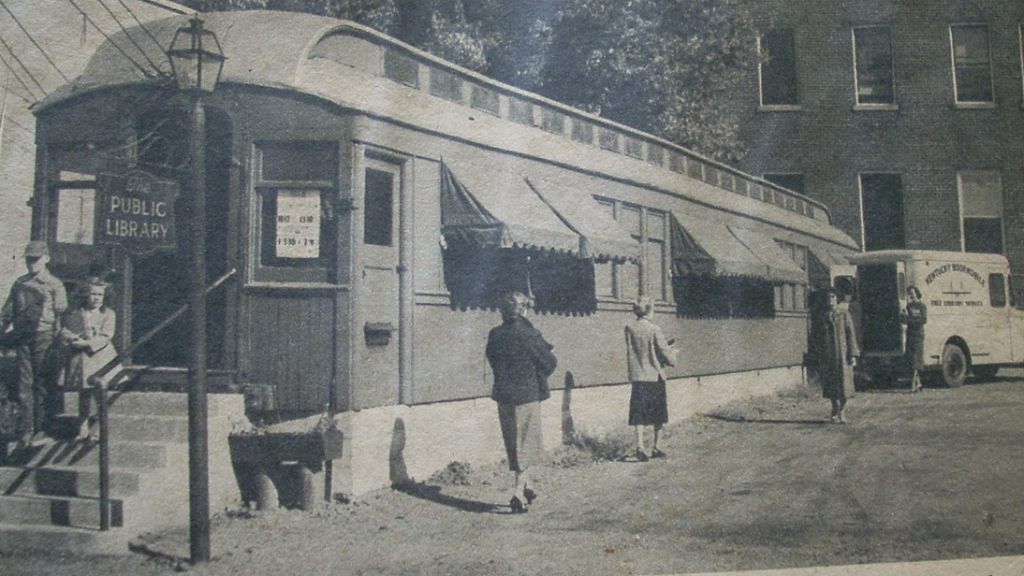
The Fine Arts Club then began efforts to establish a public library that would also serve adults. The city agreed to underwrite $4,000 of the cost, and the county put up $6,000, while the state came through with $5,000. Plans got underway the following year with the donation by Codell Construction Company of a retired railroad passenger car, which they installed behind City Hall on South Maple Street. Club members again took the lead, painting the inside and outside, installing shelves, moving the books from the Children’s Library, and hiring Virginia Parsons as librarian. They soon had accumulated 5,000 books and registered 3,800 users.
By 1958, the library had outgrown the railroad car and moved into the old Presbyterian Church on South Main Street. Lynne Boxley became the librarian and served for fourteen years. Use of the new facility grew quickly; in 1966, over 50,000 books were circulated, and another 30,000 were borrowed from the bookmobile. A rear expansion was added the next year, and many other site improvements followed.
Never miss a thing with our FREE weekly newsletter.
A decade after the move, the board found that usage had outstripped the church’s capacity. In 1968, Danby Williams, a librarian, and Helen Hunter, chair of the library board, announced plans to collect enough voter signatures to authorize a library tax to fund the expansion of the facility. Through the efforts of many volunteers, the needed effort succeeded. The fiscal court approved a library tax in 1974, enabling the construction of a 2,436-square-foot addition.

Growth continued, and in 1994, the Board of Trustees sought an increase in the tax rate to fund a brand-new facility, which required another voter-signature drive. That accomplished and the new rate approved, the library purchased the old Winchester High School with the help of a $2.4 million grant from the state. With increased tax revenue, the library signed a construction contract in 1997, and the present Clark County Public Library opened on December 7, 1998, with Danby Williams serving as librarian. The new building enclosed 18,200 square feet. Under the leadership of librarian Julie Maruskin, a 9,000-square-foot addition was added in 2008, which included a children’s wing and a large meeting room.
The Clark County Public Library is highly valued in the community, as reflected in its continued growth in patronage and circulation, and is recognized as one of the region’s outstanding libraries
It is unfortunate that space does not permit listing the names of the multitude of persons in the community whose dedication has made Winchester’s libraries a success for well over a century.