I awoke this morning thinking about the concept of “over:” over-share, over-indulge, over-take, etc. I wondered if attaching “over” to the verbs in our lives is a bad thing. My first inclination was that if we hover “over” anything, we are somehow dominating it, risking arrogance in service to our egos.
To understand my early morning philosophical query, I resorted to a customary strategy. I dug into the etymology of the word “over,” and learned an amazing tidbit. The word “over” evolved from the Proto-Indo-European word “upo,” which means “under,” as to come “up from under.”
Here, on the morning of March 15, the day of Julius Caesar’s demise in 44 BCE, I find myself contemplating whether it is okay to blindly command anything. An investigation of the vocabulary of dominance seems particularly timely today, since munitions bought with our hard-earned tax dollars are raining down from above on people in other lands.
On that note, there is remarkable import to the question of who among us decides to over-whelm perceived enemies. Do we impetuously reign over others, or do we come up from underneath by understanding the situation before we act? Since we insist that we are enamored with a document that begins with the words “we the people,” I tend to believe that most of us prefer the latter.
Our overlords seem to have forgotten a seminal idea about how the promise of America is imagined. Lately, when I write to our congressional delegation to ask if that is still true, I receive a cut-and-paste email with the salutation in a different font than the boilerplate. I worry they are not listening.
As we know from human history and now from the etymology of “over,” a devil lives in the details of dominance. The fact that the word “over” encompasses both above and below is a signal that our lives are much more nuanced than they are blatant. Nevertheless, rulers (people with abundant wealth) have subtly ignored it and sent armies (people who work for them) into battle for 5,000 years.
Today, those same people bend words and reality with unprecedented power, if not veracity, to take violent excursions.
Never miss a thing with our FREE weekly newsletter.
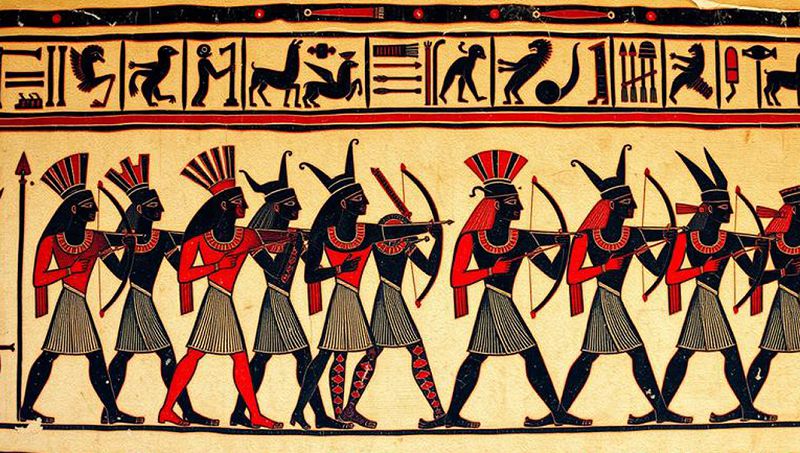
We are perched upon the knife-edge of an old story. Nation-states headed by egotists with vast resources fight for dominance over one another. Money, power, and expansionist fever dreams prevail. That struggle is celebrated in ochre and carbon pigment on the walls of Egyptian tombs and on our flat screens as images from drone cameras. We seem not to have evolved very much.
As ironic to me as the double-meaning of “over” is the fact that we wouldn’t have the language that sparked human innovation were it not for the enslaved people who labored in the copper mines of the Sinai Peninsula. They transformed the pharaoh’s 700 symbols, understood by one percent of the population, into 20 sounds represented by an alphabet that the masses could decipher. The technologies we use today to save and kill each other would not have been possible if we still communicated with hieroglyphics.
I think we can benefit from an equally ancient, less warlike idea by the Chinese philosopher, Lao Tzu. “Watch your thoughts, they become your words; watch your words, they become your actions; watch your actions, they become your habits; watch your habits, they become your character; watch your character, it becomes your destiny.”
Let’s think about moving the word “over” to the end of our verbs. Wouldn’t life be much more satisfying (and safe) if we obsessed about do-overs and sleepovers? Perhaps we could affect a change-over in the approach of those we elect to lead. Thanks to the alphabet, we only need to add the letter “L” to “over” to imagine a whole different destiny.