
It was on the first of May in the year 1769 that I resigned my domestic happiness for a time and left my family and peaceable habitation on the Yadkin River in North-Carolina to wander through the wilderness of America in quest of the country of Kentucke, in company with John Finley, John Stewart, Joseph Holden, James Monay and William Cool.
We proceeded successfully, and after a long fatiguing journey through a mountainous wilderness, in a westward direction, on the seventh day of June following, we found ourselves on Red-River, where John Finley had formerly been trading with the Indians and, from the top of an eminence, saw with pleasure the beautiful level of Kentucke.
John Filson
“Adventures of Col. Daniel Boon”
Introduction
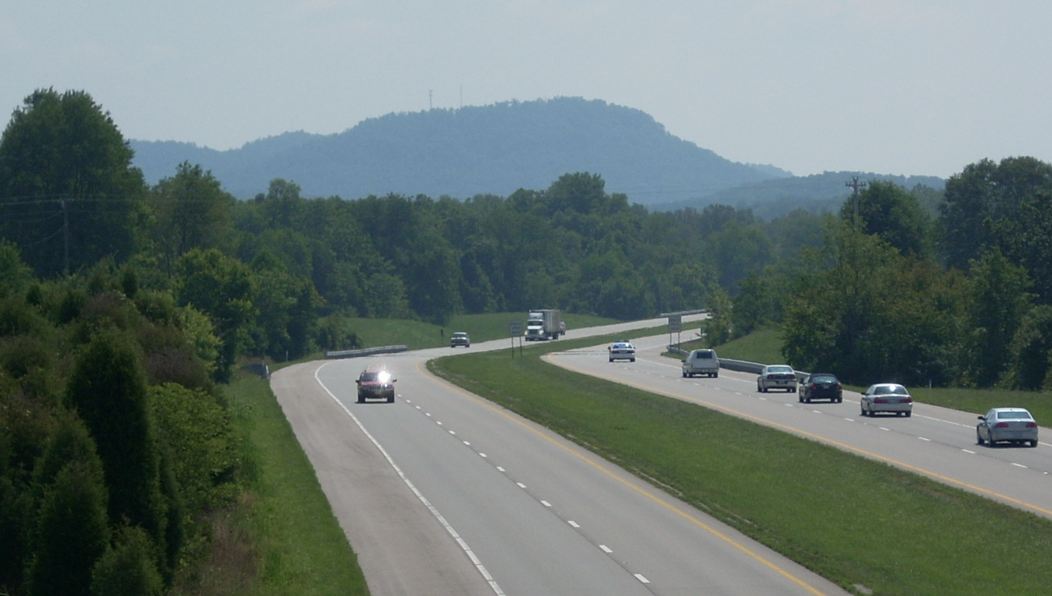
So begins the adventures of Daniel Boone in Kentucky. The above statement Boone gave to John Filson is clear to anyone familiar with the Red River country in Powell County, Kentucky. Historians place John Finley’s trading post at the Shawnee town of Eskippakithiki in a place known as the Indian Old Fields in eastern Clark County. One eminence dominates this fertile plain: Pilot Knob in nearby Powell County. Separating these two sites is Lulbegrud Creek, a fork of Red River. The association of Pilot Knob with this eminence is so obvious that the Kentucky Historical Society held its June 7 Boone Day celebration there in 1953. Nevertheless, there are those who still find fault with the statement Filson recorded.
John Filson gave us the first history and accurate map of Kentucky. In the year 1784, he published his classic work, The Discovery, Settlement and Present State of Kentucke. To his history, Filson appended Boone’s memoir—“The Adventures of Col. Daniel Boon”—which turned Boone into an international celebrity.
Over the years, however, various writers have quibbled with almost every aspect of Filson’s work. Pointing out small inaccuracies in the text, they claim that Filson got his facts all wrong. They maintain that Boone never spoke the words attributed to him—a critique of Filson’s flowery language. Some have argued that the Boone narrative was not even written by Filson. Each of these issues will be examined below.
Critiques of Filson’s Boone
Daniel Boone has long been an American icon and continues to attract the attention of modern authors and readers. The spate of books and articles about Boone continues unabated. Among these are relentless critiques of Filson’s work.
Critics jumped on Filson early. In 1884, Filson’s first biographer, Reuben T. Durrett, took issue with the opening sentence of Filson’s History:
Filson makes James McBride to have been the discoverer of Kentucky in 1754, when he cut his name on a tree at the mouth of the Kentucky River. McBride was in no sense the discoverer of Kentucky.
Durrett correctly states that French traders and other explorers had earlier views of Kentucky. However, Filson’s statement was not so much in error as it was a limitation of his sources. Filson did not arrive in Kentucky until 1782 (or possibly 1783) and published his history a year later. He learned of McBride from other sources (“certain accounts”). Filson had no library, no historical society, and no Kentucky scholars to tap for information. In this instance, he took the information he had been given and presented it with qualifications. Holding Filson accountable for not learning of the first explorers to view Kentucky seems a tad severe.

Another criticism is that Filson’s account was intended as promotional literature to bring more settlers to Kentucky and, thus, increase the value of Filson’s own land holdings. Filson probably did hope that his work would pay off, but that doesn’t diminish its value. We should be thankful that anyone bothered to publish a useful history at that extremely early date. Without it, we would not have had Daniel Boone’s own account of early events in Kentucky.
Our main concern here is the purported mistakes in the “Adventures of Col. Daniel Boon.” Here again, Durrett takes the lead, pointing out Filson’s inaccuracies.
The little work is not without its faults, such as representing herds of buffalo ignorant of the violence of man, when the Indians had been killing them for ages unknown; trees gay with blossoms on the 22d of December, when the forests of Kentucky seldom show a leaf; views of the Ohio River and the mountains at the same time from an eminence in Kentucky, when there is no known point from which such a sight could be had without the use of a telescope, which Boone does not say he had; and making the plain old pioneer compare the ragged tops of the Cumberland Mountains to the ruins of Palmyra and Persepolis, when it may be doubted if he could distinguish these ancient cities from Gog and Magog, or that he had any just conception of the classical allusion.
The first of these sounds like taking a schoolboy to task rather than listing his historical errors. And the last—reference to the ruins of Palmyra and Persepolis—falls into the category of “Filson’s florid prose.” In spite of “its faults,” Durrett had no problem adding that the “Adventures”
is the most interesting, as well as the most valuable, part of the work. It is the gem of the collection. It is the little fountain from which have flowed so many enchanting streams of Indian conflict and pioneer adventure in the “dark and bloody ground.” It begins with Boone’s first coming to Kentucky, in 1769, and gives the scenes in which he was engaged until 1784, when the work was published. The events in the career of Boone thus narrated were the initial steps of Kentucky’s settlement, and make up the charming first chapter of our Western annals.
Durrett was not only an admirer of Filson’s work, he also named the historical society he founded in 1884 after Kentucky’s first historian—The Filson Club.
Others continued to harp on Filson’s inaccuracies. John Bakeless, who penned a scholarly biography of Boone (1939), stated that Kentucky’s first historian
mixes up dates badly, represents Boone’s hasty estimates of Indian forces as if they were exact calculations, and blunders in describing incidents. His errors can be shown easily enough from contemporary documents and from the reminiscences of contemporaries.
Again, we can defend Filson by noting that he was recording Boone’s memoir and did not have access to “contemporary documents” to verify Boone’s accuracy.
An even more severe criticism comes from historian Reuben Gold Thwaites (1902): “The autobiography is often wrong as to facts, and possesses but minor value as historical material.”
Filson’s Boone has “minor value as historical material”? A pretty damning assessment. Thwaites was employed at the State Historical Society of Wisconsin, where Lyman C. Draper had spent half a century assembling a massive collection of material on Daniel Boone. Given the access Thwaites had to all this historical material, it is perhaps not surprising that he belittles Filson’s early effort. In doing so, however, he chose to ignore the long list of verifiable events in Boone’s life that were first described in detail and published by Filson:
- long hunt in Kentucky (1769)
- first attempt to settle Kentucky and death of son James (1773)
- leading a company of settlers to Boonesborough (1775)
- kidnapping and rescue of Boone’s and Callaway’s daughters (1776)
- capture of Boone and the salt makers at Lower Blue Licks (1778)
- his captivity and escape that summer (1778)
- siege of Fort Boonesborough (1778)
- death of his brother Ned (1780)
- battle of Blue Licks and death of son Israel (1782)
The actual list of events is much longer and, in spite of Thwaites’ assertion, has been an invaluable aid to historians, including Lyman Draper himself, who did not take issue with Filson’s work.
One thing Filson did not do was invent stories about Boone out of whole cloth, as other early writers were wont to do. Timothy Flint wrote a best-selling biography that has Boone fighting bears, escaping pursuing Indians on a swinging vine, and making him into a greater-than-life hero. Daniel Bryan composed a heroic epic, Mountain Muse, Comprising the Adventures of Daniel Boone, which so incensed Boone that he regretted he could not sue him for slander.
Over the years, many authors have continued to take Filson to task for putting words in Boone’s mouth—words they claim he would never have spoken. Robert Morgan, a recent Boone biographer, rose to Filson’s defense for the so-called “stilted style of the narration.” Morgan argued that Boone may have spoken differently to an educated easterner than he would to a backwoodsman. And Michael Lofaro wrote that, in spite of the “bombastic language, the information gleaned from Filson’s personal interviews with Boone and his companions still managed to shine through the rhetoric.”
The final charge, which still arises occasionally—that Filson did not author the Boone narrative—is easily dispelled. The single source for this claim comes from an interview with the pioneer Josiah Collins in 1844.
Never miss a thing with our FREE weekly newsletter.
Boone’s Filson was written by Humphrey Marshall. Boone lived at that time at the cross-plains [Athens], 10 miles from Lexington. Gen. [Marquis] Callamees and I had a conversation about some statements in that & he said Humphrey Marshall was to blame about that & that he ought not to have written it. It was always understood that Humphrey Marshall wrote Boone’s statement as published by Filson.
John Walton, Filson’s biographer, addressed this issue on two fronts. First, Filson was lavish in his acknowledgements of those who helped him with his book and map. It seems unlikely he would have failed to give credit to Marshall who would have been in a position to embarrass him for the omission. Secondly, Marshall wrote his own history of Kentucky and gave explicit credit to his sources, including “Boone’s Narrative of 1784 by Filson.”
Conclusion
It is unfortunate that authors over the years have obscured the meaning and questioned the value of Filson’s account of the “Adventures of Col. Daniel Boon.” To do so, they have had to ignore Filson’s statement that he personally interviewed Boone regarding his adventures and “published them from his own mouth.” And that the work was read, edited, and endorsed by Levi Todd and James Harrod, two of Kentucky’s noted pioneers. And, finally, that Boone himself once declared to a visitor that it was “All true. Every word true.”
Regarding Boone’s eminence, the reference to Red River “where John Finley had formerly been trading with the Indians” still rings clear. We need look no farther than Pilot Knob in Powell County.