
I stared into the distance until my eyes watered from the glare on the water, until the tops of my feet burned under the scorching sun. It was impossible that I was here, a miracle to be talking to the ocean again.
It almost feels frivolous to enjoy myself these days. To be honest, the idea of a vacation seemed more exhausting than exciting. But the things currently tying me to “my real life” are the very things I desperately needed a break from.
So I sat and stared, waited for inspiration, guidance, some sign that living is more than just surviving. The sound of the crashing waves brought with it my favorite line from Shawshank Redemption. “Get busy living or get busy dying.”
The very moment the line came to me, a giant, slimy bird erupted from the depths, suspended momentarily in the gleaming sun, and crashed back into the water, leaving a shining, silvery path in his wake.
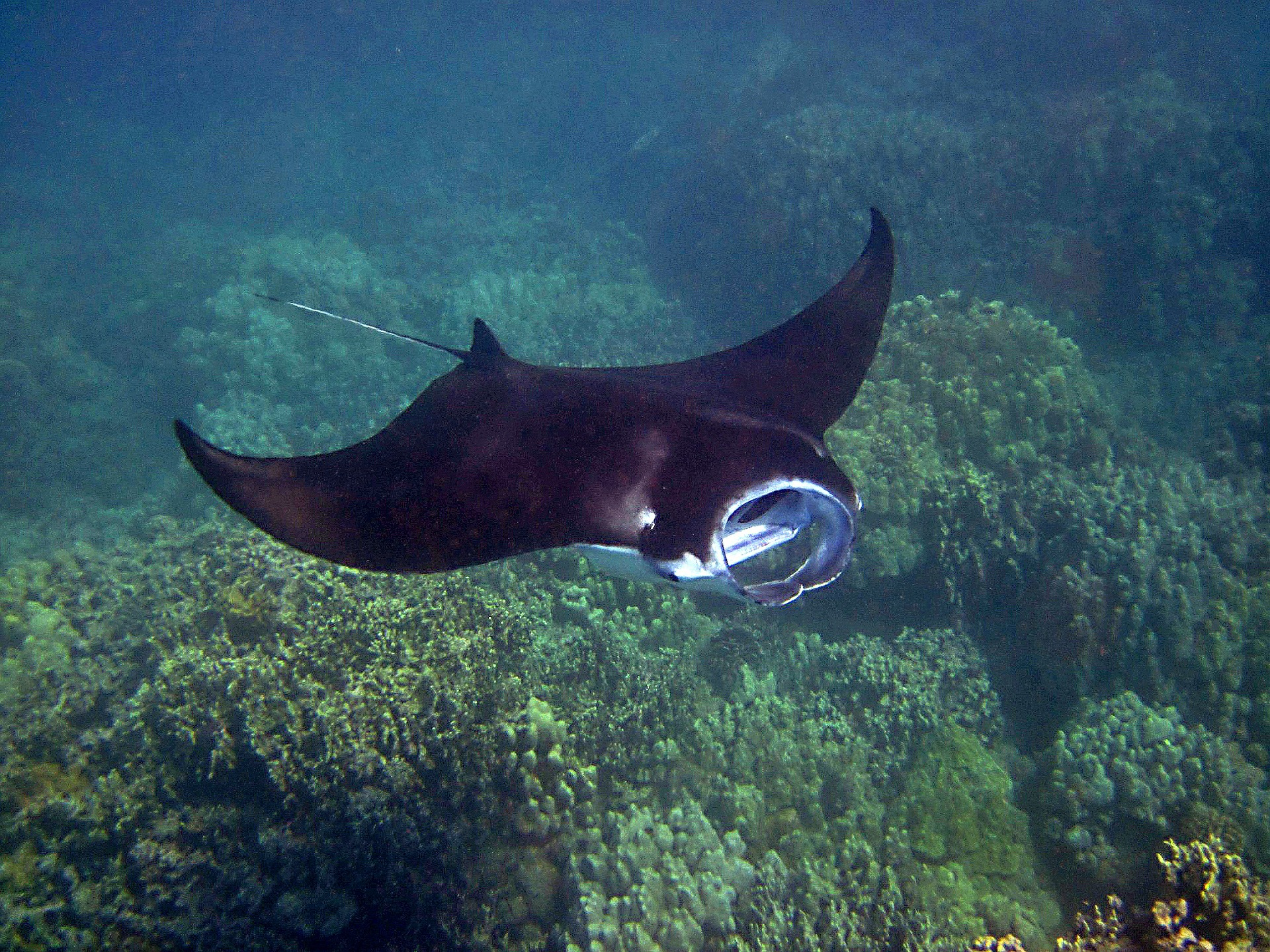
It took my brain a moment to catch up. Not a giant bird, but a manta ray. The exact totem I needed. No other creature can go with the flow with such effortless grace, gliding about as they do with open, eerily human-looking smiles to catch microscopic plankton.
Jamaicans call them the eagle of the sea; I could be forgiven for initially mistaking this giant creature for a bird. They are sometimes called devilfish, but only because their enormous fins – which can reach over 25 feet in length – are shaped like horns. Though these giant animals are often confused with stingrays, which have a barbed tail, manta rays are docile, delicate, and in no way dangerous to humans.
Manta rays are the very essence of self-awareness. They are the only fish that we know can pass the mirror test. The ability to recognize oneself in a mirror has been documented in primates and elephants, but never in fish, until we studied manta rays, which have the largest brain-to-body ratio of any fish.
When scientists placed the rays in a tank with a mirror, they repeatedly moved their fins and circled in front of it, but did not socially interact with the mirror in the same way they do when they see another ray. This suggests the rays noticed their reflection moving when they moved. They also blew bubbles in front of the mirror (Google manta ray mirror test videos for some truly adorable footage). The frequency of these movements was much higher when the mirror was present in the tank than when it was absent.
And problems? While the manta’s biggest concern is tiny parasites, nothing is better at shaking them off. The beautiful, acrobatic dance I witnessed was a manta ray shaking itself rid of parasites. And if they are injured, mantas regenerate cells quickly to heal, the very picture of resilience and renewal.
The omen isn’t lost on me.
Never miss a thing with our FREE weekly newsletter.
Shake it off.
Struggle less.
Flow more.
That’s how I will know myself, know the next best step. That’s smooth sailing in action.
I exhaled, for what seemed like the first time in a long time. A real exhale, noisy and shaky, a letting go, a promise. Later, I learned that the word manta is translated in Hawaiian as two breaths. Yes, of course it is. The inhale is nothing without the exhale. We cannot keep taking in worry and obligation and thinking – so much thinking – without releasing it as we glide on.