After beginning to research old businesses in Winchester, it occurred to me that there might be a number of ways to approach the subject.
One could say the oldest, or earliest, businesses were those established by the pioneer settlers of the area. These included ferries, gristmills, sawmills, woolen mills, rope walks, stone quarries, tanneries, distilleries, and boatyards, to name a few. Of course, all companies or owners of these early businesses are long gone, and the industries themselves have undergone extraordinary technological changes.
What I had in mind, rather, were those businesses that started in Winchester and are still going concerns today. Even limiting the subject in this way still leaves the definition open to several interpretations. For example, it could mean those that preserved the company name or that had the same owner or the same location, or variations on these. My intention with this article is to describe the oldest businesses in various defined categories. These are the ones I’ve been able to identify, but there could be some others that have escaped my notice.
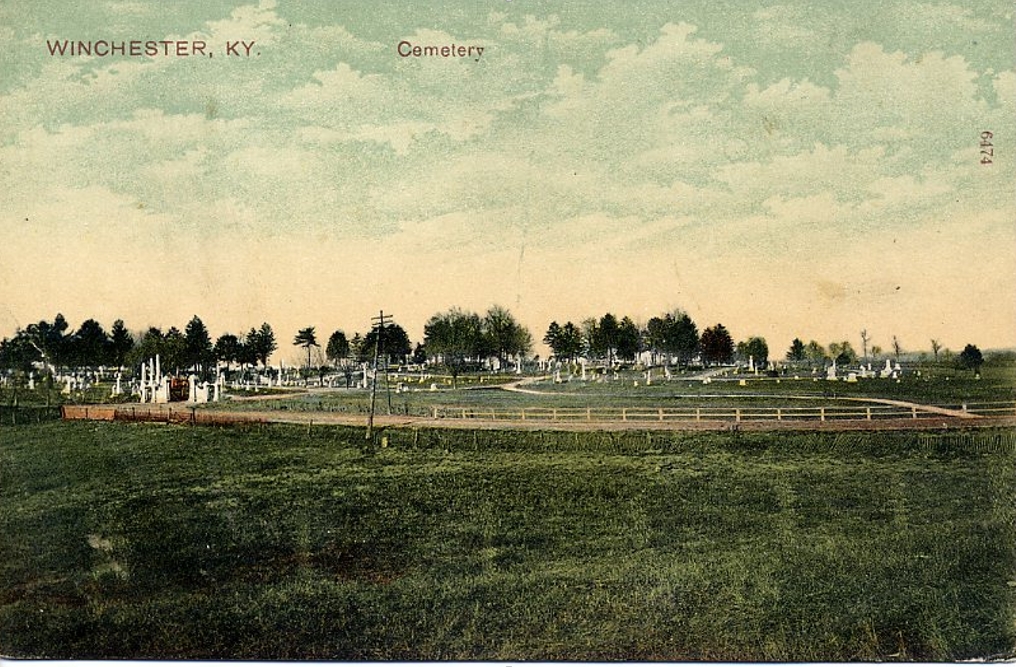
Winchester Cemetery Company, 1854
Winchester Cemetery is the oldest business I’ve found going by the same name with the same owner and operating in the same location. It was organized on February 17, 1854, and has become one of the city’s garden spots. The founding officers were J.D. Sympson, president; W. H. Garner, vice-president; V. W. Bush, secretary; A. H. Hampton, treasurer; and directors, David T. Matlack, George B. Nelson, Abram Renick and R. M. Scobee. They purchased 12 acres of land on the Lexington-Winchester Turnpike from Samuel Hanson. The cemetery presently contains approximately 55 acres, and its database of burials lists over 19,000 names.
After this, it gets more complicated, as you’ll see.
Winchester Sun, 1882
James J. Adams began his journalistic career in Winchester with a small paper called “The Smooth Coon.” In September 1882, he printed the first issue on a hand-fed press in the back of the old courthouse. The paper caught the public’s eye, and Adams changed the name to the Winchester Semi-Weekly Sun. The first issue was printed on November 1, 1878 under the name of the Sun Publishing Company. The paper became a weekly in 1881 and was renamed the Winchester Sun.

In 1903, the Winchester Sun merged with R. R. Perry’s Winchester Sentinel and became the Sun-Sentinel. Then, in 1908, Perry enlarged the scope of the paper, becoming Winchester’s first daily newspaper, the Winchester News. The News was renamed the Winchester Sun in 1912 with Lucien Beckner and Carl Robbins as editors and publishers. In 1924, the paper moved to the old Parrish & Bradley wholesale grocery. The Sun continued there until moving to Court Street in 2025.
One can see that this is a tangled story of name changes, as well as numerous changes in ownership and location. Nevertheless, The Winchester Sun marks its beginning in 1878.
Never miss a thing with our FREE weekly newsletter.
Freeman Corporation, 1900
As with the Winchester Sun, the Freeman Corporation also has a lengthy history of name and ownership changes.
In 1900, George Hon, Green Garrett, and George Tomlinson formed the Reliance Manufacturing Company and purchased the planing mill of the Conn-Hagan Company. The mill stood between Winn Avenue and the C&O‑L&N depot. In September 1902, the mill was destroyed in a disastrous fire. The company rebuilt and reopened the following year.
Reliance sold the mill to B. F. McCormick Lumber Company in 1910. The next year, the Hon-Tomlinson Lumber Company was incorporated. They purchased a lot on Magnolia Avenue and erected a plant for making tobacco hogsheads. Capable of producing a thousand barrels a day, it was said to be the largest of its kind in the world. The factory utilized an ingenious stave-making machine invented by Tomlinson. In 1920, Hon left the business, which carried on as the Tomlinson Lumber Company. The ever-creative Tomlinson began producing his patented take-down table (known all over as “Tomlinson tables”).

After Tomlinson died in 1953, his grandson, E. E. Freeman Jr., took over the company. The business carries on today as The Freeman Corporation on Magnolia Avenue and specializes in the production of hardwood veneer.