
By Laura Harbert Allen | 100 Days in Appalachia
Apostles and prophets. Spiritual warfare. Dominionism and the New Apostolic Reformation. You might come across these terms if you follow politics these days.
Here’s some context and clarity about the relationship between dominion theology and the NAR, the “apostles” and “prophets” who lead this movement, and what it all means for our politics.
Dominionism: A theology with explicit political goals
Dominionism is a theology or system of religious belief based on an Old Testament passage in the King James version of the Bible. Near the end of the creation story in Genesis, God exhorts humanity to “have dominion” over “all the earth.”
Christians have long debated this scripture from an environmental standpoint. In the Appalachian coal fields, for example, religious leaders have called for stewardship rather than abuse of the land caused by extractive industry.
Dominionism is different. It takes this verse from Genesis and applies it to a society’s civic and political life. Ultimately, dominionism is a political theology and ideology that seeks to take control of a society’s political and cultural institutions, according to Fred Clarkson, a senior research analyst at Political Research Associates, a Boston-based think tank.
“Fundamentally, the idea is that Christians are called to exercise dominion in the world,” writes André Gagné in his 2024 book Americans for Trump: Dominion, Spiritual Warfare, and the End Times.
Gagné chairs the religious studies department at Concordia University in Montréal, Canada. He describes dominionism as a “theology of political power”.
Dominion theology first appeared in the 1960s in the work of Christian reconstructionist, R.J. Rushdoony. In his book, The Institutes of Biblical Law, Rushdoony laid out his vision for a society transformed through a strict, highly conservative interpretation of the Bible. Among other strategies, Rushdoony was an early proponent of homeschooling, which he believed would slowly transform American society to reflect Judeo-Christian values.
“Let every demonic network that is aligned itself against the purpose, against the calling of President Trump, let it be broken, let it be torn down in the name of Jesus.”
- Paula White Cain, Jan. 6, 2021.
In its most extreme form, reconstructionism calls for a limited government with minimal social safety net programs, going so far as to call for the execution of individuals for homosexuality and other perceived “crimes.”
While most reconstructionists rejected Rushdoony’s most extreme measures, his teachings echo in the hundreds of anti-LGBTQ bills introduced in Appalachia and around the country this year.
The New Apostolic Reformation: Based on an extreme version of Dominionism
The New Apostolic Reformation, or NAR, is religio-political movement founded by C. Peter Wagner in the 1990s based on an extreme strain of dominionist theology. “We want to see whole cities and regions and states and nations transformed to support the values of the Kingdom of God,” wrote Wagner in a letter to supporters of his Global Harvest Ministries organization in 2007.
Wagner claimed the New Apostolic Reformation was the most significant shift in the Christian faith since the Protestant Reformation of 1517. It’s important to understand that NAR is not a formal group with membership rolls or an organizing structure commonly seen in Protestant denominations or the Catholic church. Instead, Rachel Tabachnick, a researcher with Political Research Associates, described it as more of a cross between a religion and a political party.
To accomplish their goal of Christian supremacy, NAR deploys prophets and apostles to lead the movement.
The leaders: prophets, apostles, and the five-fold approach of NAR
The idea of personal salvation — where individuals grow and develop their own relationship with God alongside other believers in church — has been a tenet of Protestant Christianity since the religion began more than 500 years ago. Historically, churches have been collectively led by clergy and laity who work together to build community. And the governance of most Protestant churches in the U.S. has become increasingly democratic.
But as religion scholar Gagné points out in his book, NAR’s “defining characteristic” is the spiritual authority the movement gives to individuals. It’s a top-down model, he writes, that “revolves around the restoration of the five-fold ministry [a concept drawn from Ephesians, referring to apostles, prophets, evangelists, pastors and teachers] and an apostolic system of governance. This model challenges the democratic structures of churches,” he adds.
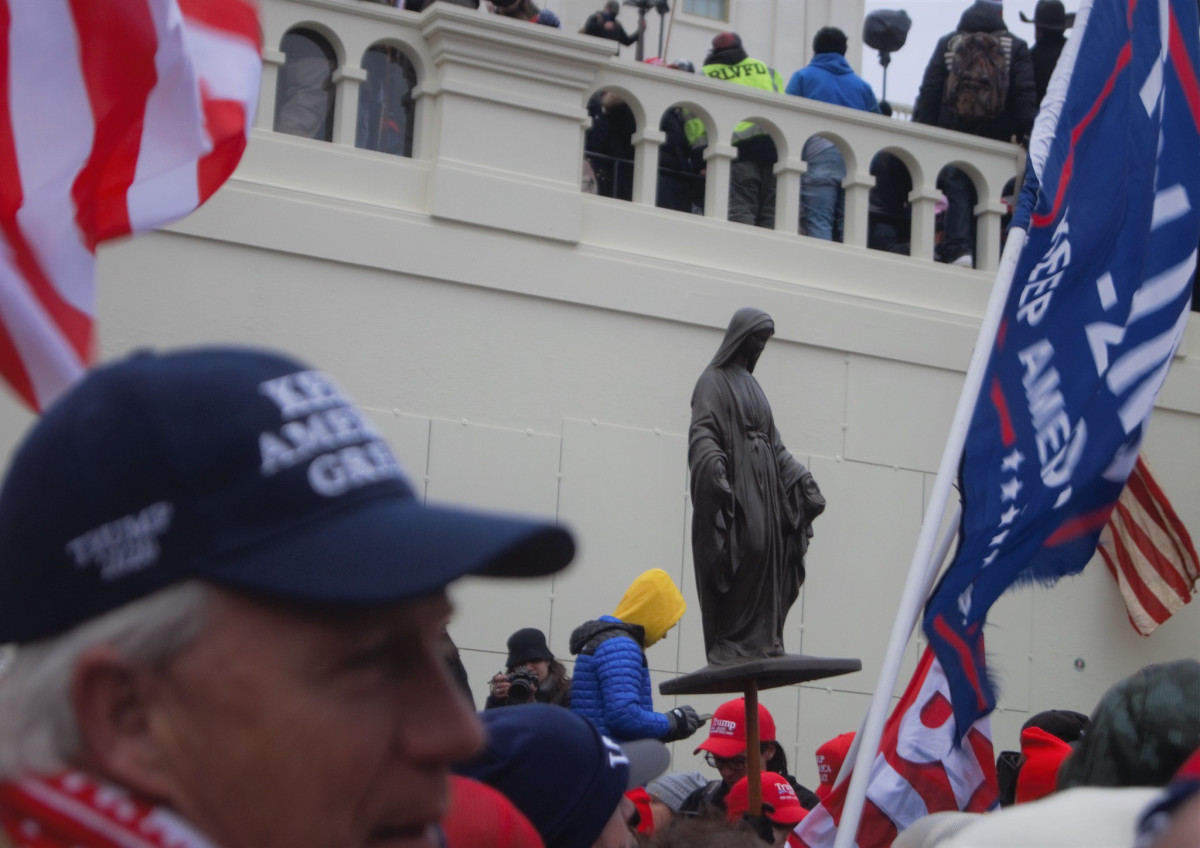
According to the five-fold paradigm, apostles and prophets have been absent for nearly 2,000 years, but are re-emerging to lead the NAR toward societal dominance. NAR apostles and prophets wield tremendous power within the movement, and their political influence can be heard in Paula White Cain’s prayer prior to the January 6, 2021 insurrection.
“Let every demonic network that is aligned itself against the purpose, against the calling of President Trump, let it be broken, let it be torn down in the name of Jesus,” Cain said.
The strategy: The Seven Mountains Mandate
NAR apostles and prophets follow the Seven Mountains Mandate, a strategy for ascending the “seven mountains” of society: religion, family, government, education, media, entertainment and business. By taking over a society’s political and cultural institutions, NAR believes its theocratic vision of society — dominated by an extreme right version of Christian supremacy — will come to fruition.
NAR followers believe they are improving society so that Jesus will return and reign on earth. This is a marked departure from the more common Christian belief that Christ will return at a time of his own choosing to save a broken world.
Lance Wallnau, an NAR apostle endorsed by Wagner, has been the most recent force behind the 7M mandate. Wallnau is also known for his book, God’s Chaos Candidate, which cast Donald Trump as a modern day King Cyrus, the pagan Persian king who freed ancient Babylon in the 6th century BCE, which allowed the Jewish people to return to the region and build a temple. Like Trump, NAR followers believe that Cyrus was a flawed individual who nonetheless served God’s purpose.
U.S. Representatives Lauren Boebert (R‑CO), and Marjorie Taylor-Green (R‑GA), as well as Speaker of the House Mike Johnson (R‑LA) have risen to positions of influence through the political mountain. Former President Donald Trump is popular among NAR followers because they believe he has conquered the business mountain. Project 2025 aligns with NAR’s seven mountains vision as well, because it calls for a complete restructuring of the government to reflect an extremist, Christian supremacist worldview.
Casting out demons: Spiritual warfare and dominionism
The NAR movement is built on the belief that demonic and supernatural forces work against the Seven Mountains Mandate. Followers believe they are at battle with these forces and deploy three types of “spiritual warfare” outlined by C. Peter Wagner to combat them.
Ground level spiritual warfare includes the exorcism of demons from individuals, and is based on stories of Jesus casting out demons in the Gospels. NAR adherents might pray for each other to cast out the demons of alcoholism, addiction, adultery, or other behaviors thought to be un-Christian. Next is what Wagner called the “occult” level of spiritual warfare, which includes practitioners of astrology, yoga, shamanism, and sorcery.
Wagner identified strategic or cosmic spiritual warfare as a strategy to combat demonic forces within governments and individuals who stand in the way of the 7M mandate. Strategic spiritual warfare is based on Ephesians 6:12, which states the Christians “wrestle not against flesh and blood, but against principalities, against powers, against the rulers of the darkness of this world, against spiritual wickedness in high places.”
When NAR apostle Paula White-Cain prays for “demonic networks” who are opposed to Donald Trump to be “broken down in the name of Jesus,” she is deploying strategic spiritual warfare.
And NAR rhetoric can be specifically directed at political leaders. NAR prophet Lance Wallnau called Vice President Kamala Harris a “Jezebel spirit” in his July 22 podcast program soon after she became the presumptive Democratic nominee for president.
Jezebel was the wife of Ahab, King of Israel who, according to the Bible, engaged in idolatry and used her powers to seduce her enemies. She also had several Jewish leaders put to death. Casting Harris as a “Jezebel” carries with it racist tropes, layered with NAR beliefs that the vice president is possessed by a demon.
Never miss a thing with our FREE weekly newsletter.
It’s the kind of rhetoric in the context of spiritual warfare, writes religion scholar Gagné, that “contributes to the current political and social polarization in the United States.” And some experts warn that rhetoric could lead to political violence again in 2024.
But such language frays the social fabric too. Churches have historically been “civic assets,” places where people can come together across political divides, through programming like free community meals, grocery assistance, addiction recovery services, and more.
Such services are especially important in rural communities in Appalachia, where churches fill in safety net gaps and serve as hubs for disaster relief efforts. NAR rhetoric, which also intersects with Christian right positions including culture war fissures around abortion and LGBTQ equity, has split churches in Appalachia.
And that means that community members — not just church members — lose a place to be with each other without repercussions for their politics.
This article first appeared on 100 Days in Appalachia and is republished here under a Creative Commons license.
