
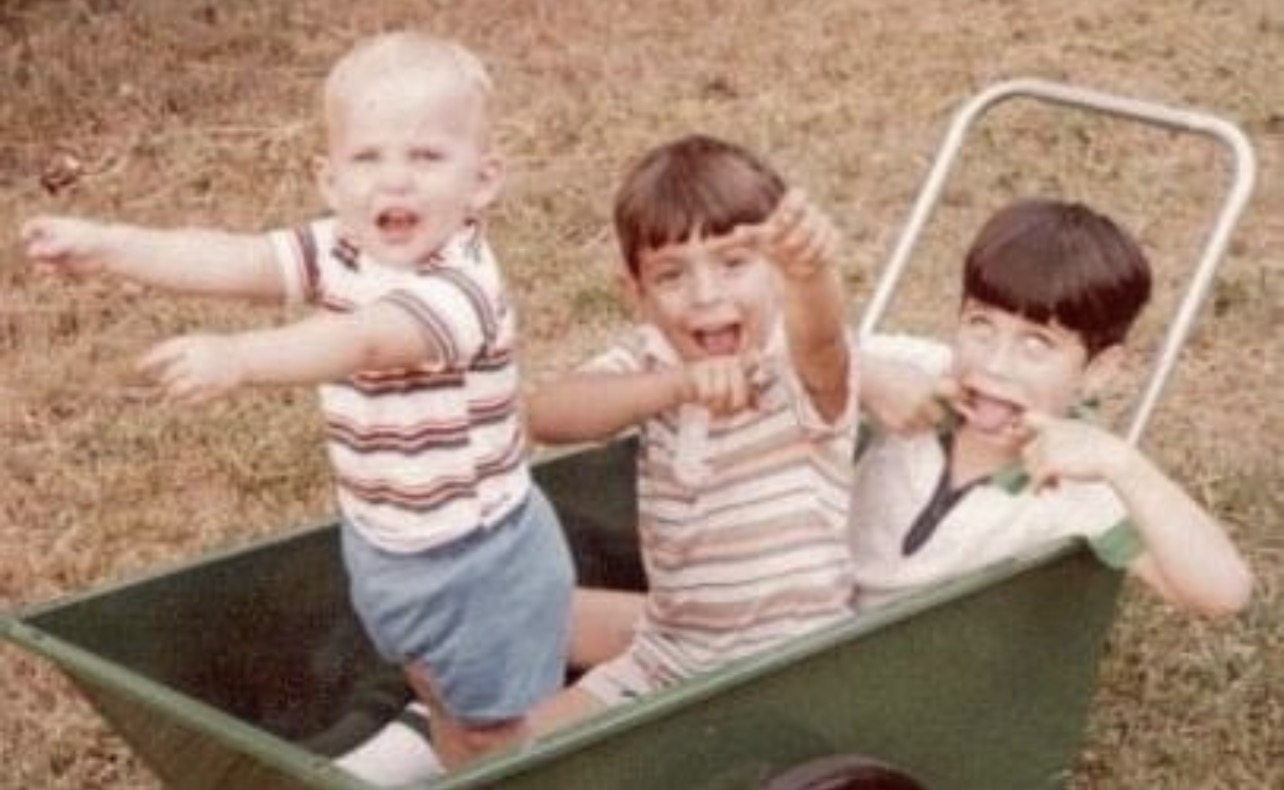
At the start of a new year, people talk easily about beginnings. Fresh starts. Turning pages. What we say less often is that every beginning also marks an ending. Something has to be left behind in order for something else to take shape. I learned that before I had words for it.
I am a child of adoption.
My adoption was a beginning and an end.
It became legal when I was three months old. I do not remember the paperwork or the moment I was brought home, but I have lived inside the consequences of that decision my entire life. What came after did not erase what came before. It grew from it.
My life began with a choice that ended another life as it had been imagined. A woman I call my birth mother made the decision that my brother and I would not simply survive, but would have the chance to thrive. She chose stability and safety over proximity. That choice was not made lightly. Her heart and her mind pulled in opposite directions. Love wanted to hold on. Reality demanded something else.
That beginning carried grief with it, and it never fully left.

Then came another beginning, one that required my parents to step into uncertainty. They already had a biological child of their own. They were not adopting to fill a void. They were choosing to expand their family, knowing that love does not divide. It multiplies. When they finally brought us home, that beginning came with its own endings too. The end of simplicity. The end of privacy. The end of moving through the world without scrutiny.
Their biological child’s sense of the world as they knew it also ended, and they had to learn, alongside us, how to understand family, space, and belonging in a newly shaped life. Their biological child became the eldest, my biological sibling moved from being the eldest to the middle, and I moved from being part of an even pair into a family of five, suddenly aware of what it meant to be the odd person out.
My parents experienced endings of their own. For my father, the life he had meticulously structured around financial stability shifted, as providing now meant stretching further and trusting that love would carry what numbers alone could not. His beginning included becoming a girl dad, a role he stepped into with humor and quiet pride, learning a different tenderness than the one he had known before. For my mother, there was also an ending and a beginning. She left a career she loved to care for little ones at home, setting aside professional identity for the daily work of presence, patience, and protection.
When the time came and we were old enough to attend school, my mother returned to her career, carrying with her a deeper strength shaped by those years. Together, my parfents’ endings and beginnings met in the same place the moment they knew their family was finally complete.
Rumors followed. Questions lingered. Some people never fully accepted us as real or permanent. We were seen as outsiders, children who did not quite fit the version of family others thought they understood. I learned early that belonging is not always granted easily.
But my parents never made us earn it.
They were open with us about our history, not as something fragile or shameful, but as something true. They did not pretend adoption erased loss. They did not ask us to choose one story over another. Instead, they taught us how to live with both. How to stand in the space where love and grief exist at the same time.
They also understood something that required real courage: the knowledge that one day we might want to know more. That curiosity about our beginnings might surface, not as rejection, but as a natural human need to understand oneself. That possibility frightened them. Loving someone always carries the risk of loss. Even so, they did not stand in the way. They trusted that love strong enough to hold the beginning could survive the questions that followed.
This is what secure love looks like.
As I grew older, I began to recognize this pattern beyond my own life. Across the natural world, scientists have documented animals adopting and raising young that are not biologically theirs, sometimes even across species. Bonobos have taken in orphaned infants from outside their groups. Capuchin monkeys have raised a marmoset infant. Dolphins have been observed caring for calves that were not their own.
These acts offer no genetic reward. There is no obligation. Still, the behavior persists.
Biologists describe this through ideas like alloparenting and cross fostering, which show that care and learning are not limited to bloodlines. What matters most is presence. Protection. The willingness to hold what would otherwise be lost.
Nature seems to understand something we often resist. Belonging is not always inherited. Sometimes it is chosen.
In that way, adoption is not an exception. It is a pattern.
All of us live inside adopted lives.
We adopt love. We adopt family. We adopt traditions, folkways, and mores. We adopt friendships, homes, and identities.
No one is born knowing how to belong. We learn through leaving and staying, through what ends and what we decide to carry forward. Families endure not because of shared DNA, but because people choose one another after the easy part has passed.
Sometimes, leaving is the only way another beginning becomes possible. People step away from places, roles, and relationships for many reasons. Health requires it. Work demands it. Growth insists on it. Sometimes safety leaves no other option. Ending something does not always mean failure. Often, it means survival. Often, it means choosing a life that can be sustained.
That, too, is OK.

We adopt friends who become chosen kin, our packs. Like animal packs, these bonds are built through loyalty and shared experience. Packs make room. Packs protect. Packs offer new beginnings without pretending there was no loss.
Even grief becomes a beginning. Loss reshapes us. It teaches us new ways of loving we never intended to learn. Responsibility and resilience are often taken on not because we want them, but because something ended and something else had to begin.
So why write this now?
Never miss a thing with our FREE weekly newsletter.
Adoption is often recognized in November during National Adoption Month. That recognition matters. But adoption does not live on a calendar.
I chose to write this at the start of a new year because the new year understands what adoption taught me long ago. To begin again, something must end. The year closes whether we are ready or not. What we carry forward is a choice.
The new year is not a clean slate. It is an honest one.
Being adopted shaped me, not only in where I belong, but in how I understand change. It taught me that love and loss can exist together, that beginnings are rarely gentle. Choosing to care, to leave, to stay, and to make room for others is an act we must repeat.
My adoption was not just how my life began. It was how I learned that every beginning carries an ending, and that unconditional love is what holds us together through the leaving, the becoming, and the life that continues.

