
During the first 2020 debate between President Donald Trump and challenger Joe Biden, moderator Chris Wallace asked Trump whether he would tell the Proud Boys to “stand down.” Trump directed his answer to the right-wing militia: “Proud Boys, stand back and stand by.”
“Stand by” means “Wait for my orders.” Those orders came four months later when Trump, via Twitter, summoned a mob to Washington, D.C., to protest what he falsely claimed was a stolen election. He promised that Jan. 6, 2021 would “be wild.”
“The central cause was one man, former President Donald Trump, who many others followed,” the report said. “None of the events of January 6th would have happened without him.”
Speaking at his Stop the Steal rally, Trump told his supporters to march on the Capitol, where Congress was about to certify Biden’s electoral win, and “fight like hell.” If they didn’t, he said, they wouldn’t have a country anymore.
In the crowd that day were members of the Proud Boys, Three Percenters, and Oath Keepers, far-right militias whose leaders had been in contact with Trump associates Roger Stone, Mike Flynn, and Steven Bannon. Some militia members left the rally before it ended, cleared barricades for the mob, and joined in storming the Capitol, assaulting police officers and hunting leaders, including Speaker of the House Nancy Pelosi and Vice President Mike Pence, whom they threatened to hang for refusing to ignore the electoral count and declare Trump the winner. In testimony they gave to the House committee investigating the Jan. 6 attack on the Capitol, rioters defended their actions by saying they were just doing what Trump told them to do.
In its 800-page report released on Dec. 22, the panel concluded that Trump plotted to criminally overturn the 2020 election and provoked his supporters to violence with his phony claims of voter fraud.
“The central cause was one man, former President Donald Trump, who many others followed,” the report said. “None of the events of January 6th would have happened without him.”
The committee referred criminal charges against the former president to the Justice Department. It recommended that Trump be charged with obstruction of an official proceeding of Congress, conspiracy to defraud the United States, conspiracy to make a false statement, and inciting or assisting with an insurrection.
But the Justice Department, which is conducting its own investigation, doesn’t have to follow the committee’s recommendations. It could charge Trump with other crimes or none. But even if Trump is charged and convicted in federal court, it may not matter. Being a convicted felon does not disqualify a candidate from seeking the presidency or serving if elected.
Trump has announced that he is running for a second term as president in 2024. If he is elected, he could pardon himself and anyone else convicted in the attack on the Capitol. He has already said in an interview that he would issue “full pardons” and a public apology to the rioters.
While a felony conviction may not keep Trump from becoming president again, there is another way to protect our democracy from the threat presented by him and his cult following. It lies in a constitutional provision that was originally intended to keep former Confederate leaders who had served in the United States government before the Civil War from serving in it again.
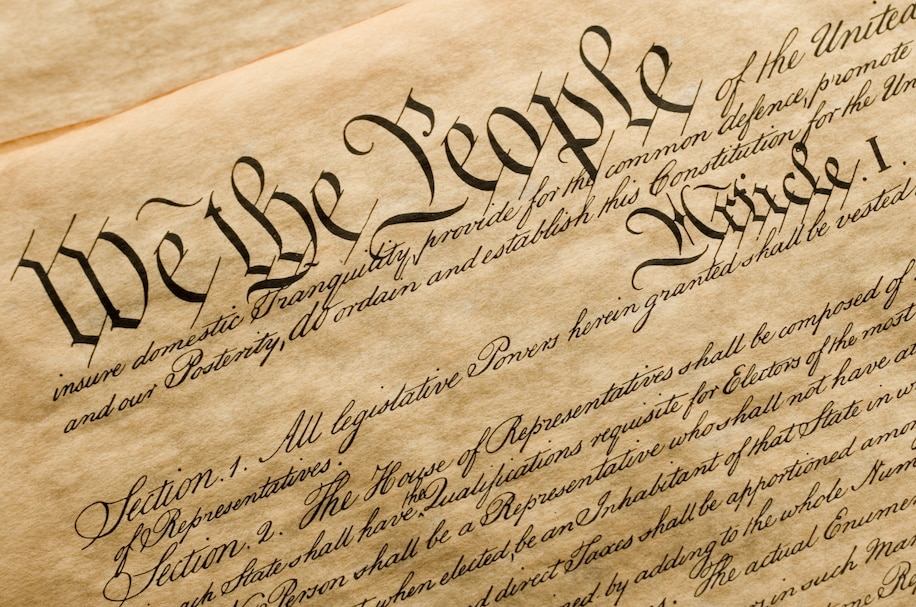
Section three of the 14th Amendment bars from state or federal office any former official who, “having previously taken an oath to support the Constitution of the United States, shall have engaged in insurrection or rebellion against the same, or given aid or comfort to the enemies thereof.”
Four years after the amendment was ratified, Congress, in a gesture of national unity, passed the Amnesty Act of 1872 to repeal the prohibition against former Confederates serving in the U.S. government. An appellate court, however, said that the amnesty only applies to those former Confederates and not to anyone else.
Eric Foner, a prominent Civil War historian, has said he believes section three could apply to Trump and members of Congress who supported the former president’s baseless claims of voter fraud and the demonstrations that led to the attack.
“The language in section three applies to anybody who has made an oath to the Constitution and then violates that oath,” Foner said. “It’s pretty simple.”
Unlike Trump’s impeachment for insurrection following the Jan. 6 attack, which failed to get a required three-fifths majority in the Senate to convict the former president, the Disqualification Clause would require only a simple majority of 50 percent plus one.
Forty House Democrats, led by Rep. David Cicilline of Rhode Island, have introduced legislation to bar Trump from holding federal office again based on the Disqualification Clause.
“You don’t get to lead a government you tried to destroy,” Cicilline said in a statement.
Not only did Trump encourage the violence of Jan. 6, the statement said, but he also tried to intimidate state and federal officials who refused to go along with his lies about the election, and for hours he refused to denounce the mob that stormed the Capitol.
Cicilline’s legislation should have been introduced early enough in the year for members to vote on it before the new Republican majority takes control of the House in January. I don’t have faith that there are enough profiles in courage among GOP members to do the right thing, but I hope I’m wrong. It may have a better chance than criminal prosecution, which could be tied up in court well into the 2024 election season, making a conviction less likely.
The danger to our democracy posed by a populist demagogue who doesn’t believe in democracy or the Constitution (he recently said on his Truth Social network that “the rules” of the Constitution could be suspended) is unprecedented.
Why not leave it to the voters to end Trump’s political career? Because, despite the fact that many Trump-endorsed election deniers lost their elections in battleground states in the 2022 midterms, it’s evident that most red state voters are still in thrall to Donald Trump and his movement. Many are so brainwashed by Fox News and other propaganda media that they don’t believe he is corrupt to the core — or so partisan that they don’t care.
And though there are a few Republican leaders like Sen. Mitch McConnell who have the courage to stand up to Trump, most are as craven as Rep. Kevin McCarthy, the next speaker of the House. McCarthy, after having called for use of the 25th Amendment during the riot to remove the president from office, went to Florida a few days later to kiss Trump’s … ring, and pledge his loyalty.
Never miss a thing with our FREE weekly newsletter.
The danger to our democracy posed by a populist demagogue who doesn’t believe in democracy or the Constitution (he recently said on his Truth Social network that “the rules” of the Constitution could be suspended) is unprecedented. Barring Trump from running for president again would be controversial and lead to accusations that it is partisan revenge. But Trump so egregiously defied the law and civil norms that he leaves us no choice. He tried to subvert our constitutional order by refusing to accept the peaceful transfer of the presidency after a free and fair election. That hasn’t happened before in our nation’s history. He must be held accountable.
And he must be kept from holding power that holds the fate of the world hostage.
Trump shows signs of being a sociopath. If he were president again and term-limited, he would have fewer restraints. He would be a reckless tyrant, an American Vladimir Putin, who would attempt to consolidate executive authority, ignore checks and balances, and threaten his enemies with “fire and fury.” That isn’t the kind of temperament we need in the leader of the free world.
Eighteenth century philosopher Edmund Burke said that national legislators are not simply delegates, but trustees who must sometimes go against the wishes of uniformed constituents and use their own judgment to determine what is in the national interest.
There is a time to follow and a time to lead. This is a time to lead.
