
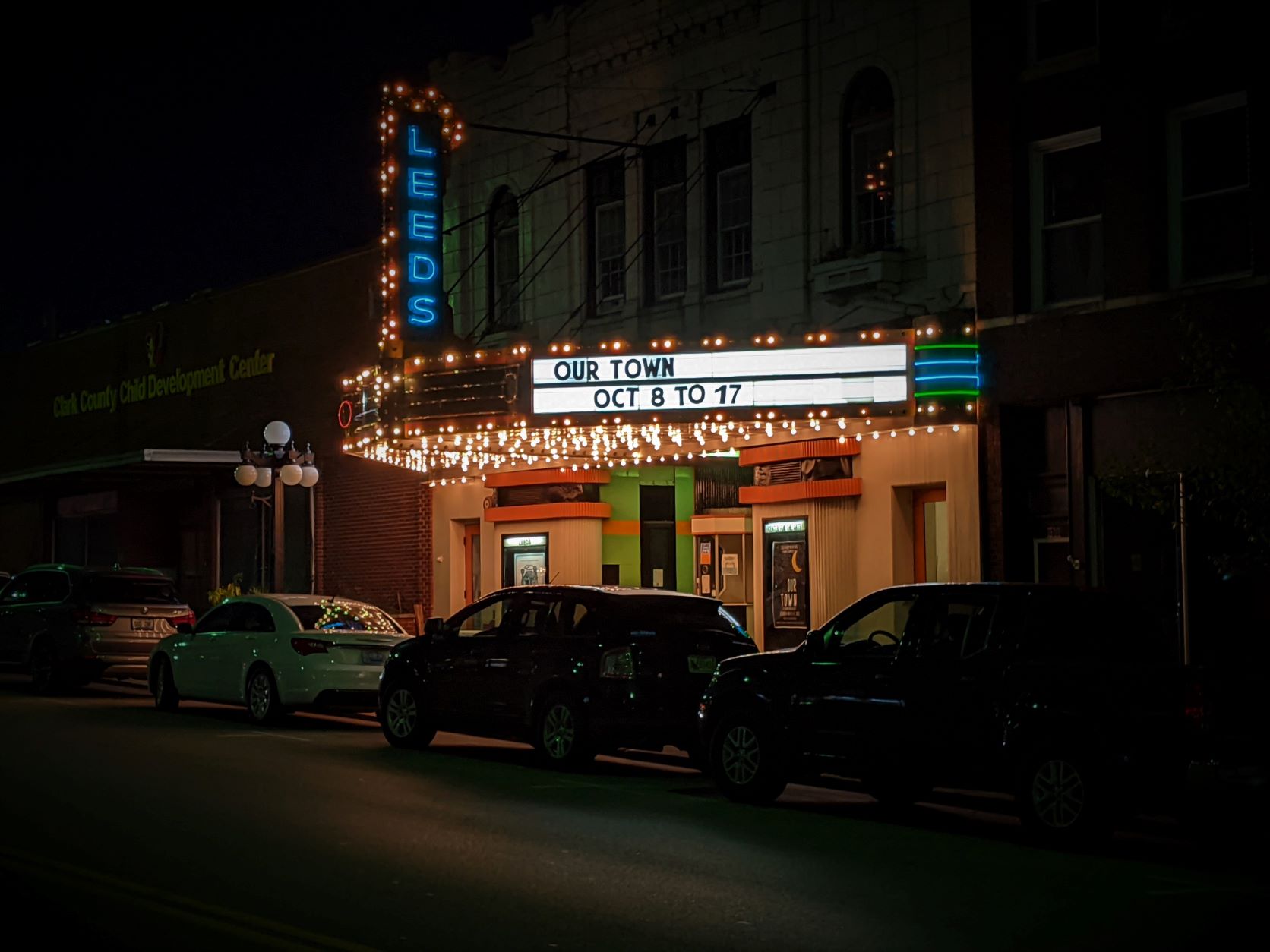

The theater was dark, save for a small light on the stage. Known as a “ghost light,” it’s a tradition that goes back perhaps a hundred years or more. Theaters used to leave one light on when the house lights were dark, and the building was empty.
In the early days of the COVID pandemic, the term took on a poignant meaning at Winchester’s beloved old Leeds Theater, today known as the Leeds Center for the Arts.
It was March of 2020, the month that life changed dramatically for us all. At the Leeds Center for the Arts, Winchester’s thriving performing arts venue, everything had changed.
Tracey Miller sat alone in the eerily quiet theater, bathed in the ghostly light. She thought about the whirlwind of events that led to the dark venue on the weekend when it had been scheduled to première the popular Thornton Wilder play Our Town.
Just days before, the center had had to make the difficult decision to close down. The cast was set, the costumes ready, and everyone had been eagerly anticipating opening night.
COVID had other ideas.
Tracey is the President of the 11-member board that governs the center. She describes her job as “wearing a ton of hats.” She does everything from producing shows, making sure that facilities are running well, and ensuring that all operational details are taken care of. Like the other board members, Tracey volunteers her time at the center. She calls it a labor of love.
Tracey and the board oversee two full-time employees. Since July, the center has had an executive director, Selena Arnett, and an Assistant Executive Director, Mary Kate Knight. The center was able to hire Selena as the result of a “generous gift” to the organization.

She was thinking about how the cast of Our Town had decided to do a final “read through” via Zoom. Listening to the actors recite their lines without any audience reaction just added to the profound sadness of the occasion.
Now, she sat down in front of the stage. The chairs were still set in the formation as if a live rehearsal were taking place. As Tracey pondered in the dim glow of the ghost light, she wondered if things would ever return to normal again. Would they ever be able to return to this hallowed space and create art, to foster community, to do what they most love?
The ghost light remained on for about 6 months.
New light
By June of this year, things were looking up. People were getting vaccinated. Masks became a rarity. Main Street and all of Winchester were coming back to life.
And plans were laid to exchange the ghost light for the house lights and the dazzle of the iconic marquee in front of Leeds. The board of the Leeds Center made the decision that “the show must go on” and so Our Town was rescheduled for the fall. There was a renewed optimism and excitement in the air among the board, the staff, supporters, and of course the cast and crew of Our Town.
The jewel was back!
“We struggled a bit with this being our first show back,” Tracey said. “because the contents are heavy. It’s about life and living and death — but it’s also about community and about taking care of one another and about our obligations as a society in a small town to take care of one another. It was a beautiful and profound show.”
Tracey Johnson Miller
Spoiler alert: COVID once again conspired to intervene, and nearly derail the show yet again.
But this time, things would be different. Utilizing every tool at their disposal – mandatory vaccinations for the cast, either a vaccination or a negative test for patrons, and other safety measures – they were able to pull it off.
Tracey explained that they had no choice. Shows are expensive to produce. If one cast member falls ill to COVID, the show has to be closed. A small arts company cannot afford to have that happen after so much has been invested in a show.
But thanks to their tenacity and adherence to safety measures by everyone involved, no one got sick and by October, opening night finally arrived.
“We struggled a bit with this being our first show back,” Tracey said. “because the contents are heavy. It’s about life and living and death — but it’s also about community and about taking care of one another and about our obligations as a society in a small town to take care of one another. It was a beautiful and profound show.”
She added that the show “spoke to people on many different levels. People would come out and many cried, but they would be happy as they could be. It’s just the profundity of this play that was written in 1937 that still resonates in our town — or any town.”
Never miss a thing with our FREE weekly newsletter.
Tracey said the show was very well received, and well attended.
Was it a success?
“We gauge success based on engagement. What are we giving? What are we putting out there and how is it received? How many people see the show?”
By those standards, it was a resounding success.
Next week: A very special holiday show in December and a fundraising campaign highlight upcoming events at the Leeds. And we talk about the center’s Youth Board and about exciting future plans. Don’t miss it!
