
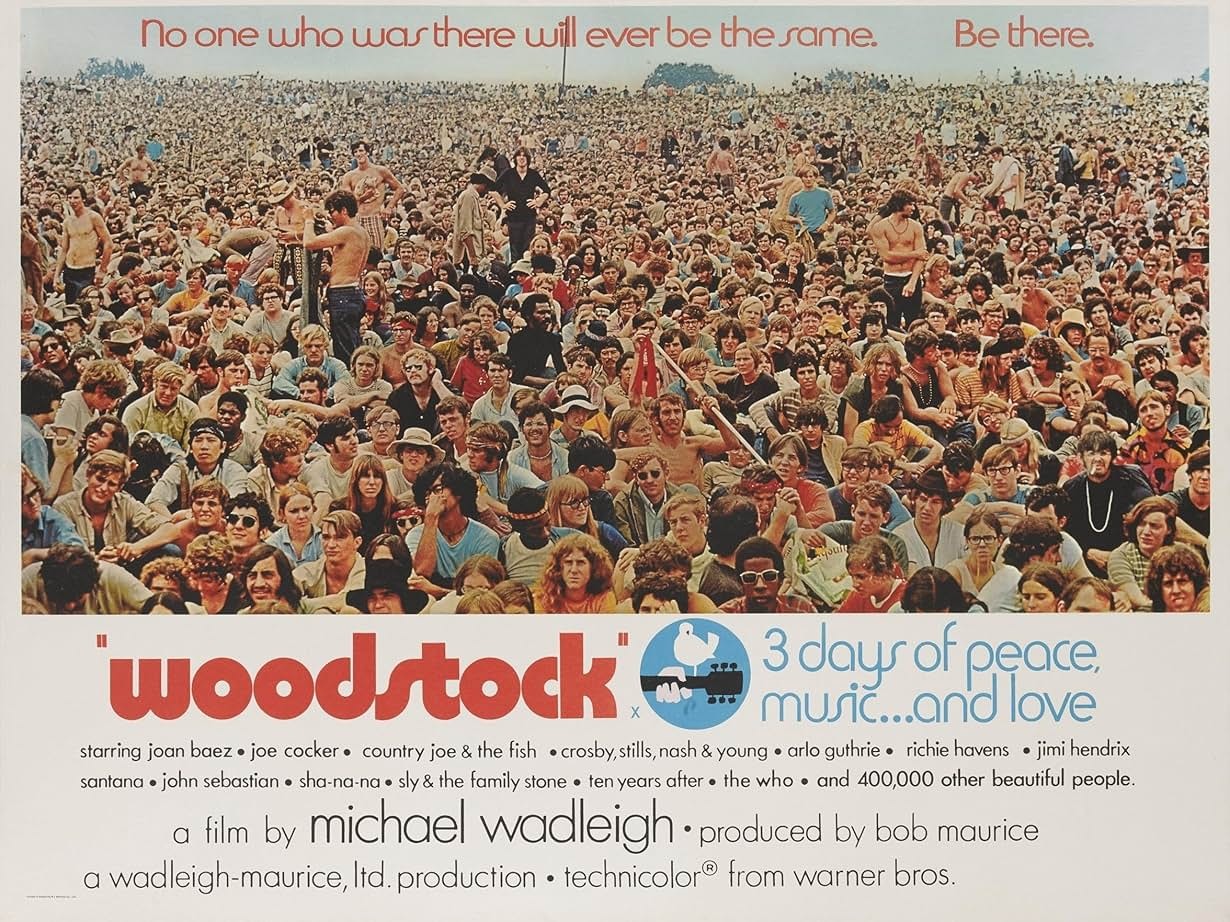
Fifty-six years ago, in August 1969, an event occurred that became a cultural reference point for a generation. Yes, “3 days of peace, music...and love.” What started out as a business venture to put on an outdoor music concert became a defining moment in history, forever captured on film, on record, and in the hearts, minds, and spirits of those who were there.
Woodstock.
Today’s Reel Classic takes a look at the documentary film released in 1970 that provided us insight into the coming together of the music festival, the behind-the-scenes efforts to make it happen, the power and beauty of the music that was featured, and the joy, love, and resilience of the hundreds of thousands in attendance. Named after the event, the film is Woodstock.
The Woodstock Music and Art Fair was held in Bethel, New York. It had originally been planned to be held in Woodstock, New York, but the promoters could not get local leaders to agree to allow it to occur. A farmer near Bethel agreed to lease his six-hundred-acre farm to the organizers for the festival to be located there. The rolling hills and the lake nearby made a perfect setting for the outdoor festival. Though now located in Bethel, the promoters kept the name Woodstock. They had hoped for 200,000 attendees but were overwhelmed when twice that number arrived. The event was scheduled to begin on Friday afternoon and run through Sunday. The cost of a ticket for the three days was $18. A single-day ticket was $7.
Given the number of people flocking to the concert, it is easy to understand why there were multiple problems to be dealt with. Roads to the festival became choked with vehicles, many of which were left abandoned on the side of the roads as people began to walk to the gates of the festival. So many people arrived that the gatekeepers could not keep up, and folks were lined up trying to get in.
The large number of attendees and the highway closure entering the area created significant challenges for the performers to access the site. Festival organizers had to make some quick and serious decisions to ensure the festival could go on. Due to the massive numbers of people trying to gain admission, the decision was made to make it a free festival, and people were allowed to come in. Fences came down as people flooded in. Also, arrangements were made to have helicopters transport the musicians, as they could not otherwise get to the site. With the numbers approaching 400,000 attendees and the decision to make it free, the hopes for financial success with the festival disappeared. However, the film and soundtrack would provide later financial achievements.

Needless to say, chaos ensued as the festival opened, with the influx of people and difficulties in getting musicians to the site. Richie Havens was the first act to appear on stage and stayed on the stage longer than planned to allow time for other performers to arrive. He was called on for multiple encores and reportedly ran out of songs to perform. He picked up his guitar and started singing and improvising “Freedom.” That song is seen in the film and provides a classic Richie Havens performance.
At one point, the governor of New York, Nelson Rockefeller, was so concerned by the size of the crowd that he talked about sending in the National Guard to break it up. Fortunately, that never came to pass. There were unexpected problems, however, given the massive number of attendees. Medical tents and food distribution tents were set up to serve the masses, with folks from the Hog Farm commune assisting. Over the three days, there were multiple examples of people coming together and helping each other. Residents of Bethel heard of the food shortage and collected donations to help feed those in attendance, and food items were helicoptered onto the site.
The filmmakers were not just filming the concert but working at documenting all the efforts that went into making these three days of “peace, music...and love” a reality. The film shows the efforts at getting the festival set up, the interactions of those in attendance, and various interviews with residents of the surrounding community. One particular interview is, in my mind, noteworthy.
Interviewer: “What do you think about the kids?”
Police Officer: “From what I’ve heard from the outside sources for many years I was very, very much surprised and I’m happy to say we think the people of this country should be proud of these kids, not withstanding the way they dress or the way they wear their hair, that’s their own personal business; but their, their inner workings, their inner selves, their, their self-demeanor cannot be questioned; they can’t be questioned as good American citizens.”
Interviewer: “That’s kind of surprising coming from a cop.”
Police Officer: (smiling)”I’m not a cop, I’m the Chief of Police.”

At one point Max Yasgur, the farmer who provided the land for the festival, took to the stage to address the crowd before him. As he flashed the peace sign, he stated “...the important thing that you’ve proven to the world is that a half a million kids, and I call you kids because I have children that are older than you are, a half a million young people can get together and have three days of fun and music and have nothing but fun and music, and God bless you for it!” Other noteworthy appearances were those of Chip Monck, the announcer, “Wavy Gravy” from the Hog Farm, and Thomas Taggert, the Port-O-San man.
And that brings us to the music. What an array of performers, which included the above-mentioned Richie Havens, Joan Baez, Joe Cocker, Country Joe & The Fish, Crosby, Stills & Nash, Arlo Guthrie, Santana, Jimi Hendrix, Sly & The Family Stone, The Who, and many others. And that is just a list of those appearing in the film. Many others were there as well, including Incredible String Band, Grateful Dead, Creedence Clearwater Revival, Blood, Sweat & Tears, Ravi Shankar, and Melanie.
Melanie’s appearance has an interesting story behind it. She was an “unknown” at the time of Woodstock and showed up at the festival, reportedly trying to get Michael Lang, one of the organizers, to let her play. He kept refusing her. However, the rainstorm caused the Incredible String Band to decide to postpone their performance and Lang decided to allow Melanie to take that spot. Her performance proved to be very popular and she went on to gain fame with her recordings, including “Lay Down (Candles In The Rain),” “Brand New Key” and “What Have They Done To My Song, Ma?”
A potential catastrophe nearly prevented Crosby, Stills & Nash from performing. Graham Nash and the band’s bassist, Greg Reeves, were flying in on one of the helicopters when one of the rear rotors failed, causing it to go into a spin. It nearly swerved into some power lines and came down hard on the ground. Fortunately, all were okay and the band was able to perform.
One of the memorable performances was that of Santana. They had been scheduled to perform later in the evening of day two, but with the multiple delays, they were asked to perform earlier in the day. Reportedly, Carlos Santana had taken some mescaline and saw the neck of his guitar become a moving snake. Obvious to any who have seen or heard Santana’s performance from that day, he handled that snake very well.
Another of the memorable performances was that of Jimi Hendrix. He closed out the festival with a very powerful performance. An interesting side note is that Michael Lang, one of the organizers, reportedly said that originally he had a different performer in mind to close out the festival—Roy Rogers singing “Happy Trails.” I think it worked out fine.

Along with the impressive list of those who performed, there is an equally impressive list of those who were invited but either could not or chose not to attend. The Beatles were invited but declined, though John Lennon indicated he would like to appear with his band The Plastic Ono Band. However, Lennon was mired in immigration issues with the US government due to his anti-war comments. The Rolling Stones had to decline as Mick Jagger was in Australia filming Ned Kelly. Joni Mitchell was invited but had to decline as she was scheduled to appear on The Dick Cavett Show, her national television debut. She later wrote the beautiful song about the festival, Woodstock, that was recorded by Crosby, Stills & Nash.
Others invited included Simon & Garfunkel, Laura Nyro, Donovan, The Rascals, The Flying Burrito Brothers, Blind Faith, Frank Zappa & The Mothers of Invention and The Moody Blues. One other notable declining performer was Bob Dylan. He refused the invitation and later was quoted as saying it was just a bunch of “kids on acid with flowers in their hair,” and saying it was not his “scene.”
The film was released in 1970 and was highly acclaimed by critics, as well as being a box office success. It grossed over $50 million and was one of the most profitable films of that year. Roger Ebert rated it at four of four stars, saying it was “maybe the best documentary ever made in America....The remarkable thing about Wadleigh’s film is that it succeeds so completely in making us feel how it must have been to be there.”
A review from the magazine Rolling Stone stated: “As much as performances by Sly and the Family Stone, the Who and Jimi Hendrix, it’s the nonmusical moments that make Woodstock the defining moment of the counterculture at its zenith. Smiling nuns flash peace signs at the camera, policemen eat popsicles alongside hippies, and elderly townspeople band together to help feed the army of fans. And like every aspect of Woodstock, the documentary’s very existence is a minor miracle.”
Woodstock was nominated for three Oscars, including Best Sound and Best Film Editing. It won the Oscar for Best Documentary. Woodstock had multiple editors, including Michael Wadleigh, Thelma Schoonmaker, and a young Martin Scorsese.

This leads me into a personal story. One of the editors was Yeu-Bun Yee. He was also one of the editors for The Band’s epic film The Last Waltz. Yeu-Bun Yee lived in Los Angeles, and at the time of the film’s release, I was living in California. One of my best friends at the time was Yeu-Wei Yee, Bun’s brother. When the film was playing in Los Angeles, we all attended the movie together. I picked up a copy of the poster for the film and it still hangs on my kitchen wall today.
In 1994, a second edition, an extended director’s cut, was released, adding another forty minutes to the film, which included performances by Canned Heat, Jefferson Airplane, Janis Joplin, and additional music by Jimi Hendrix. Additional re-releases with additional features were released in 2009 and 2014. In 1996, it was selected for preservation in the National Film Registry by the Library of Congress.
A quote from Michael Lang sums up the experience of Woodstock: “Everybody pulls together and everybody helps each other. And it works! It’s been working since we got here, and it’s going to continue working. And no matter what happens when they go back to the city, this thing is happening, and it proves that it can happen! That’s what it’s all about.”
The Internet Movie Database (IMDb) gives Woodstock a rating of 8.1 of 10. Rotten Tomatoes gives it a Critics Score of 100% and an Audience Score of 92%.
In searching my Roku device I could find no free streaming but it was available on multiple sites for a fee. There is a copy of the Director’s Cut on the shelf at the Clark County Public Library.
If you haven’t seen Woodstock I encourage you to do so. It is a wonderful display of the music of that time, but it is also a capture of a moment in time for a generation focused on peace, love and music. It documents acceptance and community as we would like to see it—people coming together to enjoy each other and assist each other when and where needed.
Never miss a thing with our FREE weekly newsletter.
Below is the iconic photo from Woodstock of the couple standing together, holding and loving each other—a true symbol of the cultural event taking place at the time. And, to you, the readers, I wish you peace, I wish you music, and I wish you love.

Information for this Reel Classic review was gathered from Internet Movie Data Base (IMDb), Rotten Tomatoes, Turner Classic Movies (TCM) and Wikipedia.
If you enjoy these classic movies, please join me on the second Tuesday of each month at 6 PM at the Clark County Public Library for “Ron Kibbey’s Comedy Classics.” I present a classic comedy film, usually accompanied by a vintage cartoon. Popcorn and drinks are provided. More information about the next movie is available on the library’s website and Facebook page, as well as the WinCity Voices Facebook page.
The trailer for this film is age-restricted and cannot be embedded. You can watch it on YouTube via this link: https://youtu.be/Ok9941BTzVg.
