
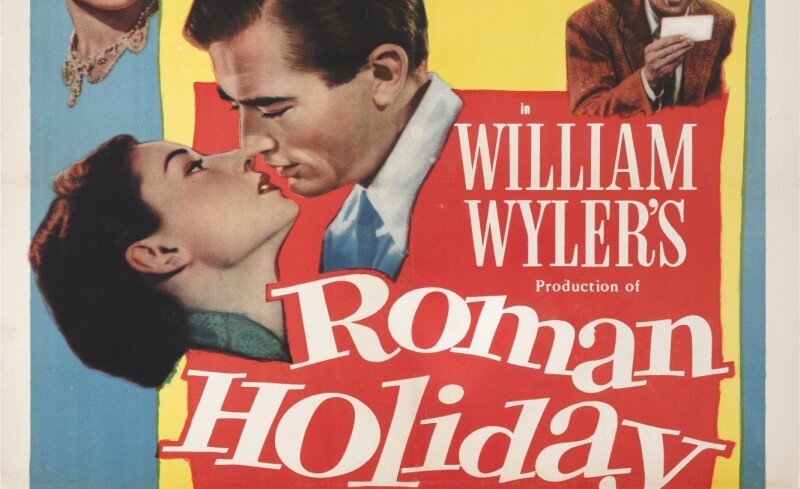
Today Reel Classics takes a look at the 1953 release Roman Holiday. The film stars Gregory Peck and Audrey Hepburn in her first leading film role. Gregory Peck plays Joe Bradley, a reporter based in Rome working for American News Service. He’s not really happy with this job as he wants to work for what he considers “a real news agency” in the USA. His pal, Irving Radovich (Eddie Albert), is a professional photographer, and they work together on stories.
Audrey Hepburn plays the role of Princess Ann, a member of a royal family from Europe who is on a goodwill tour of Europe. At the beginning of the movie, we see a newsreel clip of Her Royal Highness’s stops in various European cities, and her latest stop is Rome. We quickly learn that though she recognizes the need to uphold the Royal role in which she finds herself, she is also worn and weary of the role. She complains to one of her “ladies-in-waiting” but is quickly reminded that she is a princess and must conform to those expectations.

She opens her bedroom window and gazes out on the street below. A few blocks away, she sees the lights and hears the music of a street dance. She longs to be able to experience the “normal life” of a young woman. She verbalizes her resentments to her lady assistant, who becomes concerned about the mental state of Princess Ann. She calls in a doctor who feels she needs rest and gives her a sedative to calm her down. They all leave the room, and Princess Ann again gets out of bed and goes to the window to hear the music and laughter coming from the street dance. She then puts on some clothes and escapes the room, determined to experience life on the street.
Needless to say, the sedative begins to take effect. Enter Joe Bradley, the discontented reporter who is scheduled to be part of an entourage of reporters who will be interviewing the Princess tomorrow. He is walking down the dark street and finds a young lady, apparently suffering from too much to drink, lying on a park bench. He tries to rouse her out of concern for her safety, but she is obviously quite woozy. Eventually, and somewhat reluctantly, he decides to take her back to his apartment to “sleep it off.” He does not recognize her as Princess Ann.
The next morning he learns she is the Princess and sees an opportunity for a really big story. He does not tell her he is a reporter. He tells her he works in the fertilizer business. She sees an opportunity to spend the day seeing the streets of Rome as a “normal” young woman, not a member of royalty. She does not tell him she is Princess Ann, but instead says her name is Anya.
And so they begin a day-long trip seeing the sights of Rome, each harboring a secret from the other. Joe invites his photography pal Irving to join them, asking him to secretly take pictures of the Princess. As the day’s adventures proceed, Joe and Ann begin to fall in love with each other, both knowing that the secrets they are harboring would impact their future together.

As mentioned above, this was Audrey Hepburn’s first motion picture starring role. It was a set of circumstances that created this opportunity for her. The director, William Wyler (also known for directing the Oscar-winning films Mrs. Miniver, The Best Years of Our Lives, and Ben-Hur), insisted that the film be shot in Rome. The studio wanted to film it in Hollywood. When Wyler’s demands were granted, the studio decided to cut the budget. Instead of Technicolor, it would be filmed in black and white. Initially considered for the role of Princess Ann were Jean Simmons and Elizabeth Taylor. Instead of a well-known and costly lead actress, they would look for someone unknown and not as costly.
It is reported that what got Audrey Hepburn the role was not her scripted screen test, but her spontaneous and unscripted behavior afterward. The cameraman was told to keep the film running after the scripted test, and Wyler was impressed with what he saw. Not only was this a fortunate decision on his part, but Audrey Hepburn went on to wow many with her performance — winning the Best Actress Oscar in 1953.
A funny story about the Oscar for Audrey. In her excitement over winning the award, she reportedly started up to the stage the wrong way, kissed the presenter on the mouth (instead of the cheek), and then left the award in the ladies’ room — having to go find it so she could pose for the press.
Initially, Cary Grant was considered for the role of Joe Bradley. He turned down the role as he believed he was too old to play the love interest of the quite young Audrey Hepburn. Interestingly, they did share a love interest ten years later in the film Charade. Cary Grant later was reported to say that Audrey Hepburn was one of his favorite actresses with whom he had worked.
One of the reasons that William Wyler insisted on filming in Italy was reportedly to distance himself from the House Un-American Activities Committee, whose efforts had led to many in Hollywood being barred or at least tainted for their liberal views. Dalton Trumbo was a screenwriter who had been blacklisted for his political views. He was the writer of the story for this film but could not take any credit. His friend Ian McLellan Hunter was listed in the credits and actually was presented an Oscar for the efforts. A later release of the film in 2002 gave credit to Dalton Trumbo.
On another interesting note, Paramount Studios entered into an agreement with the British Government that there would be no indication that the character Princess Ann was of the British Royal Family. The British were concerned that viewers might link Princess Ann to their own Princess Margaret, who herself was bucking some of the royal restrictions. She had fallen in love with a “commoner” and was forced to renounce her love for him with the expectation that she find a “suitable” partner. Fans of The Crown on Netflix will be well aware of Princess Margaret’s adventures. There was a scene shot for the movie to specifically identify Princess Ann as not being part of the British royalty.

This film is a romance, but also a comedy. There are numerous funny scenes, including the interaction between Joe and Ann when he finds her on the park bench.
Another hilarious scene involves their trip to the “Mouth of Truth.” It’s a carved-in-stone head of an animal with a hole where the mouth would be. The legend was that if you put your hand in the mouth of the beast and you had been untruthful, the beast would bite off your hand. We must remember that both Ann and Joe were keeping a secret from the other regarding their true identities. Joe suggests Anya (her made-up name) go first. She starts to, but then is hesitant, obviously remembering the “little lie” she has told. Prior to the shooting of the scene, Gregory Peck had told the director that he was going to pull a trick that he has seen Red Skelton use before. Audrey Hepburn was unaware of this gag. He put his hand in the mouth and started screaming. He pulled out his arm and had his hand hidden up his sleeve, appearing to have lost his hand to the beast. Audrey Hepburn freaked out and screamed when she saw that and then realized he had played a trick on her. The scene was done in one shot, and the reaction you see is real.
Roman Holiday was nominated for 10 Academy Awards, including Best Picture, Best Supporting Actor (Eddie Albert), and Best Director (William Wyler). It won three including, as mentioned above, Best Leading Actress for Audrey Hepburn. In an interview, Gregory Peck said that watching Audrey Hepburn in her first starring role was “like watching a flower suddenly come to bloom” and that she “was born to play this princess.”
The American Film Institute lists Roman Holiday as number four on its list of ten greatest Romantic Comedies. In 1999 it was selected for preservation in the United States National Film Registry. Reviewers were highly complimentary as well. The Hollywood Reporter wrote that Roman Holiday “proves a charming, laugh-provoking affair that often explodes into hilarity...” and has a “delightful screenplay that sparkles with wit and outrageous humor that at times comes close to slapstick.” The Guardian reported the film was a “modern fairy-tale whose two leads have a charm and innocence that irradiate the whole movie.”
Never miss a thing with our FREE weekly newsletter.
A remake of the film was made for television in 1987, starring Catherine Oxenberg and Tom Conti.
The Internet Movie Database (IMDb) gives Roman Holiday a rating of 8 out of 10. Rotten Tomatoes has a critic’s score of 97% and an audience score of 93%.
In looking for streaming sites that offer the film for free, I found it on the following sites: Pluto, Kanopy (available with a library card), Movieland TV, and Fawesome. It is also available on DVD at the Clark County Public Library.
Information for this Reel Classic review was gathered from Internet Movie Data Base (IMDb), Rotten Tomatoes, Turner Classic Movies (TCM), and Wikipedia.
Keep watching for the next edition of Reel Classics, and in the meantime, enjoy the trailer below.
