
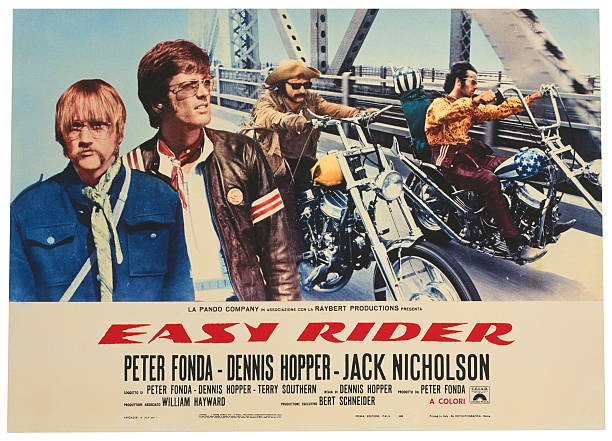
Today’s Reel Classic looks at the story of a couple of young men meeting up with a rather well-to-do businessman, who is in his Rolls Royce accompanied by his chauffeur. They complete the business transaction and decide to take a trip to New Orleans for Mardi Gras. The film is set in the late sixties at the height of the “sixties counterculture.” Our businessmen are not dressed in suits nor do they have hotel reservations awaiting them in New Orleans. Our businessmen are what were referred to as “hippies” — and the business deal completed involved the sale of cocaine.
The trip to New Orleans will be on motorcycles.
Easy Rider has been described as encapsulating “the dreams, hopes, and hopelessness of the 1960s counterculture.” Peter Fonda and Dennis Hopper are our two bikers on their trip across country. They have just made this deal that gives them enough money to set off on their adventure and a new life. The goal is to proceed to Florida after Mardi Gras and live a carefree life. Dennis Hopper is Billy and Peter Fonda is Wyatt (also known as Captain America because of the flags on his outfit and bike).
The journey from California takes them across the Southwest. They find that they are not welcomed at some of the places they stop because of their nonconformist ways and appearance. They end up sleeping outside and enjoying campfires. Along the way they do meet some accepting folks. A rancher and his wife invite them to dinner with them, and they pick up a hitchhiker who invites them to the commune in which he lives.
From there they proceed to Texas, where they come into a town that is having a civic celebration. They decide to join in the parade but are arrested by local law enforcement for “parading without a permit.” It is in jail that they meet the alcoholic attorney George Hanson who has his own issues with “the establishment,” particularly his wealthy father. A friendship develops and George Hanson decides to take off with them upon their release from jail and go to New Orleans. Sitting around a campfire one night George partakes in smoking pot for the first time. He becomes quite gleeful and talks of how creatures from Venus are among us.
The next day the three men stop at a small café for lunch but leave when confronted by hostility and the lack of acceptance because they are “different.” They are attacked that night at their campsite and beaten. The story proceeds as the bikers find their way into New Orleans where they encounter a “bad trip” in a local cemetery. These various experiences wear on Wyatt, and he begins to question of what and why he continues on.
As usual, no spoilers here. As the story plays out, we see the power of dreams and hope, we see the power of hate and nonacceptance, and we see the struggles that both of those elements bring to folks’ lives. Peter Fonda reportedly came up with the concept of the film and approached Dennis Hopper to join him in the effort as director. Fonda stated that he imagined the two characters as modern-day cowboys, so he named them Billy (after Billy the Kid) and Wyatt (after Wyatt Earp). He has stated that one of the inspirations for the concept was the movie The Searchers.
Fonda said “It would be about the Duke (John Wayne) and Jeffrey Hunter looking for Natalie Wood. I would be the Duke and Dennis Hopper would be my Ward Bond. America would be our Natalie Wood. And after a long journey to the East across John Ford’s America, what would become of us?”

Bob Rafelson and Bert Schneider were approached by Fonda to help finance the picture. They had just scored well with their TV show The Monkees. The film was shot with many of the lines ad-libbed, making it up as they went. Fonda and Hopper often utilized locals to assist in the film shooting. It did not have a set screenplay. Reportedly Fonda and Hopper argued often during the filming.
Those involved in the filming claimed that Hopper was angry and paranoid and very difficult to deal with. Hopper later attributed some of his behavior to the pot he was smoking. He claimed it was not helpful to his creativity. Also, Hopper’s version of the film was reportedly four or more hours in length. Dennis Hopper was provided a trip away so he would not interfere with the editing of the film. Though initially upset about the editing, he later accepted the final product as being what he had intended.
Besides the beauty of the countryside highlighted in the filming, another outstanding factor is the soundtrack. Instead of having music composed for the film, existing songs were collected to provide the accompanying music. Performers included Steppenwolf, The Byrds, Jimi Hendrix and Roger McGuinn. The soundtrack was released as an album and was a top ten album and the second most successful soundtrack of the year.
Easy Rider also had a number of actors involved in smaller roles. Bridget Fonda made her film debut as a five-year-old child in the commune. Robert Walker Jr and Carrie Snodgrass were also seen as members of the commune. Phil Spector appeared as the cocaine dealer and Karen Black as one of the ladies in New Orleans. Karen Black and Jack Nicholson went on to star in Five Easy Pieces the following year.
An actor with a Kentucky connection got a mention in the film. Amidst the graffiti on the jailhouse wall is written “H.D. Stanton.” That was meant as a tribute to Harry Dean Stanton, a friend of Jack Nicholson. Easy Rider was released in July 1969 and was a box office success. It became the fourth highest grossing film of 1969 and grossed $60 million worldwide. It received two Oscar nominations including Best Actor in a Supporting Role (Jack Nicholson) and Best Writing, Story and Screenplay.

Critical reception was for the most part positive. The critic in The New Yorker said the film “speaks tersely and aptly for this American age, that is both the best of times and the worst of times. The Village Voice wrote of Peter Fonda, “He comes off like a combination of Clint Eastwood and James Dean.” The New York Post wrote, “Individual scenes are so well and truly made that they remain in your mind like your own experience . . . it’s happening. It’s not a movie.” The critic for the Los Angeles Times wrote “. . . Easy Rider is an astonishing work of art and an overpowering motion picture experience.”
Not everyone appreciated the film in 1969. Vice President Spiro Agnew criticized both Easy Rider and the band Jefferson Airplane as being examples of “the permissiveness of the 1960’s counterculture.”
Just so you know, Jefferson Airplane is one of my favorite bands. No surprise to those who know me.
Never miss a thing with our FREE weekly newsletter.
Easy Rider was added to the United States National Film Registry in 1998. Roger Ebert added it to his list of “Great Movies” in 2004. In 2007 the American Film Institute ranked it at #84 on their list of “Greatest Movies of All Time.”
In 2012 Easy Rider: The Ride Back was released as a prequel to the original film. No one from the original film was involved in the production of this film. The focus of the prequel was on the family of Wyatt (“Captain America”). It was produced and written by Phil Pitzer and the rights to the name of the original film were purchased. It did not do well. Leonard Maltin described it as a “bomb” and said it was a “staggeringly bad attempt to cash in on the iconic original” and that it was “poor on all accounts.”
The Internet Movie Database rates Easy Rider at 7.3 of 10. Rotten Tomatoes gives it a critics score of 84% and an audience score of 82%. In perusing my Roku device, I was unable to find any free streaming sites. However, there is a copy of the DVD on the shelf at the Clark County Public Library.

Information for this Reel Classic review was gathered from Internet Movie Data Base (IMDb), Rotten Tomatoes, Turner Classic Movies (TCM) and Wikipedia.
I’ll be back soon with the next Reel Classic, but before I leave you with the trailer below let me remind you that if you enjoy these classic movies, please join me on the second Tuesday of each month at 6 PM at the Clark County Public Library for “Ron Kibbey’s Comedy Classics.” I present a classic comedy film usually accompanied by a vintage cartoon. Popcorn and drinks are provided. More information about the next film is available on the library’s website and Facebook page, as well as WinCity Voices Facebook page.
