
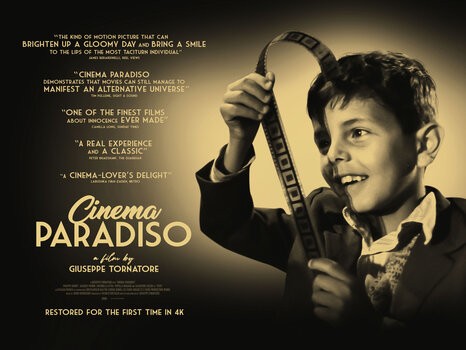
This edition of Reel Classics will look at a film in which you likely will not know any of the actors, director, or writers, but I believe that if you watch it, you will fall in love with the story. For in many ways, the theme of the movie is love in its many forms—love for another, love for a passion, love for an art form, and love for family.
Cinema Paradiso is the story of a young boy told in flashbacks by the middle-aged Salvatore Di Vita (Jacques Perrin). The year is 1988, and Jacques is a very famous film director living in Rome. He receives a message from his current girlfriend that his mother has called to inform him of the death of his friend and mentor Alfredo (Philippe Noiret). She lets him know when the funeral will be held. In thirty years, Salvatore has not been back to Giancaldo, the village in which he grew up. And a broken heart from his past has kept him troubled. Unable to sleep, he begins to flash back to his childhood in Giancaldo.
This is when we meet the eight-year-old Salvatore (Salvatore Cascio) nicknamed Toto. He is intelligent, curious, very mischievous, and has a love of movie films. There is a local theater in the village called “Cinema Paradiso.” He spends a great deal of time at the movie house and is fascinated with the projection booth. The time is just a few years after World War II, and he lives with his mother and sister—his father never returned from the war. His mother, Maria (Antonella Attili), struggles to support her two children and often grows frustrated with Toto’s fascination with the movie theater.
An example occurs when Maria confronts Toto as to why he had not brought home the milk she gave him the money to get. She learns that he has spent the money on a ticket to the movie and she is angry and whips him. Alfredo is nearby when this occurs and gives some money to her, telling her that it was found on the floor of the theater, when actually it came from his pocket. He and Toto begin to develop a close relationship. For Toto, Alfredo is like a father figure, and for Alfredo, Toto is like the son he never had.
Alfredo lets Toto come into the projection booth and he begins to show him how the equipment works and how to keep it running. Toto is absolutely fascinated and eventually begins to help out. During the showing of the films we often find the audience booing and yelling as it is obvious that some scenes have been deleted. We learn that the reason for the “censoring” is that the theater is owned by the local priest. Before the showing of a film, he watches it alone and has a little bell in his hand. When he sees a scene that he feels is inappropriate (kisses, romantic embraces, etc.), he rings the little bell and Alfredo notes to cut that scene. He has a collection of cut scenes from various movies that he has collected in a box.
Toto learns how to operate the projector and accompanies Alfredo every evening in the booth. Their relationship has grown very close. Unfortunately one evening a fire breaks out in the booth after Toto has left and Alfredo is badly injured. Toto sees the fire and races into the theater while everyone else is racing out. He saves Alfredo’s life, but Alfredo is permanently blinded. The theater is destroyed, and the villagers are very upset by the loss.

One of the local villagers has recently won a state lottery and offers to buy and restore the cinema. Alfredo can no longer operate the equipment so Toto is hired as he is the only other person who knows how to operate the projector. Alfredo continues to assist in advising him, not just regarding the projector, but on other issues in life as well.
We then see Toto as a teenager (Marco Leonardi) and he is still working the projector in the theater. He has obtained a handheld movie camera and is fascinated with making films. His relationship with Alfredo continues to be strong, and he looks to Alfredo for guidance. Toto has met a young girl who has moved to the village, and he becomes fascinated with her. Elena (Agnese Nano) is the daughter of a wealthy banker, and she and Toto develop a relationship. He often films her with his camera and watches the films alone in his room. However, her father has other plans for her and does not take to Toto. Her father eventually decides to move the family away from Giancaldo, and Toto’s attempts to contact her by letter fail, returning as undeliverable. He is heartbroken.
Toto has to serve in the military and leaves town. Upon his discharge, he returns, but Alfredo counsels him to leave and follow his dreams. He knows of Toto’s passion for filmmaking and tells him he will never realize his dreams in Giancaldo. In fact, he encourages Toto to never return and never to give in to nostalgia.

In a quote from the movie, Alfredo says to Toto, “Living here day by day, you think it’s the center of the world. You believe nothing will ever change. Then you leave: a year, two years. When you come back, everything’s changed. The thread’s broken. What you come to find isn’t there. What was yours is gone. You have to go away for a long time...many years...before you can come back and find your people. The land where you were born. But now, no, it’s not possible. Right now, you are blinder than I am.”
Salvatore: “Who said that? Gary Cooper? James Stewart? Henry Fonda? Eh?”
Alfredo: “No, Toto. Nobody said it. This time it’s all me. Life isn’t like in the movies. Life...is much harder.” Toto decides to take Alfredo’s advice, and the last time he sees Alfredo alive is in their tearful embrace at his departure. One of Toto’s parting remarks to Alfredo was, “Thank you. Thank you for everything you’ve done for me.” Alfredo responds with “Whatever you end up doing, love it. The way you loved the projection booth when you were a little squirt.”
The flashback is over, and we return to the present. Salvatore (as he is now known) looks about the village and sees all the changes. The theater has closed as people now watch TV and video tapes. Salvatore speaks with Alfredo’s widow, who tells him how Alfredo followed Salvatore’s career and spoke with pride of Toto’s accomplishments. She gives him a reel of film that Alfredo had prepared and left for him as a gift. The Cinema Paradiso is scheduled to be demolished to make way for a parking lot. At the funeral, Salvatore sees the faces of the many folks who attended the theater when he was there. Back in Rome, checking out the gift to him from his friend Alfredo, Toto finds inner peace.
Giuseppe Tornatore was the director and writer for Cinema Paradiso. He filmed the movie primarily in his own hometown of Bagheria in Sicily. He incorporated a good deal of his own childhood experiences into the story. Movie theaters were important in the towns of Italy. Reportedly, in 1956, Italy had 17,000 movie theaters—more than any other country in Europe.
The film was highly acclaimed in various world film festivals and won an Academy Award for Best Foreign Film in 1990. It is the success of Cinema Paradiso that is often credited for reviving the film industry in Italy. Another highlight of this film is the music score composed by Ennio Morricone and conducted by Andrea Morricone. One reviewer described it as “hauntingly beautiful,” and in my opinion, it enhances the emotions expressed throughout the film.

The scenes within the theater draw an emotional response from the viewer. The young children laughing, couples smiling and holding hands, and adults wiping tears from their eyes will likely stir not only emotions from the viewer but likely memories of our own experiences in the theaters from the past. As one reviewer stated, “The scenes made me realize the power of cinema and its ability to make people laugh, clap, whistle, enjoy, cry, wipe tears....”
I have a personal experience with this very film from the past. I have always been a major fan of the Kentucky Theater in Lexington and was a very frequent visitor there. I saw this film at the Kentucky Theater in 1992 after they reopened following damage to the theater from a fire in the building next door. They had a grand re-opening featuring five films—Cinema Paradiso, Singin’ in the Rain. Jesus Of Montréal, Bugsy, and Thelma & Louise. I proudly still have and wear the T‑shirt from that event with the movies listed on the back.
The Critics Consensus on Rotten Tomatoes sums up the film: “Cinema Paradiso is a life-affirming ode to the power of youth, nostalgia, and to the movies themselves.” The film is included in Steven Schneider’s “1001 Movies You Must See Before You Die.”
Never miss a thing with our FREE weekly newsletter.
In 2002 Cinema Paradiso was re-released with over fifty minutes of film cut from the original added back to it. The extended version provides more detail on Toto’s romance with Elena.
The Internet Movie Database rates Cinema Paradiso at 8.5 of 10. Rotten Tomatoes gives it a Critics Score of 91% and an Audience Score of 96%.
Checking my Roku device I found it available for free streaming on Pluto TV and Kanopy (available with your library card). There is a copy of the DVD on the shelf at the Clark County Public Library.
Information for this Reel Classic review was gathered from Internet Movie Data Base (IMDb), Rotten Tomatoes, Turner Classic Movies (TCM) and Wikipedia.
I’ll be back soon with the next Reel Classic, but before I leave you with the trailer below let me remind you that if you enjoy these classic movies please join me on the second Tuesday of each month at 6:00 PM at the Clark County Public Library for “Ron Kibbey’s Comedy Classics.” I present a classic comedy film usually accompanied by a vintage cartoon. Popcorn and drinks are provided. More information about the next film is available on the library’s website and Facebook page, as well as WinCity Voices Facebook page.
