
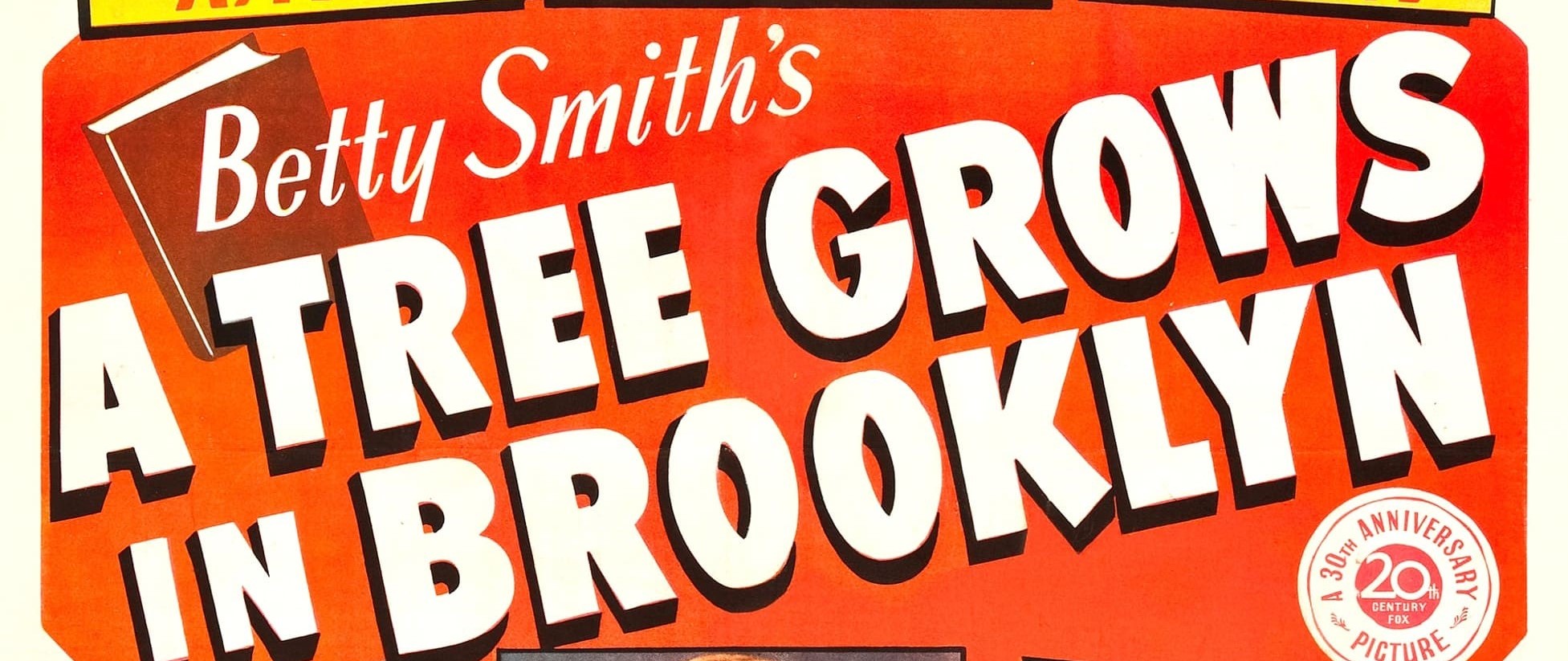
The year is 1912—the early years of the 20th century. The setting is the Williamsburg neighborhood of Brooklyn, New York. We find an Irish-American family struggling to survive in the crowded tenements of the city. Katie Nolan works all day scrubbing floors in the building and collecting rags to sell for a few pennies. She is driven and serious and hardened by her circumstances and struggles.
Katie’s husband Johnny is much more of a “happy-go-lucky” sort who bounces from one job to another as a singing waiter. He is a dreamer and quite charming to those he meets, but he is also an alcoholic and struggles to find and keep employment.
The children include 13-year-old Francie and her 12-year-old brother Neeley. Francie is bright and a bit of a dreamer like her dad. She likes — and does well — in school and has hopes of one day becoming a writer. She idolizes her father, and he stokes her dreams and hopes for the future. Neeley is not so interested in school and does what he needs to do.
Other characters in the film include Katie’s sister, Sissy, who has had several husbands and is a bit of a free spirit — the very opposite of Katie. Officer McShane is the local cop on the beat who has taken a liking to the family.
Outside the window of their apartment, there grows a tree — coming up out of the sidewalk. (My grandmother would have called it a “volunteer.”) It has grown mighty and tall, providing some shade to those sitting on the fire escapes, and a place for birds to gather and sing. Francie and her father refer to it as the “Tree of Heaven.”
Francie becomes upset when she sees the landlord is cutting branches from the tree — afraid that he is killing it. Johnny tries to reassure his daughter that nothing can prevent that tree from growing — no one planted it. It came up through the sidewalk in a crack and was determined to grow. It will grow because it is determined to grow, just as she can realize her dreams through her own determination. She can be what she dreams she can be if she is determined. He later assists his daughter in enrolling in a better school to increase her chances of realizing her dreams (though they do engage in a bit of fibbing here to make it happen).
Katie learns that she is pregnant and worries even more so about finances. She moves them upstairs to an even smaller apartment and informs Johnny of the pregnancy. She tells him that Francie must drop out of school and find work to help support the family. Johnny is not okay with destroying the dreams of his beloved daughter and intends to do what he can to prevent that from happening.

A Tree Grows in Brooklyn is based on a book written by Betty Smith. The story is based on her own experiences growing up in Brooklyn. It was published in 1943 and was highly sought after by movie studios. 20th Century Fox acquired the rights for $55,000. The film was the initial effort by Elia Kazan at directing film, and he went on to be involved in many successful and critically acclaimed films. He had previously achieved fame as a stage director.
The character Sissy (Katie’s sister) was the source of much controversy for the film. The “Production Code Administration” in Hollywood initially rejected the screenplay due to “the bigamous characterization of Sissy.” They also gave “further warnings that Sissy’s ‘false philosophy’ regarding the nature of love and marriage should be toned down.”
The studio responded by “toning down” the character, but this was also in response to a libel suit filed by Sadie Grandner, Betty Smith’s cousin. She claimed that the character of Sissy had been based on her and had caused her to suffer “scorn and ridicule.” The studio ended up settling the lawsuit out of court for $1,500.
The cast is wonderful and well-suited to these roles. In my view, the real star of this film is Peggy Ann Garner, who plays the role of the hopeful dreamer Francie. Her interactions with her father are heartwarming.

James Dunn was also magnificent in the role of Johnny. His charm and positive persona are vital to the film, and he won a Best Supporting Oscar for his performance. In real life, James Dunn also struggled with alcoholism. He had previously co-starred with Shirley Temple in her first three films: Baby Take a Bow (1934), Stand Up and Cheer! (1934) and Bright Eyes (1934). He proceeded to gain a reputation for heavy drinking and ended up in B movies. 20th Century Fox executives were not wanting him for the role of Johnny because of his reputation and problems with drinking, but Darryl Zanuck was persuaded by Elia Kazan to cast him.
In an interview, Kazan stated: “…Jimmy had been run out of movies for drinking. He was largely unemployable and felt ill at ease at the studio. But he was an awfully sweet, nice man, a hell of a guy. When I met him I said, this is it, this is Johnny Nolan, himself. He’s full of watery-eyed Irish affection. He’s ebullient. He feels guilty. He slinks.”
Peggy Ann Garner won a special Oscar, Best Child Actor, for her portrayal of Francie. Elia Kazan stated in an interview that Garner’s father was serving in the Air Force at the time, and she was always anxious about his safety. She had a very close relationship with her father, and the director encouraged her to use that emotion in her role. He also spoke of how he worked to help create a bond between Garner and Dunn and that they had a wonderful chemistry. It is displayed in the film.
Dorothy McGuire was cast as Katie Nolan. The role was originally offered to Gene Tierney, but she became pregnant, and McGuire got the role. McGuire later appeared in numerous film and television roles. Notable films include Gentleman’s Agreement (1947), Three Coins In the Fountain (1954), and Old Yeller (1957). Fred MacMurray wanted the role of Johnny but, as stated above, Kazan thought James Dunn to be the better candidate. Lloyd Nolan played the part of Officer McShane. Nolan appeared in multiple films throughout the 1940s and became a very familiar face in various TV shows from the 1950s up until the year of his death in 1985.

Joan Blondell played the role of Aunt Sissy. At the time of the filming, she was going through a divorce from her husband Dick Powell. She spoke very highly of director Elia Kazan but spared no mercy for the censors. Her role was deemed the most controversial, and it experienced the most changes in the script. In the original script, Sissy was employed in a condom factory. The kids find one and ask her what it is. She tries to explain, but the studio was forced to cut the scene. Blondell elaborates: “They cut the best scene in the picture, the best scene I ever played and the best piece of acting I have ever done … in the most beautiful writing the author, Betty Smith, did. Sissy tries to explain to the children what the rubber is; not by talking about the actual thing, but about love and life itself. It was very simply done, and all of us players hugged each other spontaneously at the end of the scene. It was marvelous, and the Legion of Decency made us take it out. Wasn’t that stupid?”
Ted Donaldson played the role of Francie’s brother Neeley. He went on to play the lead role in a series of films depicting a young boy, Danny Mitchell, and his dog Rusty. There were eight films in the series, running from 1945–1949.
A Tree Grows in Brooklyn was Elia Kazan’s first feature film, and it was highly successful. In addition to the Oscar won by James Dunn, the screenplay was also nominated for an Academy Award. It was one of the first films chosen for preservation by the Library of Congress Film Registry. The New York Times critic called the film “a vastly affecting film.” He also stated, “In the radiant performance by these two actors of a dreamy adoration between father and child is achieved a pictorial demonstration of emotion that is sublimely eloquent.” Variety praised Elia Kazan’s efforts, stating that he handled a potentially tragic story of an overcrowded and poverty-stricken tenement without letting the story become “maudlin.” Leonard Maltin described the film as “perfect in every detail.”
James Dunn reprised his role of Johnny Nolan for the radio on Hallmark Playhouse in 1949. Betty Smith assisted in writing a musical version of the story as a play that opened in New York in 1951, and Joan Blondell reprised her role of Sissy in the road company version. In 1974 NBC televised a TV film version starring Cliff Robertson and Diane Baker.
This is one of my favorite films, and I love the book as well. It is packed with emotion but focuses on the power of hope and dreams. There are many emotional scenes in the film that tug at the heartstrings. One of my favorite quotes from the film comes from Francie. To be honest, I have asked this same question many times over the course of my lifetime. The setting is Christmas in the tenement, and Francie and Neeley have just arranged to get a free Christmas tree and brought it to the apartment. Francie gazes up at her father on Christmas Eve after the tree has been decorated and the relatives have gone home. She asks, “Papa, the people in the hall when we brought up the tree, the look on their faces, all friendly and nice. Why can’t people be like that all the time, not just on Christmas?”
Never miss a thing with our FREE weekly newsletter.

As the story ends, Francie and Neeley gaze out upon the sidewalk below them. Francie sees where the tree had been cut back, and a look of surprise and joy is upon her face. She points out to her brother: “Neeley, look at the tree. It’s growing again, just like Papa said.”
Hope and dreams can survive and keep us going, “…just like Papa said.”
The Internet Movie Database (IMDb) rated this film 8 of 10. Rotten Tomatoes gave it a critic’s score of 94% and an audience score of 91%. The only free streaming site I could find was on YouTube. There is a copy on DVD at the Clark County Public Library.
Information for this Reel Classic review was gathered from Internet Movie Data Base (IMDb), Rotten Tomatoes, Turner Classic Movies (TCM) and Wikipedia.
Please join us again for the next Reel Classic, and in the meantime, enjoy the trailer below:
