
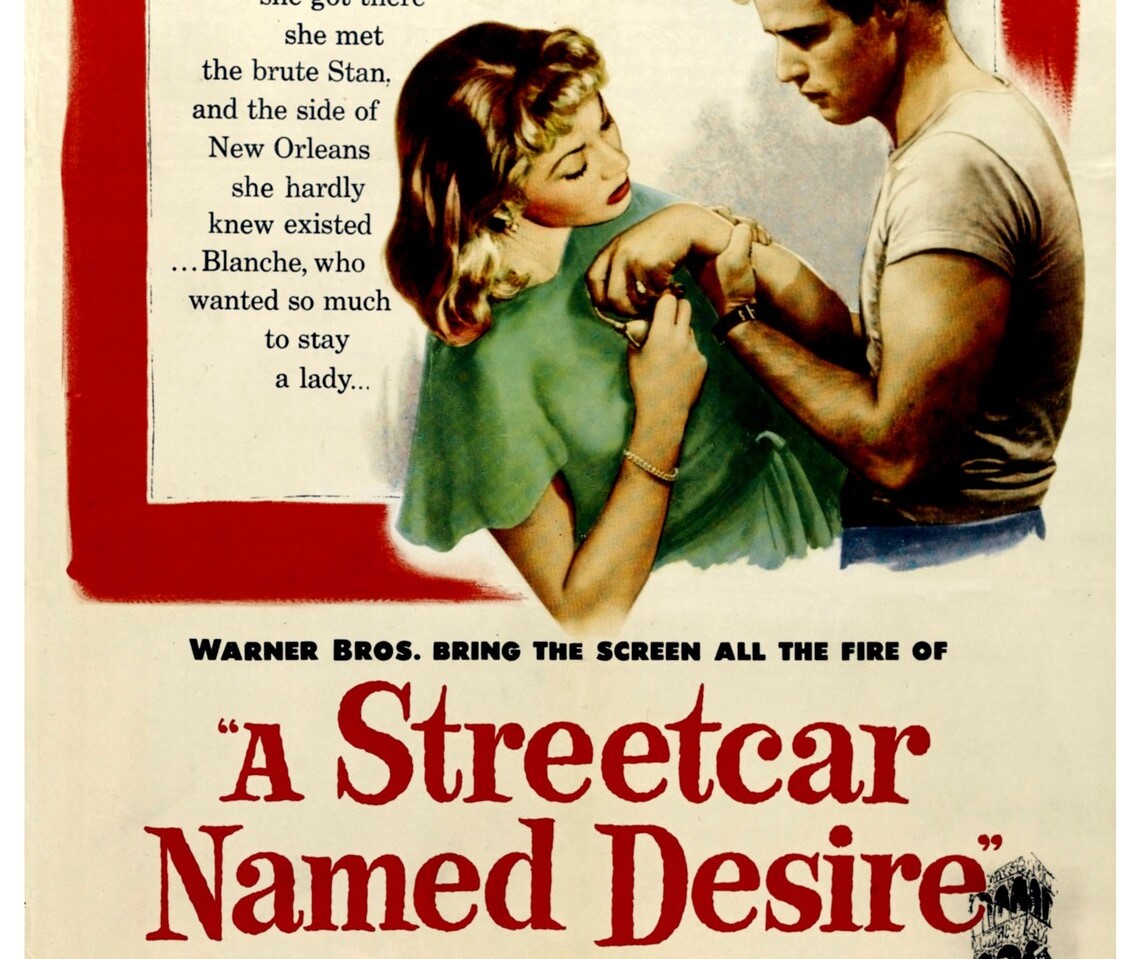
Once again, Reel Classics will look at an award-winning Broadway play adapted to film in A Streetcar Named Desire. The play originally premiered on Broadway in December 1947. The film version was released in 1951, and many members of the original play were signed to appear in the film as well.
This was Marlon Brando’s second film, and he had not yet reached the star status that he would achieve. Brando played Stanley Kowalski, who lives with his wife Stella (Kim Hunter) in a tenement apartment in the French Quarter of New Orleans. Vivien Leigh played Stella’s sister, Blanche, who comes to visit and stay after reportedly leaving a teaching job. She states that she had problems with her nerves and needed a break. Stella welcomes her sister, but Stanley is not at all thrilled with having her in his home.
Blanche presents as refined and condescending, criticizing the “shabby” two-room apartment and the crudeness of Stanley. She describes him as “common.” Stanley is not at all happy with her presence there and is complaining of her “interference” in his life with his wife. He also becomes suspicious as Blanche and Stella came from money, and there was a family estate (Belle Reve) in Mississippi. He had expected to reap some gain from that, but Blanche informs them that she has lost the estate to creditors and she is now penniless. Blanche also admits that she is distraught over the suicide of her husband (whom we learn was a homosexual and in a relationship with a man), and she feels guilty in that the suicide was a reaction to her response to her husband’s behaviors.

A day later, some of Stanley’s poker-playing buddies show up at the apartment, including Mitch (Karl Malden). His manner varies from the more coarse and crude behaviors of Stanley and his other friends, and Blanche begins a bit of flirtatious behavior with Mitch. He is attracted by her charm, and romance begins to blossom.
As time passes, the relationship between Blanche and Mitch grows while the relationship between Blanche and Stanley worsens. We begin to see the impact of mental illness and alcoholism on Blanche, and we also learn of hidden secrets from her past. Stanley, in his resentment of her, is not kind to Blanche as he uncovers her past. Needless to say, this tension between him and Blanche also has an impact on Stella, who is pregnant with their first child.
As mentioned above, a number of actors in the film were reprising roles from the Broadway play, including Marlon Brando, Kim Hunter, and Karl Malden. In the play, Jessica Tandy played the role of Blanche, and the director, Elia Kazan, wanted her for the film as well. However, the studio producers insisted that they have an actress with “star quality” to draw more box office returns. Brando was not at that point yet, as this was only his second film. Vivien Leigh had played the role in a London production, and she was chosen to play Blanche. Olivia de Havilland was offered the role but turned it down.

To prepare for the role of Stanley, Brando went to a gym where he worked out religiously, building up his chest and biceps. The change in his body physique was drastic, and Truman Capote commented that “it was as if a stranger’s head had been attached to the brawny body, as in certain counterfeit photographs.” Kim Hunter was later quoted as describing Brando as much more sensitive than the character he played. She also stated that Brando had told her that in preparing for the role, he modeled the behavior after that of his own father during Brando’s childhood.
Vivien Leigh actually suffered from mental illness in her real life as well. She was diagnosed with bipolar disorder and later said that filming the role of the mentally ill Blanche worsened her own mental health. She was quoted as saying that “it tipped me over into madness.”
In many ways, A Streetcar Named Desire is a dark, moody film. It deals with mental illness, alcoholism, marital infidelity, suicide, rape, and domestic violence. These topics created problems with the Hollywood Production Code censors as well as the Catholic Legion of Decency. The Production Code censors identified 68 script changes from the original Broadway production. There were many objections to scenes that director Elia Kazan filmed, and Warner Bros. Studio was forced to comply with the censors’ demands out of fear of losses at the box office. Tennessee Williams later wrote in his memoir that though he liked the film he thought it had been “slightly marred by the Hollywood ending.” Kazan had made a “director’s cut,” which was eventually released as a restored version of the film in 1993.
The Broadway play was highly acclaimed, winning the New York Drama Critics’ Circle Award for Best Play and the Pulitzer Prize for Drama. The film was nominated for 12 Academy Awards and won four. Winning categories included Best Actress (Vivien Leigh), Best Supporting Actor (Karl Malden), and Best Supporting Actress (Kim Hunter). Marlon Brando was nominated for Best Actor, and this was the first of four consecutive years he was nominated for that award (in 1952, Viva Zapata!; 1953, Julius Caesar; and 1954, On the Waterfront). He won the award in 1954.
One of the Academy Award nominations was for the category of Best Music. Composer Alex North wrote and recorded the score for the film, and it was the first jazz-oriented score for a dramatic film. The music was meant to complement the setting of New Orleans and the French Quarter—well known for its jazz.
There are many “stand-out” scenes in the movie, but one of my favorites occurs when Stanley is in a drunken mode and becomes violent during a poker game gathering, hitting Stella. She and Blanche flee the apartment to a neighbor’s apartment above them. Stanley, drunk but remorseful, goes out to the sidewalk below and tearfully yells out to her, “Stella! Hey, Stella!” Stella comes out and sees him. Loving him and drawn to him, she returns to him, and he carries her back into the apartment. The line was voted as the #45 best quote by the American Film Institute. The scene is immensely powerful.

An interesting note about the origins of the character Blanche. It has been thought that she may have been based on Tennessee Williams’ sister, Rose Williams. She suffered from mental illness and eventually had a lobotomy (not an unusual treatment for mental illness in the past) and became incapacitated. The success of the play reportedly enabled Williams to finance her care.
Another interesting note about the title of the film. There really was a streetcar named Desire that ran in New Orleans. Streetcars were the main mode of transportation in New Orleans, and the line ran through the French Quarter to Desire Street.
Never miss a thing with our FREE weekly newsletter.
Upon the release of A Streetcar Named Desire, the New York Times review stated that “inner torments are seldom projected with such sensitivity and clarity on the screen.” It was the fifth biggest hit of the year. A Streetcar Named Desire is included in the American Film Institute’s list of Top 100 Greatest American Movies.
A Streetcar Named Desire received a rating of 7.9 out of 10 on the Internet Movie Database (IMDb). Rotten Tomatoes gave it a Critics’ rating of 97% and an Audience rating of 90%.
I could not find a streaming site that offers the film for free, but the Clark County Public Library does have the DVD on the shelf.
Information for this Reel Classic review was gathered from Internet Movie Data Base (IMDb), Rotten Tomatoes, Turner Classic Movies (TCM), and Wikipedia.
Until the next Reel Classic, please enjoy the trailer below.
