- Orson Martin’s Factory Bottom
- Crossing Lower Howard’s Creek
- Hieronymus Cabin
Orson Martin was born in 1764 in Goochland County, VA, the son of John and Rachel Martin, who were pioneer settlers on Lower Howard’s Creek. Orson came to Kentucky in 1786. An early resident stated that “there was two of the Martins built a mill on lower Howards creek,” relating to a gristmill Orson and his father built that predated Jonathan Bush’s flour mill.
Orson settled in Clark County about the time many Fort Boonesborough inhabitants began relocating here. He participated in the industrial development on Lower Howard’s Creek, which resulted in one of the first manufacturing districts in Kentucky. The valley was an important site for water-powered mills, woolen factories, distilleries, and stone quarries.
Orson himself played a significant part in the valley’s commercial success. As a blacksmith, he plied a trade that was respected and always in need, especially in the newly developing industrial setting. He assumed a larger role when he became the owner-operator of a sawmill and gristmill. Large gristmills such as his were being built at the time to produce flour by the barrel for shipment to New Orleans. Lower Howard’s Creek, which flows into the Kentucky River, was well-situated to benefit from this trade.
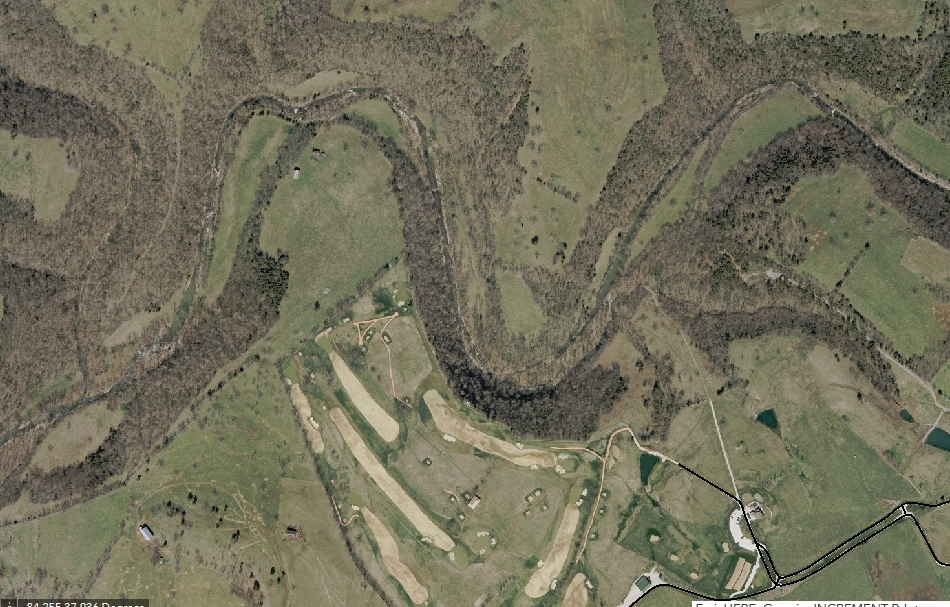
Orson Martin ran a blacksmith shop on his 25-acre tract that became known as “Factory Bottom.” He later erected a sawmill, followed by a large, stone flour mill on the site. Orson always gave his trade as blacksmith. His brothers Valentine and Job ran the sawmill. They also helped build the flour mill, which Orson rented out to a miller named Daniel McVicar.


Orson married Nancy Embree, and the couple had nine children. Nancy was a long-time member of the Providence Baptist Church. Her father, Joseph Embree, was a deacon, and Orson’s father was an elder. Orson himself never joined. He focused on his businesses and, at first, was very successful. The main road from Winchester to Boonesborough went down the creek, and Orson’s shop was a frequently mentioned landmark along the way. Skilled blacksmiths were important members of their community. It has been said that they could fix anything you had and make anything you didn’t have. This role was shaped by necessity since there was no place to buy metal products in early times.
Soon after the turn of the century, Orson’s fortunes began to change. Serious allegations were lodged against him, including assault and battery, reneging on business agreements, failure to pay his debts, and burning down a neighbor’s mill. His wife Nancy filed suit for divorce in 1813. (Her attorney was Robert Trimble, the noted jurist who later became a U.S. Supreme Court Justice.)
Her petition stated that “for many years they lived happily together, but at Length he began to addict himself to intoxication.” She added that “for about seven years he has been in the habit of beating your oratrix in the most cruel, barbarous and inhuman manner,” a charge substantiated by sworn statements from her neighbors. In his response to her petition, Orson denied any cruelty, blamed his drinking on his wife’s nagging, and submitted a remarkable list of questions he wanted her to answer under oath:
“Who refused to let me stay in my house and when I asked for water told me to go to the mill race and drink?”
“Who refused to wash for me? Did you not?”
“Who locked my shop and hid my anvil and tongs to prevent my going to work?”
“When your boys tied me in the garden, did not you say the garden was a good penitentiary for me?”
“Did not you say to me, ‘You had better go and burn William Taylor’s mill again?’”
Never miss a thing with our FREE weekly newsletter.
Because she had moved out and her life was not judged to be in immediate danger, the court–under Kentucky law in place at the time–could not grant Nancy a divorce. She eventually moved to Missouri with several of her children.
The unfortunate Orson lost everything, and his name eventually disappeared from county records. He let a promising career slip away under the influence of alcohol, a common affliction on the frontier. This disease was the downfall of George Rogers Clark, for whom Clark County is named. And, if Providence Baptist Church was any example, alcoholism was fairly rampant in the county among the highborn, yeomen, and slaves. Early church minutes list over twenty members who were “excluded” from the church for drunkenness or “drinking too much spirituous liquor”—one member, Jeremiah Bush, was excluded five times.
Orson eventually followed Nancy and her children to Missouri. Whether she took him in is not known. He died in Howard County, MO. His will was probated there in March 1821.
Orson was sued for the first time in 1803. Over the next decade, he lost a series of damaging lawsuits. He was jailed for debt, arrested on felony charges, saw his home, his mills, and all of his land slip away, and became estranged from his wife. Like many men of his times, he was both a victim of circumstances and of his own poor choices.
A number of subsequent owners operated mills and factories in Factory Bottom. The site is now located within the Lower Howard’s Creek Nature & Heritage Preserve.