
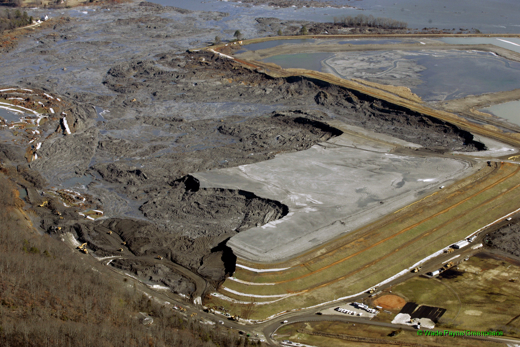
Closed Dale power station at Ford in Clark County among places affected
By Liam Niemeyer | Kentucky Lantern
Kentucky is one of a minority of states that produces most of its electricity by burning coal. A byproduct of that legacy today: creating millions of tons of what’s known as coal ash, a waste from burning coal containing a slew of toxic metals that’s often stored by utilities and power producers in impoundment ponds and landfills.
Without proper protections or cleanup at these coal ash sites, the ash can be blown into the air or seep into nearby groundwater. Coal ash impoundments failing have led to environmental disaster, such as when more than 1 billion gallons of coal ash slurry poured into the Emory River near Kingston, Tennessee, in 2008. More than 50 workers who cleaned up the aftermath died and more than 150 are sick after not having proper protection.
Such problems led the Environmental Protection Agency to issue rules in 2015 requiring the pits where the coal ash is stored to be lined and have dust controls and for the groundwater near operating coal-fired power plants to be monitored.
On Thursday, the EPA expanded those regulations to cover coal ash landfills and impoundments at retired or inactive coal-fired power plants as well, something environmental groups such as Earthjustice have called for. The agency is also seeking to regulate sites where coal ash has been disposed of outside of a regulated impoundment or landfill. The new coal ash rules are part of a number of other finalized rules that aim to dramatically curb greenhouse gas emissions and water pollution from coal-fired and gas-fired power plants.
The EPA states 194 “legacy” impoundments at 85 facilities across the country will be subject to the expanded coal ash rule, with 11 such sites in Kentucky at former coal-fired power plants including the Kenneth C. Coleman Generating Station, the William C. Dale Power Station, the Green River Generating Station, the Tyrone Generating Station and the Pineville Generating Station.
The federal agency notes some coal ash ponds at these former coal-fired power plants in Kentucky are closing or have closed under oversight from state officials, while the closure status is unclear for other sites. The EPA cites data from Earthjustice in its count of inactive coal ash sites that will now be regulated under the expanded rules. Earthjustice previously tallied the number of unregulated coal ash sites in Kentucky at 25.
Abell Russ, a senior attorney with the Environmental Integrity Project, told reporters earlier this week groundwater contamination from unlined, unregulated “coal ash dumps” can often go unaddressed because the sites are classified as an inactive or “legacy” coal ash site by the EPA, even when situated next to coal ash sites that are regulated.
“They’re not doing anything about it because they say it’s all coming from the older, larger ash pond that closed a long time ago, and so there’s no cleanup happening there,” Russ said. “This is a huge loophole.”
Russ said the EPA expanding regulations to coal ash ponds at retired or former coal-fired power plants will require utilities to monitor and improve groundwater at these sites, though enforcement capacity remains a concern.
Tom FitzGerald, a former long-time lobbyist for the environmental legal group Kentucky Resources Council, submitted a public comment about the rule urging the EPA to approve the expanded coal ash regulations, saying the exact number of unregulated, inactive coal ash sites was unknown because utilities aren’t required to report the total number of sites.
Never miss a thing with our FREE weekly newsletter.
“These dumps are almost certainly contaminating water and threatening health and the environment; however, monitoring data are not currently available for most unregulated sites,” Fitzgerald wrote. “It is appropriate and necessary that these legacy facilities be addressed and that they be required to be fully characterized and properly closed.”
Kentucky utilities in previous public comments on the coal ash rule have criticized the expanded coal ash regulations as unnecessary, expensive to ratepayers and disruptive to remediation already conducted at some sites under the oversight of state officials.
Clay Larkin, a lawyer for the Utility Information Exchange of Kentucky representing all of Kentucky’s major utilities, in a July 2023 public comment wrote that many of the “legacy” coal ash sites that would be newly regulated are “heavily revegetated” and would require “significant environmental impacts” to remove the coal ash.
“State-led closure efforts at many of these sites have accomplished careful management of existing risks and, in some cases, complete elimination of risk,” Larkin wrote. “In reaching specific closure decisions, states have balanced the concerns of, and impacts on, local and regional populations while limiting or eliminating environmental impacts to areas where site conditions are already well understood because of years of study and evaluation.”
In its final rule, the EPA explained that it could not exempt inactive coal ash sites that state officials have deemed as “closed” because of evidence that past state-approved closures were “significantly less protective” in preventing groundwater contamination.
