
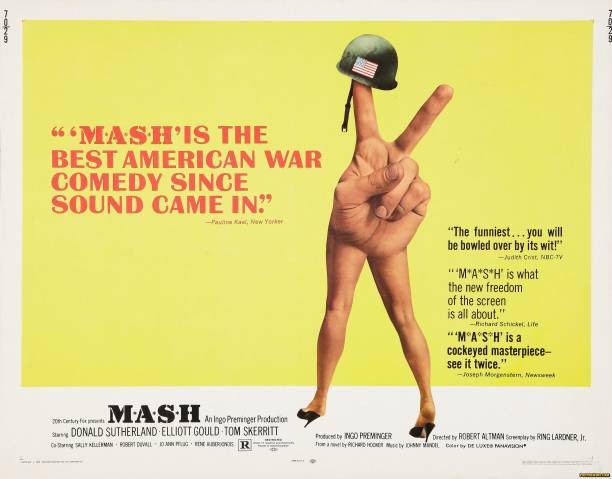

Capt. “Hawkeye” Pierce, Capt. “Trapper John” McIntyre, Maj. “Hot Lips” Houlihan, Maj. Frank Burns, and Cpl. “Radar” O’Reilly — familiar names to most of us as they were the major characters in the popular and long-running (1972−1983) television series M*A*S*H. But before the TV series there was the 1970 movie starring Donald Sutherland, Elliott Gould, and Sally Kellerman — today’s Reel Classic.
The setting is South Korea in the year 1951 in the midst of the Korean War. We find our characters assigned to the 4077th Mobile Army Surgical Hospital (aka M*A*S*H). Two new surgeons arrive at M*A*S*H in a stolen Jeep. We meet “Hawkeye” Pierce (Donald Sutherland) and Capt. “Duke” Forrest (Tom Skerritt). They may be somewhat insubordinate, prone to womanizing, and fond of pranks.
The commanding officer is Lt. Col. Henry Blake (Roger Bowen), an at times bumbling leader who is often rescued by his extremely competent chief clerk “Radar” O’Reilly (Gary Burghoff). Other members of the 4077th include Frank Burns (Robert Duvall), who is quite full of himself and not very competent, Margaret “Hot Lips” Houlihan (Sally Kellerman), the head nurse, and “Trapper John” McIntyre (Elliott Gould), who fits right in with “Hawkeye” and “Duke.”
Hawkeye and Duke are assigned to share a tent with Frank Burns, but quickly learn that they cannot tolerate him (nor he them). They manage to get Lt. Col. Blake to reassign Frank to another tent and welcome “Trapper John” to the “Swamp,” their nickname for their tent. The three become known as the “Swampmen.”

We learn that Frank Burns and Hot Lips are having an affair, and the Swampmen, with the assistance of Radar, slip a microphone into the tent of Hot Lips — and the passion between her and Frank is broadcast over the camp’s public address system. The incident leads to a confrontation between Frank and Hawkeye with Frank then being referred for a psychiatric evaluation.
We follow our characters throughout a variety of scenarios. M*A*S*H is episodic in its presentation, and other events include the unit’s dentist, Capt. “Painless” Waldowski, contemplating suicide, Hawkeye and Trapper John’s trip to Japan to perform surgery, and a football game organized by Lt. Col. Blake and Gen. Hammond of the 325th Evac Hospital.
Appearing as players in this game are famous pro footballers Fran Tarkenton and Johnny Unitas.
Though the setting is the war in Korea in 1951, director Robert Altman wanted to give the film a subtext relating to the current war at that time in Vietnam. Initially he had little reference to South Korea in the film, but the studio insisted that he identify the setting as Korea. The opening sequence identifies the setting as South Korea.
Altman saw the film as an anti-war statement and much of the country at the time was against the continued conflict in Vietnam.
The film was adapted from the 1968 novel MASH: A Novel About Three Army Doctors written by Richard Hooker. It was adapted for the screen by famous writer Ring Lardner Jr. However, a good bit of the dialogue, about 80% according to Tom Skerritt, was improvised. Some of the actors in the film had no previous movie or television experience, but were folks Altman found in various improvisational clubs. In the opening credits 13 of the 25 actors identified have the word “introducing” before their name.

Partly because of the popularity of the television series, the theme song from M*A*S*H, “Suicide is Painless,” is very well known. The music was written by Johnny Mandel, but interestingly the lyrics were written by Robert Altman’s fourteen-year-old son, Mike Altman. Robert Altman was paid $75,000 to direct the film. His son, because of the long-running TV show and syndication, has made $2 million for his efforts.
As mentioned above, a good deal of the dialogue was improvised, and a lot of attention went to the supporting cast. This did not sit well with Elliott Gould or Donald Sutherland. They both felt that they were not being given enough attention. They approached studio executives and asked that Altman be fired as director, unbeknownst to Altman. The studio refused, and after the film was released and received various accolades, Elliott Gould confessed to Altman what he and Sutherland had done. In an interview in 2009 Gould stated, “I think that, in hindsight, Donald and I were two elitist, arrogant actors who really weren’t getting Altman’s genius.”
Interestingly, M*A*S*H was one of two films released in 1970 that were satires of American wars. The other was Catch-22, set during World War II and based on the novel by author Joseph Heller. It was directed by Mike Nichols and starred Alan Arkin and Martin Balsam. Upon the release of both films, expectations were that Mike Nichols’ effort would be the more successful, especially after his success with the previous film The Graduate (1967). However, M*A*S*H was the more successful, leading Altman to hang a banner in his office that read “Caught-22.”
Upon its release M*A*S*H earned $41 million in 1970 and became the second highest grossing comedy of all time. And, it was the third highest grossing film of the year, with Love Story and Airport leading the way.
Critics’ reviews were very favorable.
Pauline Kael was very positive in her review: “MASH is a marvelously unstable comedy, a tough, funny, and sophisticated burlesque of military attitudes that is at the same time a tale of chivalry. It’s a sick joke, but it’s also generous and romantic — an erratic episodic film, full of the pleasures of the unexpected . . . I don’t know when I’ve had such a good time at a movie.”

The critic for The Hollywood Reporter described it as “the finest American comedy since Some Like It Hot.” The critic for Time wrote: “M*A*S*H, one of America’s funniest bloody films, is also one of its bloodiest funny films.”
M*A*S*H received five Academy Award nominations, including Best Picture, Best Director (Robert Altman), Best Supporting Actress (Sally Kellerman), Best Screenplay — Based on Material from Another Medium (Ring Lardner Jr.) and Best Film Editing. It won the Best Screenplay Oscar. The original music score written by Johnny Mandel also received a Grammy nomination.
The American Film Institute in 2007 ranked M*A*S*H at #54 on their list of Greatest Movies of All Time. Steven Schneider includes it in his “1001 Movies You Must See Before You Die.” Rotten Tomatoes Critics Consensus states: “Bold, timely, subversive, and above all funny, M*A*S*H remains a high point in Robert Altman’s distinguished filmography.” In 1996 it was selected for preservation in the National Film Registry by the Library of Congress.
As mentioned above, the film spawned the television series of the same name that became one of the most popular shows of its time and remains popular in reruns today. Gary Burghoff, who played Radar O’Reilly, was the only actor to carry over into the TV series.
Sylvester Stallone made one of his earliest film appearances in this film. He appears as a soldier sitting at a table having lunch about ten minutes into the film. He did not receive credit in the film and was about six years away from the fame Rocky would bring him.
Never miss a thing with our FREE weekly newsletter.
Another familiar face is that of Bud Cort. He is seen as Private Lorenzo Boone. He would find fame the following year starring with Ruth Gordon in the cult classic Harold and Maude.
The Internet Movie Database rates M*A*S*H at 7.3 of 10. Rotten Tomatoes gives it a Critics Score of 86% and an Audience Score of 82%. I could find no free streaming sites, but there is a copy of the DVD on the shelf at the Clark County Public Library.

I’ll finish with a quote from the review of Roger Ebert writing for the Chicago Sun-Times:
“Most comedies want us to laugh at things that aren’t really funny; in this one we laugh precisely because they’re not funny. We laugh, that we may not cry . . . We can take the unusually high gore-level in M*A*S*H because it is originally part of the movie’s logic. If the surgeons didn’t have to face the daily list of maimed and mutilated bodies, none of the rest of their lives would make any sense . . . But none of this philosophy comes close to the insane logic of M*A*S*H, which is achieved through a peculiar marriage of cinematography, acting, directing, and writing. The movie depends upon timing and tone to be funny . . . One of the reasons M*A*S*H is so funny is that it’s so desperate.”
Information for this Reel Classic review was gathered from sources including the Internet Movie Database (IMDb), Rotten Tomatoes, Turner Classic Movies (TCM) and Wikipedia.
Ron Kibbey’s Comedy Classics
If you enjoy these classic movies, please join Ron on the second Tuesday of each month at 6 PM at the Clark County Public Library for “Ron Kibbey’s Comedy Classics.” The evening features a classic comedy film, usually accompanied by a vintage cartoon. Popcorn and drinks are provided. More information about the next film is available on the library’s website and Facebook page, as well as WinCity Voices Facebook page.
