
In the garbage, I see beauty. In beautiful things, I see the garbage.
One cannot exist without the other.
~lexicographer, linguist, ontologist, and archaeologist Barbara Ann Kipfer
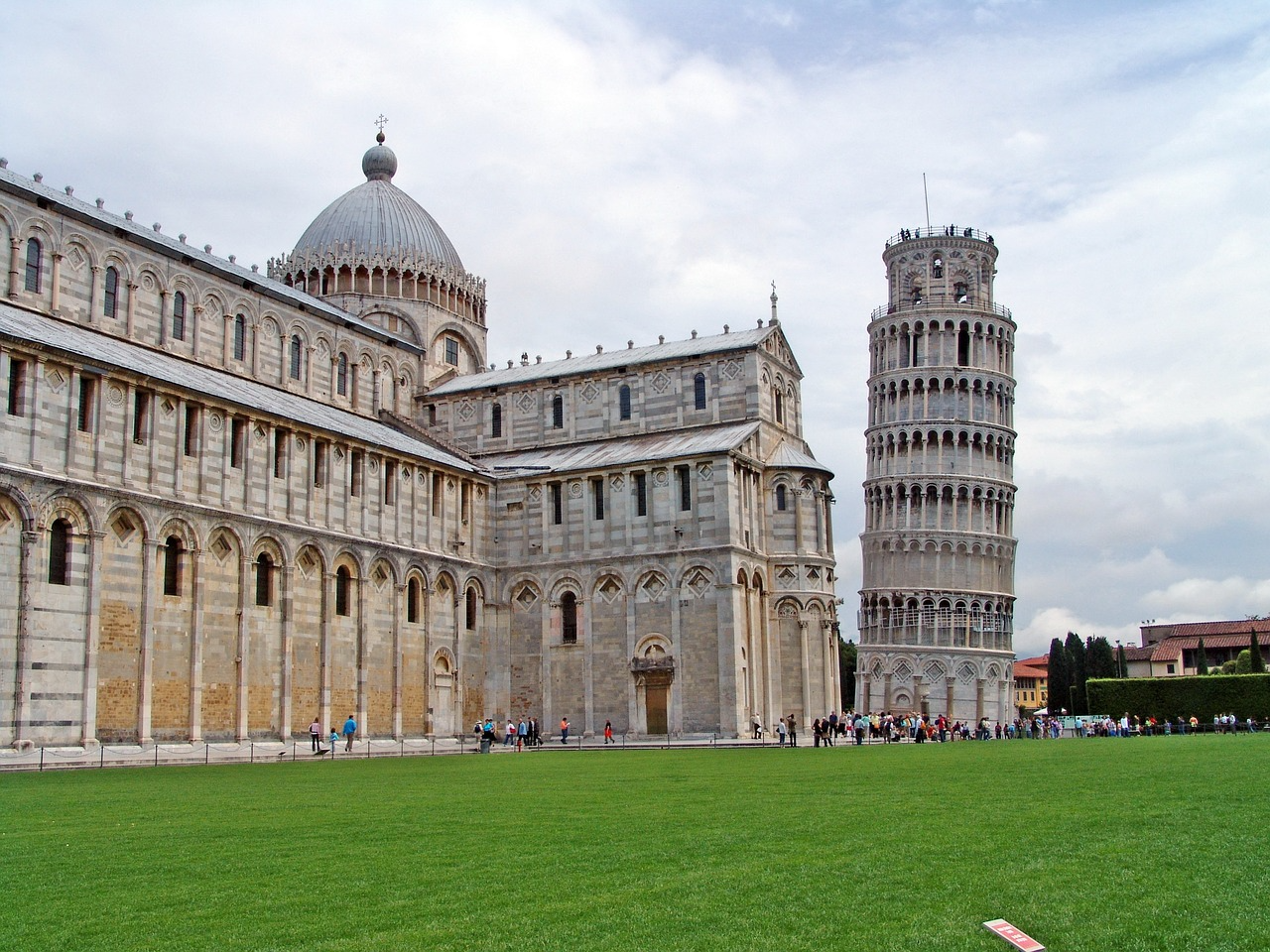
Construction of the Tower of Pisa began in 1173. The 58m-high bell tower, or campanile, took almost 200 years to build, and was already alarmingly leaning to one side when it was unveiled in 1372. The tower, made of heavy limestone and lime mortar, was built on dense clay, which was not a very stable place to build a 14,500-ton tower. The foundation started to sink into the soil on one end, ultimately causing the entire structure to list almost 5 degrees to the side.
Throughout the middle ages, it was considered an enormous failure by both the country and the Church. Since it was built as an extension of the town’s cathedral, it was seen as an affront to God.
And yet, it’s now one of the most visited sites in all of Italy and boasts more than 5 million visitors each year. That so-called “affront to God” currently pours more than 20 million euros into the local economy each year. I have been there twice, and long to return. I spent an entire afternoon on the great lawn before it, my head cocked like a golden retriever, a smile on my face. I drank aperol spritzes and burned my fingers on street panzerotti. I was mesmerized by the bell tower, couldn’t look away.
Success is contextual. Our culture is so focused on perfection we often overlook the benefits of failure. Failing well spurs creativity and cultivates resilience, two characteristics of a well-lived life. Sometimes it’s the imperfections that make something really stand out. Like karaōke that’s so off-key it’s charming. A well-placed freckle that adds interest to an otherwise flawless completion. Our favorite sleep shirts, with every hole and stain a story. Or a really old bell tower that cants adorably to one side.

Perfect just isn’t interesting. Our attention is drawn to things that stand out, not things that fit in. I have a Navajo rug that has a mistake in it, a random red square distorting the pattern of black circles. Then I learned that many Navajo artisans intentionally add these “mistakes” to highlight the imperfection of humanity. Either way, this rug is far more interesting than something mass-produced to perfection in a factory.
Never miss a thing with our FREE weekly newsletter.
Perfection isn’t natural either. Without genetic imperfections, there would be no evolution of any life form and all progeny would be identical to their ancestors. Humans have a very poorly designed skeleton. Our spines are much better adapted to walking on four legs than on two, but our insatiable curiosity about what might be over there created the necessity to stand. Our animal ancestors did struggle with bad backs, fallen arches, and painful live births, but they must have felt it a small price to pay for seeing farther afield. Our craniums are far too large to sit well atop the vertebrae, yet we certainly wouldn’t trade it for the smaller, less neurally connected brains of our ancient ancestors.
Perfect is limiting, because where do you go from there? Those people to whom everything is easy? They never learn the doggedness that comes from failing and trying again. Their lives are less full for not knowing wabi-sabi.
I suspect that true perfection doesn’t exist. It’s a lie we’ve been encultured to believe, but takes a lot of photo editing to keep the lie going. And if it does exist, it’s ephemeral, a dynamic and ever-changing event.
Because perfection and beauty are two different things. Beauty is relatable and authentic, while perfection is some unattainable ideal, Sisyphus rolling his boulder back up that hill. So build your towers, write your books, bake your cakes, tell your story, wear the bikini.
Strive for beauty instead of perfection. Hopefully what you leave behind will live in infamy.