
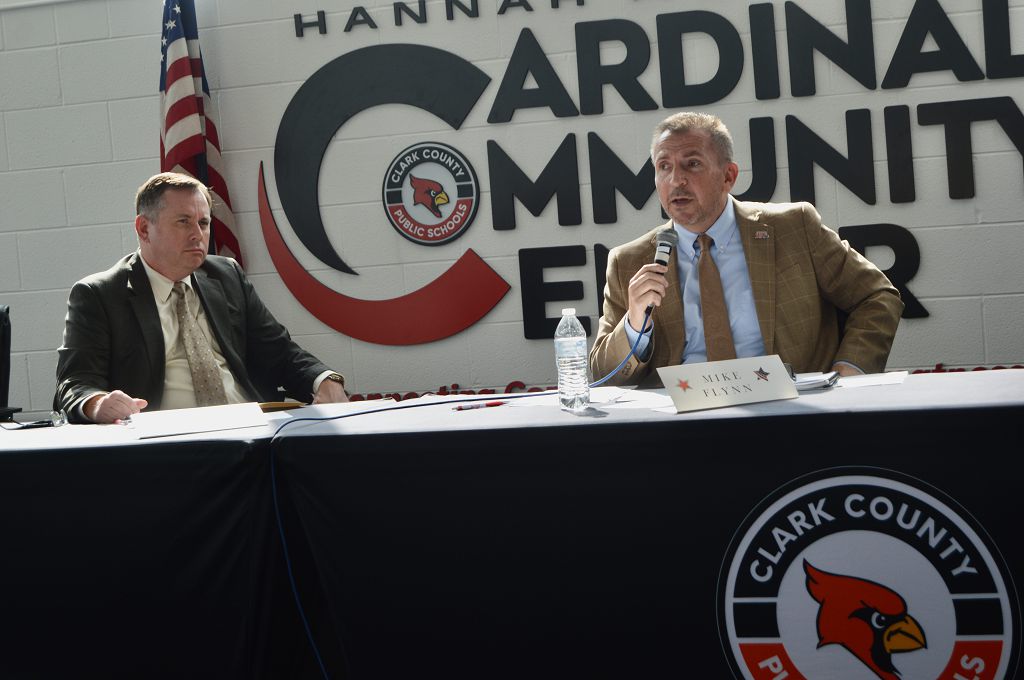
Clark County Republicans
Republicans running for local office in Clark County say they don’t want higher taxes. But during a candidates forum Saturday at the Cardinal Community Center, only two said unequivocally that they wouldn’t raise taxes regardless of conditions.
Those two were Magistrate Ernest Pasley, who is running for re-election in District 2, and Eric Vetter, a candidate for county judge-executive.
During the first part of the debate, District 2 candidates were asked under what circumstances they would consider a tax increase and what services they would consider reducing.
“OK, I don’t like either one of those,” Kelley Nisbet said, drawing laughter from the audience.
She said that no one could definitively say they would not raise taxes or cut spending until they’re in office and know the situation.
“I think everything needs to be on the table,” she said.
Bryan Howard, a retired firefighter, said he wouldn’t want to raise taxes, but he especially wouldn’t want to cut emergency services such as fire protection or law enforcement.
Pasley, however, was blunt.
“I will not raise your taxes,” he said.
Instead, he said, he would go to Frankfort or Washington, D.C., and “find the money” through state and federal grants.
‘Never say never’
“Anytime you say ‘never,’ it comes back and bites you,” Winchester City Commissioner Shannon Cox said later in the forum when the same question about raising taxes was presented to candidates for county judge-executive.
Cox said the county needs to consider every alternative first, but he wouldn’t rule out a tax increase if necessary.
“It would be the last thing I would ever do,” Magistrate Steve Craycraft said.
“I don’t think you can never say never,” candidate Justin Charles agreed.
But Vetter came close to saying it.
“I will say I wouldn’t raise taxes over the next four years if elected,” Vetter vowed.
Vetter said that, as judge-executive, he would focus on reducing the current tax burden and would let economic growth and grants cover any needed revenue increases.
Not the PVA’s job
Pasley said the current property valuation administrator had raised landowners’ assessments, so there was no need to increase rates as well.
PVA Jada Brady could not attend and speak for herself because she had the flu.
“I don’t believe in property taxes at all,” said her primary opponent, Allan Curtis.
Although doing away with property or ad valorem taxes would require a state constitutional amendment, Curtis vowed to lower property taxes by accurately and fairly assessing homes, businesses, and farms.
“The PVA’s job is not to generate revenue for local government,” he said, it is only to determine the fair market value of the property to be taxed.
Curtis said he doesn’t know which model Brady uses to determine values, but different methods yield different outcomes.
He also said he would like to meet personally with homeowners and let them make their case about home additions and other factors before they’re surprised by a big bill.
“You’ve got to engage people very early on,” he said.
‘Waste of money’
Although there was broad agreement on many questions during the three-hour forum hosted by the Clark County Republican Women’s Club and the Republican Party of Clark County, there also were a few differences.
For example, during the segment for the three primary candidates for District 2 magistrate, Pasley said one of his priorities would be having an ambulance in the Clark County fire station at Trapp.
His opponent, Howard, who is from Trapp and is an emergency medical technician, said, “that’s a waste of taxpayers’ money.”
Howard said there are too few runs in the area to justify having an ambulance at Trapp. But he said he had talked with Winchester Fire/EMS Chief Chris Whiteley about having an advanced EMT assigned to the firehouse there.
Nisbet, a real estate broker, criticized the Fiscal Court for buying a building for a third county fire station without first having an appraisal.
“I want to bring a strong commitment to accountability,” she said.
Pasley said one place he would look for savings would be the county jail.
“We spend more on the jail than we do on EMS, the fire department and our sheriff’s department combined,” he said.
In the past three years, he said, two illegal immigrants who needed dialysis cost the taxpayers “half a million dollars.” He would have had the feds come and get them and deport them.
Howard suggested there be a study to consider merging the city and county fire departments or finding ways to avoid duplication of services.
One of his priorities, he explained, is “making sure we use our tax dollars wisely.”
But Pasley said the county has already done two studies on fire service, in 2004 and 2009, and it doesn’t need to spend millions of dollars on another one that might suggest the city run the fire service for the whole county.

Where growth occurs
Where and how the county should grow was another point of contention.
“I want us to grow, but I do not want us to lose our rural atmosphere,” said Christy Bush, a longtime educator who is running for District 3 magistrate.
She said she has seen many recent high school graduates move away because they think there are no opportunities for them here, and she wants them to “find our community a place they can call home.”
Bush said one of the county’s priorities should be completing the eastern bypass, or Veterans Memorial Parkway, around Winchester and adding the utilities needed to develop that corridor.
She and the other candidate for District 3, Ben Moberly, both favor expanding the Winchester Industrial Park to provide good jobs and greater revenue for the county.
Bush said the park’s location near Interstate 64 and the Mountain Parkway is ideal, and that the county needs to take advantage of its potential.
To build more affordable housing, attract retail businesses and restaurants, and provide high-quality public education and services, industrial growth is essential.
“We have to keep that moving forward,” she said.
The park is nearing capacity.
“We still have 30 acres left, and I think we need to make sure those 30 acres are filled with the most … revenue-producing industries that we can find,” Moberly said.
But he also wants to make sure that companies given incentives to locate there are “going to be good stewards of our community and give back to our citizens as much as we give to them.”
In the debate between the 5th District candidates, incumbent Chris Davis and challenger Mike Flynn agreed that Clark County needs more growth, but differed about where it should occur.
Davis favors developing the U.S. 60 corridor east of Lexington, which the state plans to widen, and where the county is currently getting easements to expand sanitary sewer service, probably within the next year.
“I remain committed to improving our critical infrastructure so that we can set the stage for growth and prosperity in our county,” Davis said.
In response to a question about how to balance economic development with preserving the county’s rural, agricultural, and small-town character, Flynn said local governments should target the east side of the community where the new bypass is and work with WMU and other utility companies to put in place the infrastructure needed to locate commercial businesses and residential development there.
He said he doesn’t want to see Winchester become like Nicholasville, where one can’t see where Fayette County ends and Jessamine County begins. The city limits of Nicholasville and Lexington abut each other on U.S. 27.
“I do not want to be a bedroom community to Lexington,” Flynn said. “I would be in favor of growth on this end of the community and very structured growth on that end.”
Davis disagreed, saying the county needs to focus its growth in the northwestern part of the county because that’s where the industrial park is and where there is already infrastructure, such as the Strodes Creek wastewater treatment plant, rail, natural gas, and other utilities.
He indicated he wasn’t concerned about the loss of prime farmland in that area.
“We’ve got a very vigorous farm community, and I think it’s going to stay that way,” he said.
Merged government?
One issue Flynn and Davis agreed on was that there should not be a Winchester-Clark County unified government like that of Lexington-Fayette County.
“I am not in favor of merged government. I am in favor of integrating services,” said Flynn, who is a former city manager and currently interim city manager of Winchester.
Flynn said that delivering public services is becoming increasingly costly, and the Fiscal Court “needs to honestly assess where we stand financially and think creatively and collaboratively” with other community leaders about how to work together to “build a realistic road map towards goals that benefit Clark County as a whole.”
Davis said that the merged government had created “an enormous bureaucracy” for Lexington and Fayette County.
“I would argue that it hasn’t saved them a dime,” he said.
It certainly isn’t the answer for a community the size of ours, he added.
However, Davis said it is sometimes beneficial for the two governments to work together to provide services, and they already have multiple inter-local agreements to that end.
Next county judge
Candidates for county judge-executive also weighed in on the question of growth.
Vetter, a pharmacist and retired Navy captain, started the discussion by saying he is “the most pro-growth candidate” in the race.
Vetter said Clark County is “falling behind” its neighbors in population.
In the past 25 years, he said, Clark County has grown by a little more than 4,000 people, while Madison County has grown by 20,000 and Montgomery by 10,000.
What he wants, he said, is “not reckless growth, not paving over everything we love, but start preparing for intentional growth.”
That means having sites that are “build-ready” and utilities for those sites, he said.
“If we don’t choose how we grow, someone else might choose for us, and we may not like the results,” he said.
Vetter is one of five candidates for county judge-executive, including four who are vying for the Republican nomination. The office is currently held by Democrat R.J. Palmer, who was appointed by the governor to fill the vacancy created by the recent resignation of Judge Les Yates. Craycraft briefly served as interim county judge.
Whoever wins the GOP primary will face the lone Democrat in the race, Vaché King.
Craycraft has been a farmer, factory worker, small business owner, and commercial real estate investor.
“Farming is our number one industry in this county, and make no mistake about it, farming is economic development,” he said.
Craycraft, who called himself a “farm preservationist,” said local governments need to look at where “the real money” is. Many people mistakenly believe that residential development produces a significant amount of revenue, but studies have shown that for every dollar in tax revenue a residential development generates, it costs more than a dollar in public services.
“The real money that drives our community is in industry — the net profits tax and the payroll tax. That’s how you grow,” he said.

Data centers debated
A controversial issue nationally that county judge-executive candidates were asked was where they stood on allowing data centers to come into the community.
Data centers used for artificial intelligence generate significant tax revenue but also consume large amounts of electricity and water, which can raise utility rates for homeowners and businesses and create environmental problems.
Craycraft said it’s a “tough” issue that involves balancing property rights with the need to generate “a ton of money” for the county.
“I’m very much in favor of preserving the character of our beautiful county, but I can’t say I’m against it,” he said.
Charles gave a straightforward answer.
“I would vote for data centers,” he said. “I would vote for almost any industry … that would bring us more revenue, more jobs, and help our county to grow.”
“As an electrician, I know that they do put a load on our power grid,” Charles said, but he said the county could work with Clark Energy and Kentucky Utilities “to help them prepare for that.”
As a retired Navy captain, Vetter said he considers the strategic importance of artificial intelligence.

“If we don’t put the data centers in the United States somewhere, we’re going to lose out to China,” he said. “They’re going to become the next world leader in AI.”
It would make sense to put data centers here because of our county’s proximity to coal and coal-fired power plants, he said.
Vetter said he would welcome the centers.
So would Cox, a longtime city commissioner.
“Imagine what a billion-and-a-half-dollar project would pay in property taxes,” he said.
Imagine what 100 employees earning $75,000 to $150,000 a year would do for the county’s occupational tax revenue, he added.
“That is what they are able to contribute to your community,” he said.
‘Experience counts’
Yates, the county judge-executive who resigned to run for state representative, served in the state legislature once before, for a single term. His opponent is Magistrate Daniel Konstantopoulos, who had the microphone to himself Saturday because Yates didn’t attend.
“I don’t know the reason,” Yates canceled Friday night, said the moderator, Richard Nelson of the Commonwealth Policy Institute.
All the candidates had previously confirmed, according to Kim Clark Elkins of the Republican Women’s Club.
“You’re going to hear a lot about ‘experience counts,’” said Konstantopoulos, who is serving his third term on the Clark County Fiscal Court. “My opponent touts all his experience, but here’s the fact. He’s passed just as many bills as I have — zero.”
“I promise today that I will not propose the same bill he did, to take away your right to vote straight Republican,” he said, taking a dig at Yates, who co-sponsored a bill that would have done away with straight-ticket voting. Kentucky is one of the few states that allow straight-party voting rather than requiring voters to select candidates individually.
Asked what would be the first bill he would file as state representative for the 73rd District, Konstantopoulos said it would be a proposal to bring driver’s licensing back to every county.
A few years ago, the state took driver’s licensing away from the circuit clerks’ offices and created regional Department of Motor Vehicles offices to handle that role.
That approach isn’t working, Konstantopoulos said.
He said he would work with Sen. Greg Elkins, R‑Winchester, to “come up with a resolution for that problem.”
“I think it’s ridiculous,” he said, for a resident to have to drive to another city and “wait for hours to get a piece of paper,” and then later get their laminated license.
In response to a question about school choice, Konstantopoulos mentioned that his wife has been an educator in Clark County for more than 20 years. And although he supports funding for public education, he also supports “the parents’ right to choose where their kids go to school and how they’re educated.”
Never miss a thing with our FREE weekly newsletter.
In 2024, Kentucky voters overwhelmingly defeated a proposed constitutional amendment that would have used public funds to pay for children to attend private or charter schools.
As written, the Kentucky Constitution allows taxpayer dollars to be used only for “common schools,” which courts have interpreted to mean public schools.
Konstantopoulos said that as a state legislator, he would work to continue to cut the state income tax, create an environment conducive to small businesses, and secure infrastructure funding to promote economic growth.
“I am the only one in this race who truly understands how local government works, and I will be able to use that experience in Frankfort to draft commonsense legislation that helps us all,” he said.
Editor’s note: The debate was live-streamed on YouTube under the title 2026 Clark County Republican Candidates Forum — April 18th. However, because of technical issues, not all of the segments were fully recorded. You can view that video below.
