The John Holder Trail, located in Lower Howard’s Creek Nature & Heritage Preserve, is open for visitors Tuesdays and Thursdays from 9 a.m. to 1 p.m. About four-tenths of a mile in, the trail crosses the creek at the mouth of Deep Branch, then ascends a hill located in an oxbow of Lower Howard’s Creek. At several points along this climb, one can look down and see the creek on either side far below. A general name for his type of feature is “Devil’s Backbone.”
There is a Devil’s Backbone that was once a well-known local landmark in northeastern Clark County. It is located in an oxbow bend of Stoner Creek, about one mile northwest of Wades Mill. A good description was provided in the Clark County Chronicles (see footnote):
“In the rear of the old Alpheus Lewis mansion and between it and the Gay residence and the stone house of Rezin Gist, the creek makes a great bend and returns so close to the original point that the narrow ridge between, at its summit, is only wide enough for a wagon road, and one can stand on the top and throw a stone into the creek on either side. This narrow ridge has been known for generations as the Devil’s Backbone.”
Sadly, the historic Gay and Gist houses are gone, and at last report, Alpheus Lewis’ “Oakwood” was in poor condition. The Chronicles continued:
“On the east bank of Stoner at the Backbone, Alpheus Lewis had a large mill and a distillery that produced whiskey under the brand of A. Lewis & Son. When Lewis died there were forty barrels of whiskey left in the warehouse. Half the stock was purchased by an unscrupulous rectifier, a blender of whiskeys. He was reported to have put a spoonful of this into more than 50,000 barrels of cheap whiskey. He then sold his blended whiskey, with the label “A. Lewis & Son’s, Clark County, 1866,” at hotel bars all over the country bearing large gilt signs with this name.”
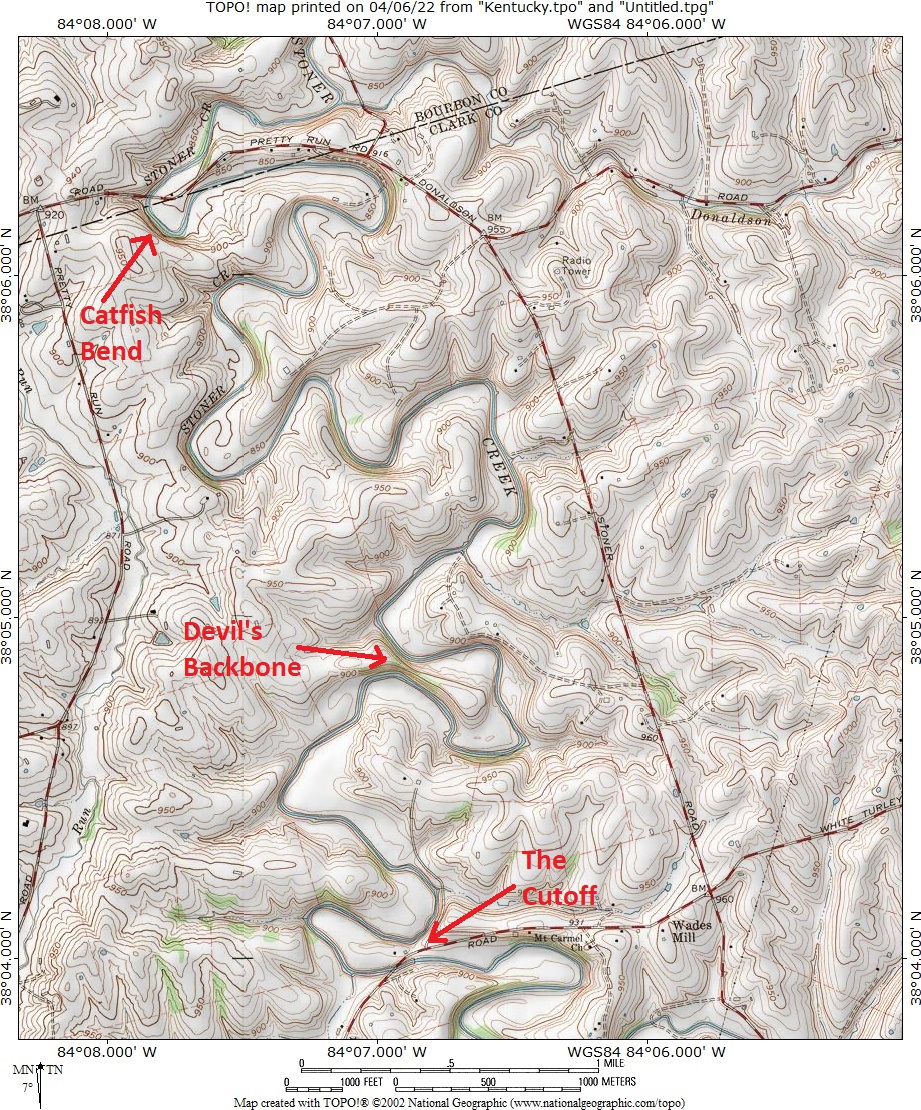
Devil’s Backbone is shown on the map below. As you can see, it is not accessible from Wades Mill Road. There are two other similar features on Stoner Creek that one can actually drive through.

The Chronicles article described one of these, located about a mile west of Wades Mill, known as the “Cutoff,” where the creek could be forded. You can access the Cutoff today on Wades Mill Road (see map).
“In high water the stream had ages before washed out the channel down to the limestone rock and through which the high water flowed with great swiftness, in fact with such a strong current that travelers were unable to ford it on horseback. The ford mentioned was the only place near by where the stream could be forded and this of itself gives some idea of the great size of this stream before the deforestation of the country which it drains.”
There is one more drive-through feature on Stoner Creek, another oxbow accessible via Big Stoner-Pretty Run Road. It lies on the Clark-Bourbon border and is labeled “Catfish Bend” on a 1926 Clark County map. The ridge here narrows to less than 500 feet. No idea where the name comes from. A noted fishing hole?
Never miss a thing with our FREE weekly newsletter.
Strodes Creek also has a number of oxbows, the most prominent one you can drive through is on Route 627 about two-thirds of a mile north of the Bourbon County line. This was the site of a well-known early [1788] gristmill. Again, according to The Chronicles:
“Just across the Clark line in Bourbon, and in fact in sight of the line, was a very noted mill and probably the largest one in pioneer days, massively built of stone and known in early history as Hornback’s Mill and afterwards for three-quarters of a century as Thatcher’s Mill. It was situated in the big bend of Strode’s Creek, through which the mill race ran, connecting the two sections of the creek forming the bend and was within a few hundred feet south of the covered bridge at that point. The old mill was only torn down a few years ago.”
The best time to visit these features is in winter or early spring before dense foliage obscures the views. Get yourself a map and go exploring soon!
Originally published in The Winchester Sun, these columns were written in the 1920s by the Clark County Historical Society. The Chronicles have been recently edited by Rosemary Campbell and republished by the Bluegrass Heritage Museum.