
Hooray Jake, hooray John
Breakin’ up Christmas all night long
Santa Claus come, done and gone
Breaking up Christmas right straight along
Don’t you remember a long time ago
The old folks danced the doesey-doe
~Bluegrass standard Breaking Up Christmas, author unknown
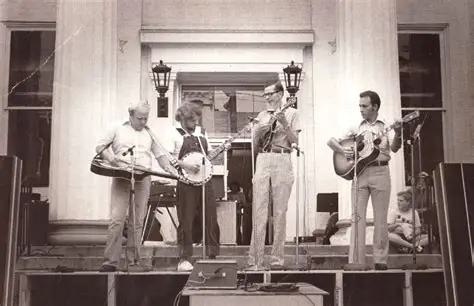
When I was in high school, I played the violin (quite poorly, to be honest) in the GRC Orchestra. I was always breaking my strings, and my mother would take me to her friend Homer Ledford to get them fixed up. I had no idea that Homer was a world-famous luthier, or maker and inventor of stringed instruments (several of his instruments are even in the Smithsonian).
Anyway, Homer invited us to a “Breaking Up” party one year during Christmas break (I think it was at his house, but he was there regardless). I assumed someone had broken up with their girlfriend, and the party was to cheer them up. Everyone brought an instrument or a dish to share. There was mulled wine, a cozy blaze in the fireplace, and lots of bluegrass music.
Well, it took more than 30 years, but I finally learned what a “Breaking Up” party is. And it starts with the history of the Gregorian calendar.
In the Christian calendar, January 6 is known as Epiphany, or the Twelfth Day of Christmas, marking the visit of the Magi to the baby Jesus. In many Appalachian communities, this day is understood as the true birthday of Jesus. As written in the 1917 book Old Christmas and Other Kentucky Tales in Verse, “Old Christmas occurs on the 6th of January as it did in England before the change in the calendar in the eighteenth century, and as it still does in lands spiritually controlled by the Greek Church.”
You see, in 1582, Pope Gregory XIII introduced the Gregorian calendar to correct inaccuracies in the Julian calendar, which had been used since Roman times. This reform shifted dates slightly, so that feasts and seasons aligned more closely with astronomical events like the winter solstice.
Never miss a thing with our FREE weekly newsletter.
Not everyone adopted the new calendar immediately, because they didn’t have a way of learning about it. Most rural and isolated communities maintained older liturgical traditions that celebrated Christ’s birth according to the “Old Style” calendar, which placed it on January 6. In this sense, celebrating Jesus on January 6 was not a deviation, but a continuation of a centuries-old Christian practice.
For early Appalachian families, the date was less about exact calculations and more about faith. The Twelve Days of Christmas became not just a single moment, but a whole season. And a whole vibe. Houses were decorated, fires kept burning, and families gathered in fellowship, extending the joy of Christmastide beyond December 25.
Several generations later, many mountain communities still keep spirits bright long after December 25 has passed. They call it Breakin’ Up Christmas, a rolling celebration that stretches from Christmas Day through Twelfth Night. It isn’t about taking a break from the holidays but rather breaking it into twelve small, shining pieces. Twelve nights to gather, eat, dance, and play music. Twelve nights to carry folks through the hardest part of winter.
I’m pretty sure I attended one of these festive jams that year. Breaking Up Christmas is more than an Appalachian custom. It is a testament to the enduring genius of mountain people, who have always known that the antidote to darkness is community. It’s a reminder that joy is not tied to a single day on the calendar, but is, instead, a season of presence, connection, and light in the darkness.
The Appalachian Epiphany teaches us that the deepest celebration comes not from schedules, not from presents, not from the calendar, but from being together, keeping faith, and carrying light into the long nights. In the hollers of the mountains, on the Twelfth Day, the spirit of Christmas stretches on alive, radiant, and eternal.