Indian Old Fields is one of the most historic places in Clark County. Geographically situated in the extreme eastern end of the county, it is a 3,500-acre plain of fertile soils perched between Lulbegrud Creek and Upper Howard’s Creek. The area can be reached from Winchester by Highway 15 or the Mountain Parkway.
Native Americans occupied this area for thousands of years. Archaeologists have identified over 50 significant prehistoric and historic sites at Indian Old Fields including villages, hunting camps, mounds, earthworks (“sacred circles”), and stone graves. The Goff Village Site, recognized as an outstanding example of a Fort Ancient circular village, is listed on the National Register of Historic Places.

Eskippakithiki, the only Indian town in the interior of Kentucky shown on Lewis Evans’ 1755 map, has long been thought to have been at Indian Old Fields. Another map from about the same period shows a “Shawna Town” in roughly the same location. Both maps show the famed Warrior’s Path, which connected the northern and southern tribes, passing through the town.
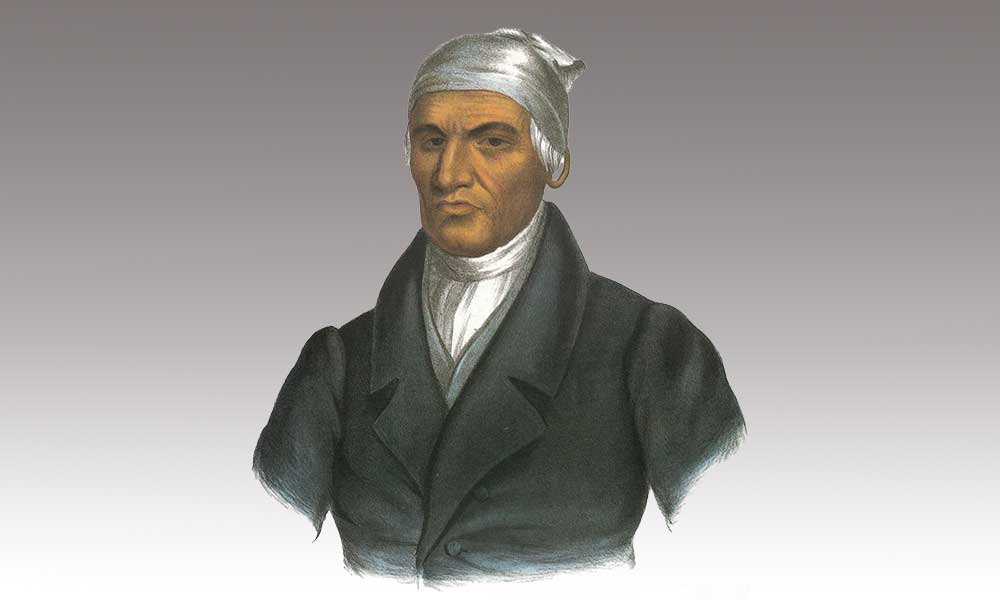
By far the most important person associated with Indian Old Fields is Catahecassa, known to the whites as Black Hoof. He was a principal chief of the Shawnee for over 50 years. Black Hoof was a celebrated orator, had a commanding presence, and was one of their fiercest warriors. He was said to have fought in every important Shawnee battle from Braddock’s War in 1755 to their defeat at the Battle of Fallen Timbers in 1794. When he signed the peace treaty at Greenville (1795), he vowed never to fight the whites again—a promise he faithfully kept. Black Hoof argued against the confederacy of Tecumseh and his brother Tenskwatawa and was able to keep many of the Shawnee out of an alliance with the British during the War of 1812.


An 1816 article in the Lexington Reporter stated that “The celebrated chief Blackhoof, long distinguished by his attachment to our government, and three others we understand are on a visit in Bourbon county.”
Leaving Bourbon County with an interpreter, Black Hoof then visited Indian Old Fields. A number of local residents told of seeing him. According to Jesse Daniel, “In his speech, he told about the country then. Said that they had had a town there till one year before Braddock’s war, at the old fields. My understanding is somewhere in Mrs. Gough’s [Goff] farm that this old man had once lived there. That then some tribe from the south—I think the Catawbas—proving too hard for them, they had been obliged to remove.”
Never miss a thing with our FREE weekly newsletter.
Joseph Ficklin described his valuable conversations with Black Hoof: “When Black Hoof arrived in Kentucky in 1815, he supposed his age to be 109 and those who conversed with him had the utmost confidence in his statements. He could tell his age to be 50 when Gen. Braddock was defeated and many points of History to confirm his story. Although he had not been at Lulbegrud for about 100 years he could describe the face of the Country & the Creek. When approaching the spot within a few miles his recollection improved & he pointed out the spot & country around before he was in sight. His activity was equal to that of most men at 80. He road well & could walk without a staff.”


Black Hoof counseled the Shawnee to adapt to the white men’s ways and seek legal titles to their Ohio lands. He visited Washington, D.C. on four occasions, once in 1802 to ask President Jefferson for help obtaining farming implements and livestock:
“Brother, We beg your assistance in geting all necessary Farming tools & those for building houses that we may go to work as quick as possible. It is the wish of all our Brothers and likewise to furnish us with some domestick Animals. It is our desire to live like good Brothers & good neighbors, as long as the Grass grows & the water runs in the rivers.”
Black Hoof died in 1831 at Wapakoneta, Ohio. In spite of all his efforts to hold onto the Shawnee lands in Ohio, almost immediately following his death in 1831, President Andrew Jackson ordered the Shawnee to be removed to Kansas.
Black Hoof has been commemorated by monuments at numerous locations. Sadly, there are none to be found at Indian Old Fields.