
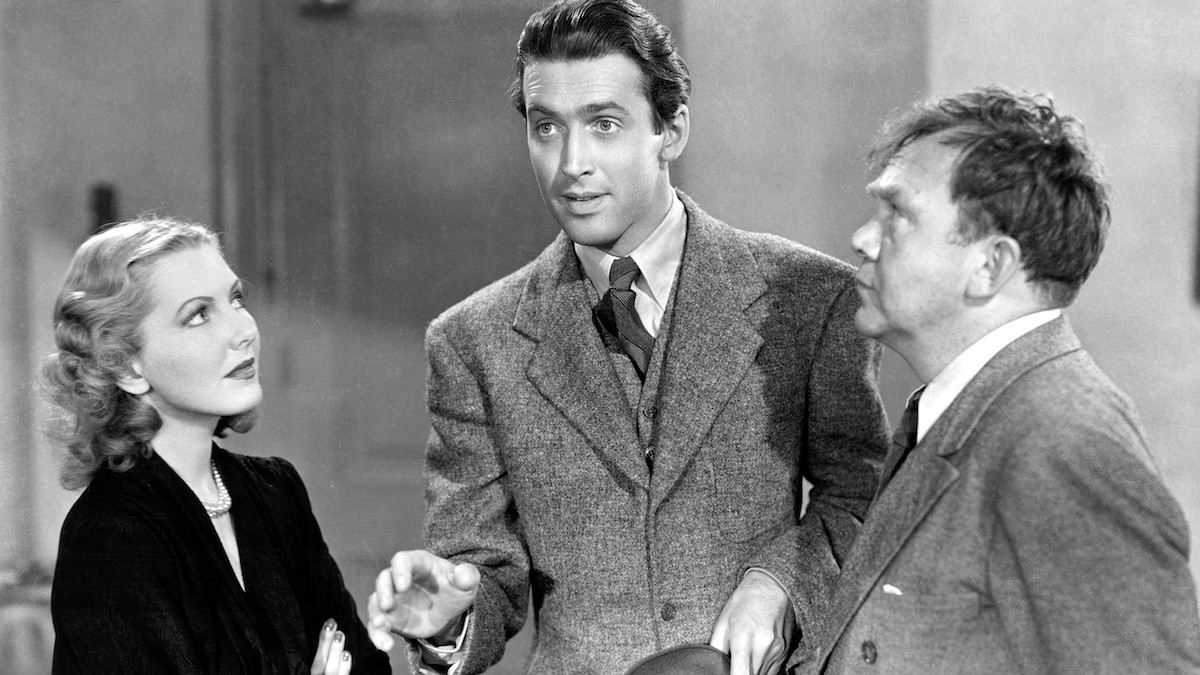

Now that the midterm elections have brought significant change to Washington, it seems an appropriate time to revisit one of Frank Capra’s classics — Mr. Smith Goes to Washington.
The setting is the late 1930s and a senator representing one of the western states has died. Governor Hopper (Guy Kibbee) is to appoint a replacement and has decided on the rather naïve Jefferson Smith (James Stewart), head of the Boy Rangers. He had been chosen because of his lack of political experience and the belief by the political leaders that he could be manipulated.
Arriving in Washington, Smith is awed by the city and the historical monuments and is quickly taken under the wing of Senator Joseph Paine (Claude Rains), who was a friend of Smith’s late father. The local press see him as a “country bumpkin” and ridicule him in the papers.
Senator Paine suggests that Smith propose a bill and, with the assistance of his secretary, Clarissa Saunders (Jean Arthur), he develops a bill that would have the federal government provide a loan to buy land in Smith’s state to create a national boys’ camp. Clarissa Saunders was the secretary for the previous senator and is well-versed in the legislative and political workings in Washington.

Unknown to Smith, the site for the proposed camp is already included in the Senate appropriations bill developed by Senator Jim Taylor (Edward Arnold) and supported by Senator Paine. The site is slated for a dam-building project that is part of a corrupt graft scheme. Paine tells Senator Taylor that he wants out of the scheme, but Taylor reminds Paine that his influence is essential to Paine’s success in Congress.
Paine approaches Smith and advises him to be silent on the matter, but Smith refuses. An attack is arranged by those corrupt officials that falsely accuse Smith of owning the land and profiting from the proposed legislation. Smith is devastated to learn that he has been betrayed by Senator Paine.
However, Clarissa Saunders, the secretary with experience in the political arena, convinces Smith to filibuster in an effort to postpone the appropriations bill and to proclaim publicly his innocence.
Though at first she was skeptical of Jeff Smith, she has come to appreciate his sincerity and commitment to act on behalf of others. Supported by Clarissa from the gallery, Smith launches into his hours-long speech, attempting to sway the opinions of the Senators and build the support of his constituents. He also attacks the efforts of corruption by government officials.
Will Smith be able to convince his colleagues and constituents that he is innocent of the charges leveled at him? Will he be able to see the Boy Rangers Camp that he has proposed? Will the growing support of Clarissa develop into something more?
As usual, no spoilers.
Mr. Smith Goes to Washington was a controversial film when released in 1939. The film’s story was based on an unpublished story written by Lewis R. Foster called “The Gentleman from Montana.” Foster’s story was loosely based on Senator Burton K. Wheeler, who had similar experiences while investigating the Teapot Dome scandal of President Warren G. Harding’s administration.
The film was attacked by a number of politicians who claimed it was disrespectful of the government. The U.S. Ambassador to Great Britain, Joseph P. Kennedy, requested that the film not be distributed for viewing in Europe, saying he was concerned the film would damage “America’s prestige in Europe.”
The New York Times reported that “the Boy Scouts of America objected to having any part in Mr. Capra’s reform movement” and therefore he had to use the name Boy Rangers in the film. Interestingly, the film was banned in Germany, Italy, and Spain over fear that it showed democracy works.

Along with the above-mentioned actors, the film also starred Thomas Mitchell as Diz Moore, Beulah Bondi as Ma Smith, Harry Carey as President of the Senate, and William Demarest as Bill Griffith. Many of these actors and actresses appeared in multiple Frank Capra films.
Originally Frank Capra had obtained the story and saw it as a sequel to his film Mr. Deeds Goes to Town (1936), which starred Gary Cooper and Jean Arthur. It was tentatively titled Mr. Deeds Goes to Washington. However, Gary Cooper was not available, so James Stewart was brought in and the character was changed to Mr. Smith.
Capra was reportedly pleased with having James Stewart, saying “I knew he would make a hell of a Mr. Smith. He looked like the country kid, the idealist. It was very close to him.”
Because of fear that in retribution Congress might pass legislation that would be punitive to Hollywood, some film studios offered Columbia, Capra’s studio, $2 million to not release the film. Columbia chose to release it anyway, and it became the second highest-grossing film of 1939 and the fourth highest-grossing film of the 1930s.
Not only was it well-received by the viewing public, it also won much attention at the Oscars. Mr. Smith Goes to Washington was nominated for eleven Oscars, including Best Director (Frank Capra), Best Actor (James Stewart), Best Supporting Actor (Claude Rains and Harry Carey), and Best Writing (Lewis R. Foster). The competition was difficult that year, including Gone with the Wind, Goodbye, Mr. Chips, Stagecoach, and The Wizard of Oz. It did come away with the Oscar for Best Writing.
It was the first film to receive two Best Supporting Actor nominations (Rains and Carey), but they lost to co-star Thomas Mitchell for his role in Stagecoach.
The American Film Institute ranks Mr. Smith Goes to Washington at #5 on their list of 100 Most Inspiring Movies of All Time and #26 on their list Greatest Movies of All Time. Steven Schneider has included it in his “1001 Movies You Must See Before You Die.” The Critics Consensus on Rotten Tomatoes reads, “Mr. Smith Goes to Washington — and returns with an uplifting ode to idealism that distills the strengths of its director and leading man.”
In 1989 it was preserved in the National Film Registry.

In an article in The Washington Post in 2020, film critic Ann Hornaday ranked the film as #1 of the Best Political Movies ever made. She wrote, “Have you watched it lately? You should. (And by ‘you,’ we mean every sentient being on Capitol Hill.) Frank Capra’s classic is still the granddaddy of America’s small‑d democratic, participatory ideals. And James Stewart’s portrayal of a small-town nobody and his quixotic battle against self-dealing politicians still claims pride of place as Hollywood’s most stirring, convincing and timeless reminder that the Constitution is a sacred trust that all American citizens — and their representatives — have responsibility for bearing.”
Ron Kibbey’s Comedy Classics
If you enjoy these classic movies, please join Ron on the second Tuesday of each month at 6 PM at the Clark County Public Library for “Ron Kibbey’s Comedy Classics.” The evening features a classic comedy film, usually accompanied by a vintage cartoon. Popcorn and drinks are provided. More information about the next film is available on the library’s website and Facebook page, as well as WinCity Voices Facebook page.
In 1949 Columbia studio planned a sequel to the film called Mr. Smith Starts a Riot but it never got off the ground. In 1952 a similar fate occurred with a remake that would star Jane Wyman in the lead role.
Get the book! "Our Stories, Our Voices: A 5-Year Anniversary Collection."
Mr. Smith Goes to Washington came to television as a series that ran from 1962–1963. It starred Fess Parker (of Davy Crockett and Daniel Boone fame) along with Sandra Warner and Red Foley. There have also been a couple of “loose” remakes including Billy Jack Goes to Washington (1977) which was produced by Frank Capra’s son, Frank Capra Jr., and The Distinguished Gentleman (1992) starring Eddie Murphy.
The Internet Movie Database (IMDb) rates the film at 8.1 of 10. Rotten Tomatoes gives it a Critics Score of 97% and an Audience Score of 94%. Searching my Roku device, I found the film available for free streaming on Tubi and there is a copy of the DVD on the shelf at the Clark County Public Library.

Looking back at the character Jefferson Smith, we may find him to be naïve and idealistic upon his entry into the hallowed halls of the U.S. Senate. However, we will also find that his idealism was a strength in his fight to do what he believes to be right. He courageously spoke up and spoke out for what he believed. I will leave you with the following quote from his filibuster speech.
“Just get up off the ground, that’s all I ask. Get up there with that lady that’s up on top of this Capitol dome; that lady that stands for liberty. Take a look at this country through her eyes if you really want to see something. And you won’t just see scenery; you’ll see the whole parade of what Man’s carved out for himself, after centuries of fighting. Fighting for something better than just jungle law, fighting so’s he can stand on his own two feet, free and decent, like he was created, no matter what his race, color, or creed. That’s what you’d see. There’s no place out there for graft, or greed, or lies, or compromise with human liberties.”
That was from a film made in 1939. Still rings true today, don’t you think?
Information for this Reel Classic review was gathered from sources including the Internet Movie Database (IMDb), Rotten Tomatoes, Turner Classic Movies (TCM) and Wikipedia.
