
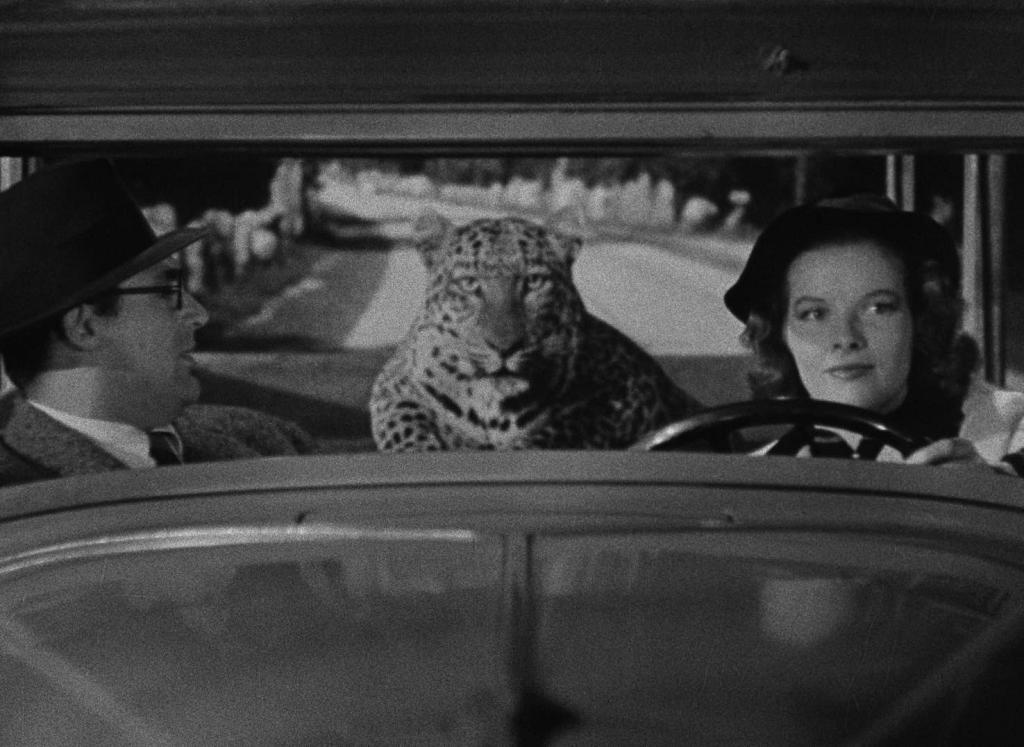

Today’s Reel Classic is one of the definitive screwball comedies of the 1930s. Bringing Up Baby, released in 1938, came to theaters during a period in our history when audiences were seeking escape from the everyday turmoil brought on by the Depression.
Laughter is a very healthy form of escape, and this film is filled with laughs.
It stars Cary Grant as David Huxley, a meek and mild-mannered paleontologist who has been working for years in a museum assembling the skeleton of a Brontosaurus. His task is almost completed but he is missing one bone. He is engaged to be married to Alice Swallow, a rather serious, no-nonsense woman. He is also hoping to impress the wealthy Elizabeth Random (May Robson), a potential million dollar donor to the museum.

He happens upon a young woman on the golf course who appears to be a bit of a free spirit and a bit scatterbrained as well — very much unlike the other women in his life.
This chance meeting begins a series of events that bring David Huxley and this young woman, Susan Vance (Katherine Hepburn), together. She shares with David that her brother has sent her a present from Brazil — a tamed leopard named Baby. She convinces David to help her escort Baby to her farm in Connecticut. He learns that when the leopard gets anxious it is calmed by singing the song “I Can’t Give You Anything But Love, Baby.”
By the time they make it to the farm, Susan finds that she has fallen in love with David and plots to keep him from leaving the farm and prevent him from marrying another. She goes so far as to hide his clothes and he is forced to wear Susan’s négligée.
As embarrassing as this may be for David, circumstances take a turn for the worse when Susan’s aunt shows up at the house and finds David in the négligée. Is this bad enough? It only gets worse!
David learns that Susan’s aunt is Elizabeth Random, the potential million dollar donor to the museum. And it doesn’t stop there. While at the house, the missing bone for the Brontosaurus has been delivered to David Huxley. Aunt Elizabeth’s dog George finds it and takes a liking for it — burying the bone for later.
At the house we also meet Major Horace Applegate (Charlie Ruggles), a big-game hunter and Aloysius Gogarty (Barry Fitzgerald), Elizabeth Random’s gardener.
The adventures (or more appropriately misadventures) continue when Baby escapes the farm and a local zoo is contacted to help find the leopard. David and Susan try to find Baby before the zoo keepers do so and end up mistakenly freeing a leopard from a nearby circus. They get arrested by the local constable who, hearing their stories, begins to doubt their sanity.
The chaos continues as the others from the farm house appear at the jail, adding to the confusion and leading the constable to wonder about the sanity of them all.
It doesn’t end here by any means, but I will stop with the story so as to provide no spoilers.

This was Katherine Hepburn’s first comedy film. The director, Howard Hawks, brought in several veteran vaudeville comedians to help coach her.
One of those who worked with her was Walter Catlett, who also portrayed Constable Slocum in the film. Reportedly Harold Lloyd also assisted in the coaching of Hepburn. Harold Lloyd was a veteran of silent comedy films and was well known for his naïve, meek character portrayal. Hawks reportedly asked Cary Grant to model his appearance and performance in the style of Lloyd (which included the wearing of glasses).
One particular interesting story about the filming was that Katherine Hepburn had a habit of talking — a lot. Often she would ignore the pleas for “Quiet!” and continue talking.
Once when this occurred on the set, Hawks motioned to the rest of the crew to stop what they were doing. Hepburn finally realized she was the only one talking and asked “What’s the matter?” Hawks informed her that she just keeps on talking so they would just sit back and watch.
Upset with him, she told Hawks that he shouldn’t talk to her like that as she had a lot of friends on the set. Hawks reportedly looked up at an electrician working on a scaffold above them and said “If you had a choice of dropping a lamp on Miss Hepburn or me, who would you drop it on?” The electrician responded by telling Hawks to move out of the way.
Hepburn said “I guess I’m wrong.” They never had the problem again.
Another interesting story is the relationship between Hepburn, Grant, and Baby. Hepburn was reportedly comfortable around the leopard and even petted it. However, Cary Grant was not comfortable and most of the scenes featuring Grant and Baby utilized special effects or a double for his character. Katherine Hepburn played a prank on Grant one day by putting a stuffed leopard in a vent in his dressing room. She stated that when he saw it “He was out of there like lightning.”
Fans of the Thin Man films with William Powell and Myrna Loy may recognize the dog George. He also appeared as the dog Asta in those films. His real name was Skippy and he did rather well in Hollywood — earning $250 a week for his efforts.
Bringing Up Baby was greeted with mixed reviews.
The critic for Variety praised Howard Hawks’ direction and described Hepburn’s performance as “one of her most invigorating screen characterizations.” The reviewer for Film Daily described the film as “literally a riot from the beginning to end, with the laugh total heavy and the action fast.” The New Yorker critic complimented both Grant’s and Hepburn’s performances.
But The New York Times critic was not so kind, describing the film as “derivative” and “cliché-ridden.” He also was critical of Hepburn’s performance, describing it as “breathless, senseless, and terribly, terribly fatiguing.”

The film did not fare as well at the box office as the studio had hoped. It did well in some cities on both the East Coast and West Coast, but not so well in New York City. The box office return was also disappointing in the Midwest.
Because the studio deemed Bringing Up Baby a commercial failure they released Howard Hawks from his contract with RKO. However, he was destined to work again on screwball comedies with Cary Grant in His Girl Friday (1940) and Monkey Business (1952).
Grant and Hepburn would also reunite in Holiday (1938) and The Philadelphia Story (1940).
As with many classics, the popularity of this film increased over time. One of the precipitators of the rise in popularity was its arrival on television in the 1950s, as it developed a new audience of folks appreciative of the humor.
Famed film critic Leonard Maltin wrote that Bringing Up Baby is now “considered the definitive screwball comedy, and one of the fastest, funniest films ever made; grand performances by all.”
Sheila O’Malley, a writer for the Criterion described the rise in popularity: “Bringing Up Baby was rediscovered in the fifties and sixties with the advent of television . . . . The film quickly shot to the top of everyone’s list as one of the funniest comedies of all time. Its initial reputation as a flop continues to puzzle, and points to the pitfalls of deciding what is or is not a classic in real time. Sometimes you just have to wait. Hawks lived to see his film vindicated.”
At the time of the film’s release, Howard Hawks was disappointed in the movie’s reception. He attributed it to the characters all being “madcap” with no “normal” people. However, many today consider it to be his best film.
The Critics Consensus at Rotten Tomatoes states: “With Katherine Hepburn and Cary Grant at their effervescent best, Bringing Up Baby is a seamlessly assembled comedy with enduring appeal.”
In 1990 Bringing Up Baby was selected for preservation in the National Film Registry of the Library of Congress. It is also listed in the American Film Institute’s listing of Top 100 Greatest American Movies (#97) and Top 100 Funniest American Movies (#14). Steven Schneider includes it in his book “1001 Movies You Must See Before You Die.”

The Internet Movie Database (IMDb) rates Bringing Up Baby at 7.8 of 10. Rotten Tomatoes gives it a Critics Score of 97% and an Audience Score of 89%.
Never miss a thing with our FREE weekly newsletter.
I found the film available for streaming on the Kanopy site (free with your Clark County Public Library card). There is also a copy of the film on DVD at the library.
I will put a wrap on this review by again referencing the Criterion site in their description of Bringing Up Baby:
“Screwball sparks fly when Cary Grant and Katherine Hepburn let loose in one of the fastest and funniest films ever made — a high-wire act of invention that took American screen comedy to new heights of absurdity . . . Bringing Up Baby’s sophisticated dialogue, spontaneous performances, and giddy innuendo come together in a whirlwind of comic chaos . . ..”
Need I say more?
Information for this Reel Classic review was gathered from sources including the Internet Movie Database (IMDb), Rotten Tomatoes, Turner Classic Movies (TCM) and Wikipedia.
Ron Kibbey’s Comedy Classics
If you enjoy these classic movies, please join Ron on the second Tuesday of each month at 6 PM at the Clark County Public Library for “Ron Kibbey’s Comedy Classics.” The evening features a classic comedy film, usually accompanied by a vintage cartoon. Popcorn and drinks are provided. More information about the next film is available on the library’s website and Facebook page, as well as WinCity Voices Facebook page.
