
What does it take to be an effective county judge-executive?
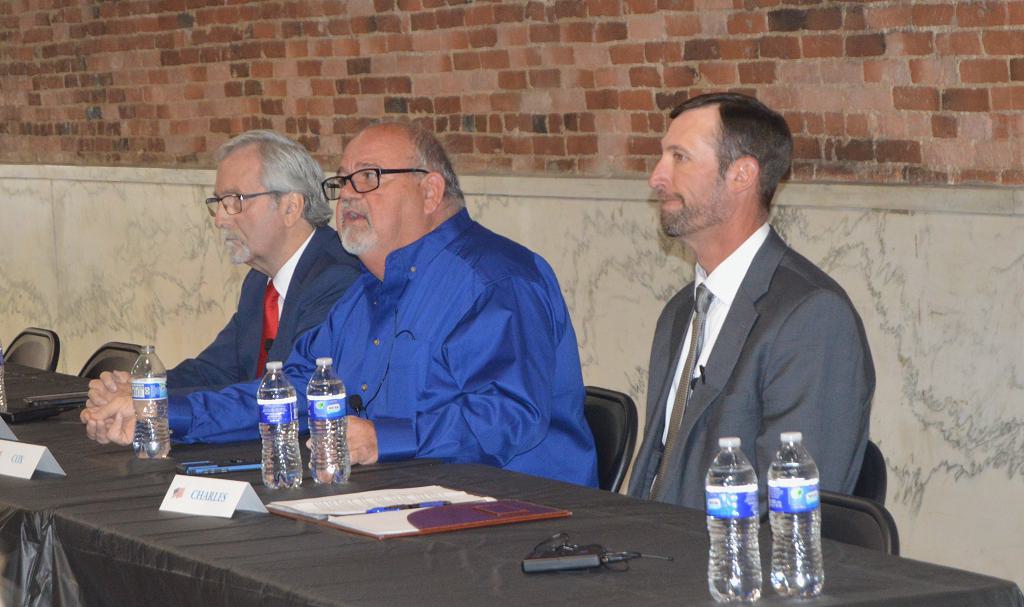
That was the main point of contention in a Republican candidates’ debate on May 13 at The Venue at Whiskey & Wiles.
Three of the four Republicans vying to be the county’s chief executive officer made their case to the voters during the town hall-style forum: County Magistrate Steve Craycraft, City Commissioner Shannon Cox, and businessman Justin Charles.
The fourth, Eric Vetter, a pharmacist and retired naval officer, did not attend.
Craycraft, who has been the 3rd District magistrate for three years and briefly served as interim county judge, presented himself as the only one with the right background.
“I believe that unless you have county government experience, you are not qualified to do this job,” he said.
Without mentioning Charles by name, Craycraft said there was one candidate who had “no public service experience whatsoever.”
Later in the exchange, when the candidates were asked about their leadership style, Craycraft spoke directly to Charles, asking when he had ever led anyone.
Craycraft said there has been misinformation circulated about the county government’s supposedly dire financial circumstances.
“That’s not true. We are good. Despite a lot of obstacles that we have had during this past administration, we have done very well,” he said. “The problem is poor management, and we need more accountability. And I am the one who has been on the inside, and I know what needs to be done, and I will do that.”
Cox, who smiled throughout Craycraft’s opening statement, said he had been a city commissioner for 28 years and was familiar with budgeting and financial planning. He also noted that it was only a short walk across the street from City Hall to the Clark County Courthouse.
“I think I can make that transition pretty easy,” he said.
Cox said he knows that “when you get to the end of the money … you have to stop spending.”
The first thing he would do as judge-executive would be to budget a contingency fund for the Fiscal Court.
“We have to be prepared for the unexpected,” he said.

“I’m running for Clark County judge-executive because I believe the county government should work for the people again,” Charles stated.
For too long, he said, the Fiscal Court has fallen short of its most important responsibility, which is “representing the people of the county and protecting their best interests.”
His goals, he said, were to restore trust, transparency, and accountability. That starts with being “open and honest about all of our financial decisions” and ensuring taxpayers understand how their money is spent. And it means better communication with the public, he added.
As county judge, Charles said, he would hold quarterly district meetings around the county and listen to citizens’ concerns.
“Throughout this election, we’ve heard a lot about experience, but experience only matters if it produces results,” he said.
During the questions, the candidates were asked, “What makes a candidate qualified?”
Craycraft repeated what he had said earlier about the importance of experience in county government.
Cox agreed that it was important, but “not vital.” He said that when he became a commissioner in 1999, he was “overwhelmed,” but he added, “You learn these things.”
The most important lesson, Cox said, is to be organized, to plan, to listen.
Charles said the most important quality is how an official treats people. Respect is what voters want from a leader, he said.
The second question was: “What does leadership look like for you, especially when others are falling short?”
Cox responded by quoting University of Kentucky baseball coach Nick Mingione: “A leaders knows the way, goes the way, and shows the way.”
It’s important not only to know the direction, but to lead from the front, he explained.
Charles said he has always been willing “to do the hard things” that he asked others to do.
In his one-minute rebuttal to Craycraft’s question about when he had led, Charles, a master electrician, said he had been involved in construction projects that were team efforts. He admitted that he had no employees, but said he leads himself. Every morning, “I get up and motivate myself,” he said.
Transparency, accountability, and taxpayers’ money
The candidates were asked about transparency and communication, in particular regarding the county budget.
Charles repeated his plans for meetings with magistrates and constituents, and said county officials should listen more than talk.
Craycraft said his door would always be open to anyone who wants to come by.
Cox said he would have open office hours where nothing else is on his schedule except meeting with magistrates, department heads, and others. He would vary the times to accommodate people’s schedules.
Asked how the county government could meet infrastructure needs without overburdening taxpayers, Cox said it was important to set priorities.
“We have a five-year plan for just about everything” in city government, he said, to decide what to pay for now and what to defer buying until later.
Also, Cox said, it’s necessary to understand that some large purchases will require borrowing money through bond sales.
Charles said he would put together a plan to determine infrastructure priorities, and he mentioned that a top priority should be the eastern bypass, also known as Veterans Memorial Parkway.
He said it will be “really tough” to improve the county’s current financial condition.
“It’s going to take some tightening up of all departments” and “hard looks” at things in the budget “that need to be cut to the bone if we’re going to move forward,” he said.
Craycraft said “the holdup” on developing the eastern bypass is that the county doesn’t have the money for infrastructure, and it needs the “full support” of the state legislature. He said the county’s Republican legislators, Sen. Greg Elkins and Rep. Ryan Dotson, have been working hard to get that funding.
As for being financially strapped, Craycraft said: “We’re OK on money, we just need to move things around from time to time.”
The final question concerned the county’s compost site for disposing of dead animals.
“It is a model for animal decomposition in Kentucky,” said Craycraft, in whose district the site is located.
Unfortunately, he noted, the former county judge-executive had missed out on some money that could have been used for improving that program, and when he fired the supervisor, “it had to shut down for a while.”
Craycraft didn’t mention the name of that judge-executive, Les Yates, who left office early this year to run for state representative.
During his time as interim county judge after Yates’ unexpected resignation, Craycraft said, he got a call from Kentucky’s General Counsel for the Dept of Agriculture, and they were able to reinstate the money for the expansion.
“I was there in the month of August, and I gagged,” Cox said, describing a visit to the compost site.
Never miss a thing with our FREE weekly newsletter.
Cox said the county needs to contact the Department of Agriculture and the Division of Water for help controlling runoff from the site.
Charles said he was not familiar with the guidelines or the funding required, so he would have to “dig deeper” into the issue, but it is important to the county’s farmers and warrants the county’s attention and investment.
The winner of the May 19 Republican primary will face Democratic candidate Vaché King in the Nov. 3 general election. King, who is unopposed in her party’s primary this year, also ran in 2022 but lost the nomination to Charles, who ran as a Democrat that year and recently changed his registration to Republican.
This story was updated on 5/15/2026 5:12 p.m. to clarify that Mr. Craycraft spoke to the General Counsel for the Department of Agriculture, and not the Secretary of Agriculture, as previously reported.
