
I was raised in a place where faith wasn’t loud.
It didn’t need to be.
It lived in quiet things—folded hands at the table, the hush before a storm rolling over the hills, the way my Great Gran spoke about God like He was close enough to hear but never something to be used.
Back home, faith wasn’t a weapon.
It wasn’t something you strapped on like armor and marched into battle with.
And it sure as hell wasn’t something you used to sell a war.
But that’s exactly what I’m seeing now.
There was a time when this country knew how to recognize propaganda.
We called it out in China, where the state controls the narrative so tightly that only one version of truth survives.
We condemned it in Russia, where Vladimir Putin has spent years framing war as a moral stand against a corrupt West—casting his nation as righteous, inevitable, and justified.
We pointed to North Korea, where leaders are turned into near-mythic figures and imagery does the persuading long before words ever have to.
We said that kind of messaging was dangerous—because it doesn’t inform people.
It conditions them.
It tells them what to feel before they’ve had a chance to think.
And now?
Now we’re watching the same playbook unfold here at home.
Since the escalation of conflict involving Iran, the American public has been fed a steady stream of language that has shifted—subtly at first, and now unmistakably—away from strategy and toward something far more absolute.
We’ve heard phrases like:
“A battle between good and evil”
“Defending civilization itself”
“Standing on the side of righteousness”
This isn’t accidental language.
It’s deliberate.
Because once you frame a war that way, you don’t have to explain it anymore.
You don’t have to justify costs.
You don’t have to answer hard questions.
You don’t have to tolerate dissent.
Because in a “good versus evil” narrative, there is no room for complexity — only loyalty.
And increasingly — whether from officials, military briefings, or political allies — the language has taken on something else entirely:
Faith.
Reports have surfaced of U.S. service members being told the war is part of “God’s divine plan,” tied to biblical prophecy and even the idea of Armageddon.
Let that sit for a moment.
Not whispered in the corners, but spoken in command structures.
Not as metaphor, but as justification.
And then came the imagery.
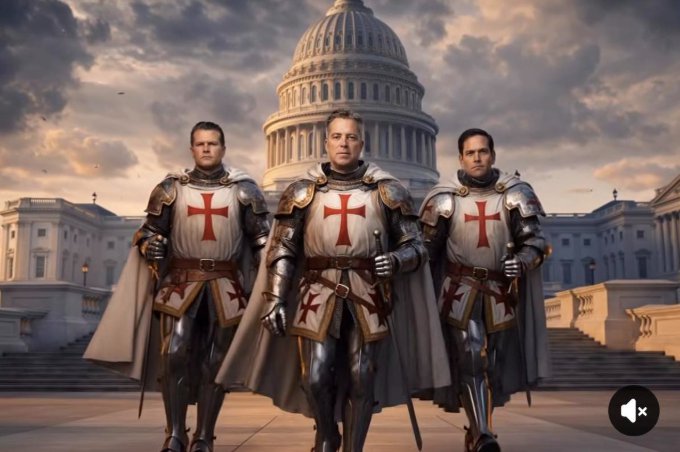
When Andy Ogles shared that now-circulating image — political leaders dressed as crusaders, crosses emblazoned across their chests, standing in front of the Capitol — it wasn’t just tone-deaf.
It was revealing.
Because that image doesn’t come from nowhere.
It pulls directly from the legacy of the Crusades — a time when war was framed as divinely sanctioned, when violence was justified in the name of faith, and when questioning the mission meant questioning God Himself.
That’s not subtle symbolism.
That’s a message.
And it doesn’t stand alone.
Some political figures and commentators have gone so far as to frame support for Israel not just as strategic, but as a religious obligation.
Let’s be plain about what that means.
When policy starts being justified by prophecy …
when war starts being explained through scripture …
when leaders lean on faith not as personal conviction but as public persuasion …
we are crossing a line this country was built to hold.
So let’s ask the question out loud — the one people are thinking but afraid to say:
Is the United States drifting into a religious war?
Maybe not in name.
But in language?
In imagery?
In the emotional framing being pushed on the public?
It’s getting harder to argue otherwise.
And if that’s even partially true, then we have a constitutional problem on our hands.
The First Amendment doesn’t just protect religion.
It protects freedom from government-imposed religion.
That line — between church and state — was drawn intentionally, because the founders understood something we seem to be forgetting:
When governments claim moral or divine authority, they stop being accountable to the people.
Because how do you challenge a policy that’s been framed as God’s will?
How do you question a war that’s been dressed up as righteous?
How do you dissent when disagreement is quietly recast as disloyalty—or worse, as standing on the side of evil?

That’s not democracy.
That’s indoctrination.
And before anyone dismisses that as too strong a word, let’s be honest:
We have used that exact word to describe other nations for decades.
We said it about China’s messaging.
We said it about Russia’s narratives.
We said it about regimes that blurred truth, patriotism, and belief until citizens couldn’t separate one from the other.
We warned that when a government overwhelms its people with a single, emotionally charged narrative — repeated often enough, amplified widely enough — it stops being information.
It becomes propaganda.
And propaganda doesn’t always look like lies.
Sometimes it looks like certainty.
Sometimes it sounds like conviction.
Sometimes it wraps itself in a flag and carries a cross.
Back home, we were taught something simple:
If something is true, it can stand up to questions.
It doesn’t need to shout.
It doesn’t need to simplify.
And it sure doesn’t need to dress itself up as holy to be believed.
So if what we’re being told about this war is solid — if it’s justified, necessary, and right — then it should be able to withstand scrutiny.
Real scrutiny.
Not the kind that gets dismissed as unpatriotic.
Not the kind that gets drowned out by louder, more emotional messaging.
But the kind that asks hard questions and expects real answers.
Because once a nation starts telling its people that it alone stands on the side of good …
history shows us what comes next.
And it’s not something we should be comfortable repeating.
Back home, the hills have a way of telling on you.
You can’t hide much in a place where people know the sound of your voice before they see your face, where truth has a way of rising up like morning fog whether you’re ready for it or not.
My Great Gran used to say that anything worth believing didn’t need to be dressed up or shouted down — it would hold steady all on its own.
And I can’t help but think about that now.
Because if this war is just …
if it’s necessary …
if it’s truly grounded in something honest and right …
Never miss a thing with our FREE weekly newsletter.
then it shouldn’t need crosses painted on armor or God’s name woven into the justification to convince us.
It should be able to stand plainly in the light.
And if it can’t —
then maybe the problem isn’t the people asking questions.
Maybe it’s the story we’re being told.
