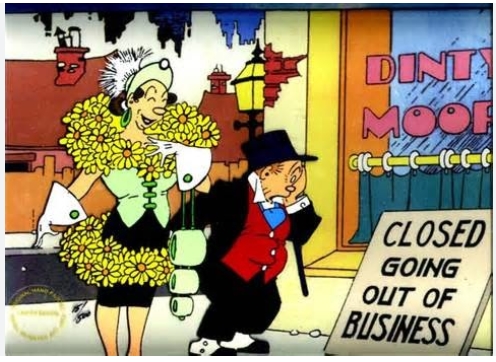
Once awhile back, when I was at the library reading newspapers on microfilm, I ran across an interesting ad in the Winchester Sun for a local restaurant called “Dinty Moore’s.” Since restaurants often take the name of their owners, I wondered if a Winchester person named Dinty Moore was the inventor of the famous Dinty Moore beef stew.
When I was young, all us kids knew about Dinty Moore beef stew, the perfect carry-along on overnight camping trips. We loved it. You didn’t even have to heat it up. Like Vienna Sausage or Deviled Ham, you could just eat it right out of the can.
Knowing nothing then about doing research on the Internet, the connection between the Winchester restaurant and the famous beef stew went unanswered. With the Sun now available on newspapers.com, I thought now might be time to look into it.
The short answer: A Winchester man named Dinty Moore did not invent Dinty Moore beef stew. However, there emerged a much richer story that had unexpected connections. First, let’s have a look at Dinty Moore’s, the local restaurant.
In 1919 two young men, Menter Wheeler, 25, and Wharton Renaker, 21 — just home from the war — purchased Si Dinelli’s confectionary shop from Si’s widow. This was the corner shop in the row of storefronts on the ground floor of the Opera House. They opened as Renaker & Wheeler’s Confectionary, but two years later renamed their place “Dinty Moore’s.” The first twist in this story comes from the Sun’s explanation that Renaker and Wheeler had to get permission from the International Feature Service in order to use the name. This was the company that syndicated the work of George McManus.
Here’s where the story gets interesting.
Older citizens may recall (and young people may never have heard of) George McManus, the New York City comic strip artist who produced “Bringing Up Father,” better known as “Jiggs and Maggie.” Jiggs was a newly rich Irishman who loved nothing better than hanging out with his friends and eating corned beef and cabbage at Dinty Moore’s restaurant. Maggie was his snobbish, rolling pin-wielding wife who tried to keep him away from his lower-class pals. The strip began daily circulation in 1916 and ran for years. It was one of my favorites growing up.
A New York restauranteur, James Moore, thought the comic strip was based on his place on 46th Street, which he promptly renamed “Dinty Moore’s.” Corned beef and cabbage was a specialty, of course. So was Irish Stew. Other Dinty Moore’s soon began springing up around the country — including the one in Winchester.
In 1935 Hormel Foods began producing a steamed beef-and-gravy product that they marketed as “Dinty Moore Beef Stew.” Although the connection to McManus’ comic strip was obvious, Hormel somehow managed to survive a trademark suit. You can still buy their beef stew at the grocery today.

Returning to Dinty Moore’s in Winchester, the confectionary became a popular hangout with the college crowd. In response they expanded the menu, remodeled the dining area, and became a real restaurant. It was so successful that they opened a second restaurant on Main Street in Lexington called the “Canary Cottage.” Wheeler managed the new establishment, while Renaker stayed in Winchester.
Never miss a thing with our FREE weekly newsletter.
A year later Renaker and Wheeler sold Dinty Moore’s to a businesswoman, Mrs. C. R. West, who had run the West Confectionary at 18 North Main Street for some 36 years. Meanwhile, the sellers went on to open Canary Cottage No. 2 in Louisville.
Dinty Moore’s operated under a series of owners until purchased by Louis Schlegel in 1934 and reopened as Louis’ Restaurant. In 1941 he moved Louis’ into swank new quarters in the Brown-Proctor Hotel, whose revamped dining rooms could hold more than 200 patrons.
Wharton Renaker left Louisville to manage the fashionable Maison-Blanche tea room in New Orleans. He returned to Winchester in 1938 and opened the Chatter Box Restaurant at the corner of Main and Court Street.
Lessons learned: None of this story had anything to do with a real person named Dinty Moore. The famous beef stew brand came from a restaurant of that name in the “Jiggs and Maggie” comic strip; it was the place Jiggs was always trying to sneak off to. The Winchester restaurant called Dinty Moore’s also took its name from the comic strip restaurant.
After writing this, I had to give the “famous” beef stew a try. With low expectations, I microwaved a bowl and have to admit that it wasn’t bad. I wouldn’t mind having some Dinty Moore beef stew again soon.