
I confess to a weakness, bordering on obsession, for place names. I search for them, collect them and spend hours trying to locate them. Even a small area such as Clark County offers a nearly inexhaustible supply. The eastern edge of the county has these gems: Rabbit Town, Right Angle, Trapp, Log Lick, Lulbegrud, Indian Old Fields, Red Bridge, Cotton Branch, Crowe Ridge, Pharis Hill, Sewell’s Shop, Pilot View, Thomson Station, Oil Springs, and Kiddville. You can find each of these on a 1926 county map. (The library and museum have copies.)
Maps conveniently provide the location of named places. However, many of the place names I encounter pop up in old documents that offer few clues to their location. These often require lengthy investigation to pin down. Here are a few of the places I’m still trying to find:
Logan’s Lick. Presumably so called after someone named Logan, probably in the area of today’s Logan’s Lick Road. Hugh and William were early residents in Clark County, but there is no evidence tying them to this lick.
The Cane Brake. Although large areas of the county were once covered in canebrakes, this particular one was situated not far from Winchester on Cane Brake Road (now Irvine Road).
Jones Race Paths. Horse races were held here from 1798 to 1800. Located somewhere near Becknerville; probably named for one Richard Jones.
Big Stamp. A place where buffalo gathered and stomped the ground. Probably a salt lick. Located somewhere on Four Mile Road (now Muddy Creek Road).
Log Meetinghouse. This old log church, mentioned in an 1818 road order, was located in the Log Lick-Vienna area. Refers to the Baptist congregation that formed there in 1804 with Rev. James Quisenberry presiding. It may have been very near the present Log Lick Christian Church; the Baptists and Christians shared a church building in the 1800s.
The Ponds. Mentioned in a court order altering the road from “the Ponds to Germantown.” This appears to refer to present-day Jones Nursery Road. Germantown was near its intersection with Athens-Boonesboro Road. The Ponds—also called Hockaday’s pond(s)—would have been on Combs Ferry Road near Becknerville.
Free Frank’s place. Frank was one of the enslaved persons owned by Robert Lewis, who died in 1799. His will provided for the emancipation of his slaves and their use of 66 acres of land he owned in Clark County. In 1801 the county court emancipated Frank, Chloe, and Phillis. “Frank’s place” was in the Lower Howard’s Creek area, a bit above or below the reservoir. He was listed as a free black man in the 1810 and 1820 censuses.
The Wolf Pen. In 1795 the county court appointed William Cotton overseer of a road from the Kentucky River “to one Mile below the wolf pen.” Although “wolf pen” sounds like a place to keep your pet wolf, it was actually a type of wolf trap.
Before the arrival of Europeans, American Indians coexisted peacefully with wolves. But farmers with livestock, then as now, could not abide a wolf in the neighborhood, and they were relentlessly destroyed. Kentucky offered a bounty for killing wolves. In order to claim the reward, a person had to present the wolf’s head to a county magistrate and swear an oath that they had killed it. For obvious reasons, the magistrate was required to have the wolf’s head destroyed in his presence.
Wolves were difficult to take in steel traps, so wolf pens were commonly used. These resembled small, roofless log cabins with four walls leaning in. A partially devoured sheep carcass placed inside attracted the wolf who could clamber up the side and enter through the open top but could not get out.
Never miss a thing with our FREE weekly newsletter.
These pens must have been very common in early times. Examination of current Kentucky place names reveals 36 Wolfpen Branches, 4 Wolfpen Creeks, and 1 Wolfpen Run. There are 5 Wolfpen Hollows and 1 Wolfpen School.
James Still, one of Kentucky’s most beloved writers, lived in a log house between Wolfpen Creek and Dead Mare Branch in Knott County. He published The Wolfpen Poems in 1986 and The Wolfpen Notebooks in 1991.
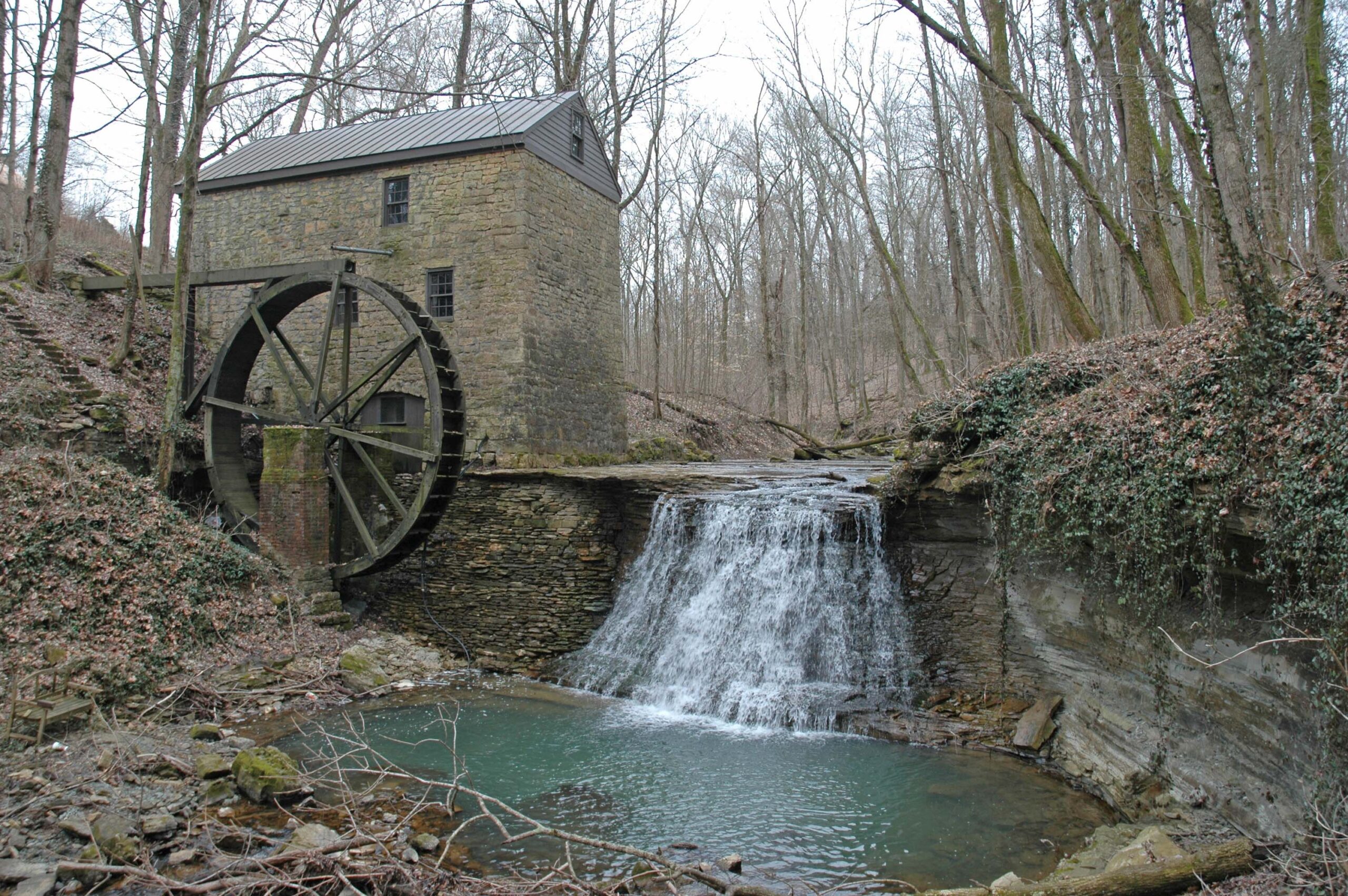
The well-known Wolf Pen Mill is located on Wolf Pen Branch in Jefferson County. The stream was the site of a gristmill in the early 1800s. The present mill there was erected in 1875. Twenty years ago, Louisville native and philanthropist, Sallie Bingham, purchased the mill property and donated it to the conservation non-profit, River Fields. Ms. Bingham had the picturesque mill restored to working order by master millwright, Ben Hassett.

Although hunted to the brink of extinction, today the wolf is making a comeback. But as its population increases, so do the conflicts with humans. The emotional debate over wolf control will likely continue for a long time to come.
I have been writing about local place names since 2005. This work is published in a series of books called Where In The World? Historic Places in Clark County, Kentucky.