
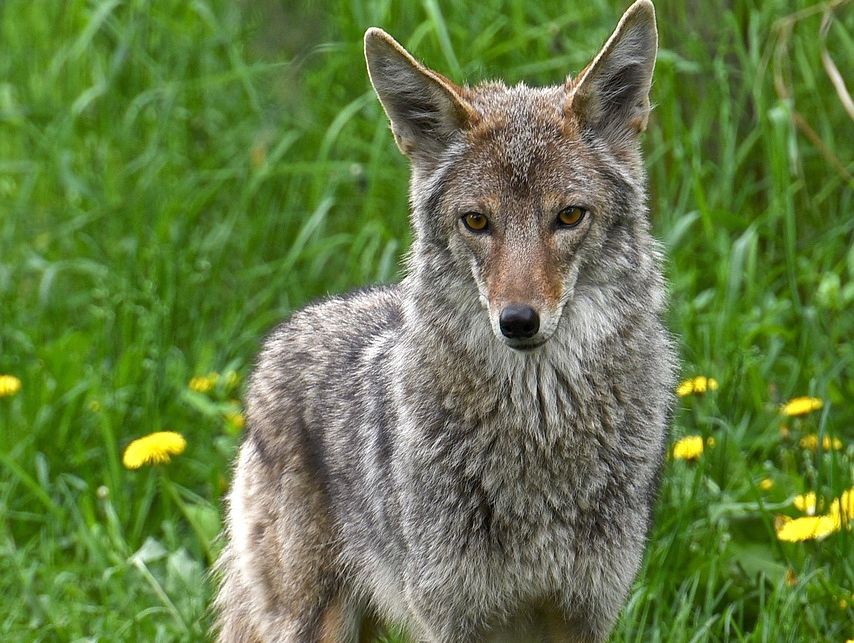
I have a half-mile loop around my house that I use as a walking path. The rest of the ten acres is wild: tall fescue grass dotted with coneflower, milkweed, wild sunflowers, and tiny yellow primrose. It’s also filled with chiggers, poison ivy, ticks, and snakes galore, so I admire its beauty from the relative safety of the mowed path.
The best time is in summer, just after a mowing, when turkeys, deer, raccoons, foxes, birds, and groundhogs come to scavenge the shorter grasses for sustenance. This week, on an early morning stroll, I came face-to-face with a coyote. He raised his head, snout bloody from his fresh kill. We locked eyes, and I backed up slowly, giving him a wide berth. He chuffed in warning but clearly saw me as no threat and returned to his meal. So I stood there and watched, mesmerized to be this close to such a beautiful creature.
Now, ask anyone from Appalachia, and nine of ten people will tell you how much they detest coyotes as nuisances that pose a threat to livestock and pets. And I take their point. We are pretty sure coyotes have killed at least two of our cats in the last 25 years. But everybody has to eat, am I right? I refuse to hate this animal.
In Native American traditions, the coyote is known as the trickster, the clever animal that stole fire from the humans. To warm the world, you sometimes have to steal a little light. Some may call that thievery, but I call that resourceful.
In the wild song of evolution, few creatures have composed a melody as resilient and resourceful as the coyote. Once confined to the open plains of the American West, Canis latrans—the “barking dog”— has written itself into the landscapes of nearly every part of North America, not only surviving but thriving.
Coyotes first evolved in North America around one million years ago, descendants of an ancient lineage of canids. Unlike their larger cousins—the wolf and the dire wolf— coyotes specialized in being small, swift, and cunning. During the last Ice Age, many predators perished. But coyotes, ever the opportunists, diversified their diet and expanded their range. They are wild yet urban, solitary yet social, feared yet admired.
Coyotes will eat anything: rodents, berries, garbage, roadkill. They will raise their pups in rocky dens, storm drains, or beneath garden sheds. When humans altered the world with highways and suburbs, coyotes simply moved in. They became the great generalists, thriving precisely because they refused to specialize too narrowly.
Never miss a thing with our FREE weekly newsletter.
In the 20th century, humans tried to wipe coyotes out. Poisoned, shot, trapped—millions were killed. Yet the more we hunted them, the more coyotes evolved. They began breeding faster, expanding into new regions, becoming more elusive, more nocturnal, more clever. Even in death, they outsmarted us. It’s as though pressure forged them into something fiercer. Where many species collapse under the pressure of climate shifts and habitat loss, the coyote teaches us that flexibility is not weakness, but a superpower.
In Native American traditions, the coyote is known as the trickster, the clever animal that stole fire from the humans. To warm the world, you sometimes have to steal a little light. Some may call that thievery, but I call that resourceful.
The coyote raised his head again and shot me a haughty, indifferent look, more akin to the dismissive stare of my cat than my dog. Barkley, my 20 pound cockapoo, comes from a line of dogs domesticated somewhere between 20,000 and 40,000 years ago. The “wolf” that sleeps in my bed bears no resemblance to his ancestors. He’s built for blankets and peanut butter treats and sweaters from T.J. Maxx, a product of thousands of years of evolutionary changes to become our most beloved companion.
Coyotes never accepted our invitation. While dogs walked into our homes, coyotes stayed on the edge of the firelight, maintaining their independence. Coyotes are not loved, not fed, not protected by humans. And yet, they flourish. They thrive in chaos, adjust with uncanny agility, and carry the old world in their bones.