
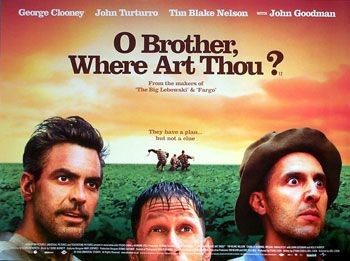
We’ll begin today’s Reel Classic review with a recipe. We start with the two quirky Coen brothers, Ethan and Joel, as directors and writers. We add in the classic poem The Odyssey by Homer. Next, we stir in a bit of the 1941 film Sullivan’s Travels by Preston Sturges, add a pinch of the “Three Stooges,” and finally top it off with an award winning soundtrack. Mix well and we serve it up—the Depression era film O Brother, Where Art Thou?
As our story begins we meet our three main characters who are imprisoned and part of a chain gang in the deep South. There is Pete Hogwallop (John Turturro), Delmar O’Donnell (Tim Blake Nelson), and their leader, Ulysses Everett McGill (George Clooney). McGill has convinced the two men chained together with him to escape, and he will lead them to retrieve a buried treasure that had been hidden at a site that is about to be flooded to create a lake. With the hope of becoming rich, they agree to escape with him.
They are initially assisted by a blind man driving a handcar on the railroad tracks. He foresees their future and tells them they will find fortune, but not the one they are pursuing. They make their way to the home of Pete’s cousin Wash, who helps to break the chains and gives them food and a place to sleep. However, he also reports them to the local sheriff. Sheriff Cooley and his men come after the escaped convicts, but they again slip away with the help of Wash’s son.
Their adventures take them to a baptism gathering on the banks of a river where Pete and Delmar get baptized. Their journey continues and they meet up with a young black man with a guitar named Tommy Johnson (Chris Thomas King). He tells them he has sold his soul to the devil in exchange for being able to play the guitar. Having stopped at a local radio station they learn that they can earn a few dollars by recording a song. They present themselves as “The Soggy Bottom Boys.” Soon after they part ways with Tommy Johnson as they learn the Sheriff is on their trail.
Their adventures lead them to a meeting with the gangster “Baby Face” Nelson and later with three “sirens” washing clothes in the river while singing. The beautiful “sirens” offer them some corn whiskey and it is not long before the boys are passed out. Upon awakening, they find Pete’s clothes next to them but he is gone. Next to his clothes is a toad and Delmar is convinced the “sirens” transformed Pete into a toad.
The adventures of Everett and Delmar continue as they meet up with a one-eyed, crooked Bible salesman (Dan Goodman), “Big Dan,” who also happens to be a member of the Ku Klux Klan along with some crooked politicians. Eventually, they come to the home of Everett’s ex-wife, Penny (Holly Hunter), and he confesses that there was no treasure. He just wanted to return to his wife and prevent her from remarrying. They also learn that Pete was not turned into a toad, but was instead turned into the police by the “sirens.” They arrange to help him escape.
The three stumble upon a KKK rally and learn that the Klan is about to lynch Tommy, the guitar player they had previously met. They manage to help him escape. During these various adventures, what they don’t know is that the song they recorded at the radio station has become a big hit, and folks love “The Soggy Mountain Boys.”

Their adventures continue and include an attempt by Everett to win back his wife Penny, attendance at a political event where they are recognized by the crowd as “The Soggy Bottom Boys,” and another run-in with Sheriff Cooley, who wants the boys hanged for their deeds.
These are not even all of the adventures experienced in the film. The film proceeds almost as a collection of episodes as the various experiences of the characters unfold. As mentioned above, the story has some parallels to the poem The Odyssey by Homer. Homer is even listed in the credits, along with Joel and Ethan Coen, as a co-writer. The characters are also loosely based on those in the classic poem. Clooney’s character, Ulysses Everett McGill, represents Odysseus (Ulysses). Pete and Delmar represent the soldiers who accompanied Odysseus on his journey. “Big Dan,” the one-eyed crooked Bible salesman, represents the Cyclops in the poem. Holly Hunter’s character, Penny, represents Penelope, and Sheriff Cooley represents Poseidon. The singing women at the river doing the washing represent the “Sirens” from the poem. Their singing voices are dubbed by three musical sirens — Emmylou Harris, Alison Krauss, and Gillian Welch.
Interestingly, even though Homer is listed as a co-writer, the Coen brothers claimed they had never read The Odyssey. They said they were familiar with the story from other means but had never read the actual poem. As mentioned above, the film was also influenced by other factors. The title O Brother, Where Art Thou? was taken from the classic Preston Sturges film Sullivan’s Travels, released in 1941. That story was also set during the Depression and is about a director who wants to make a film that will be a “commentary on modern conditions, stark realism, and the problems that confront the average man.” The director was going to call his film O Brother, Where Art Thou?, and sets out to experience the plight of “the average man.”
The interplay between the three main characters has, at times, a bit of “goofiness” in it. Joel Coen was quoted as saying the film is “a Three Stooges movie in a lot of ways.” One of the film’s most notable attributes is its music. In the movie, you will find tributes to the music of the times. There is a diverse range of religious music, including Primitive Baptist and African-American gospel, Delta blues, country, swing, and bluegrass. The music was meant to be a major part of the film from the outset. Producer and musician T Bone Burnett was engaged to work on the soundtrack while the Coens were working on the script. The soundtrack for the film was recorded before the movie was filmed. Musicians contributing to the soundtrack (and some dubbing vocals for the performers) included Ralph Stanley, John Hartford, Norman Blake, and Dan Tyminski as well as the three “sirens” mentioned above.

George Clooney practiced his singing for the film for weeks prior to filming. In an interview, he recalled practicing and said that it was assumed that he could sing, as he was the nephew of the great singer Rosemary Clooney. However, once he got into the studio, it was quickly determined that Dan Tyminski would sing Clooney’s parts. Clooney was born and raised in Kentucky, and to ensure that he got the Southern accent (which he had lost) right, he sent the script to his Uncle Jack in Kentucky. Uncle Jack read all the lines and recorded them on a tape recorder. Clooney stated in an interview, “I just did my Uncle Jack through the whole thing.” He also stated that the dance he performed in the film was inspired by the cloggers he saw while growing up in Kentucky. In describing the cloggers, he said, “...none of their upper body moves, their legs are going nuts.”
The character Tommy Johnson spoke of selling his soul to the devil to play the guitar well. This is based on the story of famed blues musician Robert Johnson, who reportedly “sold his soul to the devil” at a crossroads to ensure his talent. There is a crossroads monument dedicated to Johnson in Clarksdale, Mississippi, where the event is alleged to have occurred. At the beginning of the film, we hear a chant from the chain gang, which was from an old recording of an actual chain gang.
The character of Mississippi Governor Pappy O’Daniel (Charles Durning) was actually based on a real Governor from Texas (1939−1941) named W. Lee “Pappy” O’Daniel. He made his money in the flour business and had a radio show with his music group, “The Light Crust Doughboys.” He later served in the U.S. Senate.
O Brother, Where Art Thou? premiered at the Cannes Film Festival in May 2000. It opened in the United States in September of that year. It grossed nearly $72 million and cost $26 million to produce. The soundtrack, produced by T‑Bone Burnett, was also very successful. It sold over seven million copies in the U.S. and led to a concert tour featuring musicians involved in the recording. From that tour came a recording for TV as well as a CD and DVD. It was called Down From The Mountain and included performers Ralph Stanley, John Hartford, Alison Krauss, Emmylou Harris, Gillian Welch, Dan Tyminski, and others.

The critic for Rolling Stone described the film as “... a wild, whacked-out wonder. Coenheads rejoice.” The Washington Post critic stated “It’s a new new thing, classic myth from both literature and the movies, commingled, set to great folk music, and untrammeled by any sense of predictability, urgency, realism or believability but hypnotic, graceful and seductive.” And, from The New York Times: “A rambunctious and inspired ride in which the Coen brothers’ voracious fascination with the arcana of American popular culture and their whiz-kid inventiveness reach new heights of whimsy.” The TCM (Turner Classic Movies) reviewer states “Despite the heavy-hearted title, their depression road movie is lighthearted and whimsical and filled with infectious music. In Clooney, they found a star with the look of a thirties matinée idol and the snappy delivery of a seasoned Hollywood comic.”
Roger Ebert, the critic with the Chicago Sun-Times, was positive though a little less glowing in his review: “O Brother contains sequences that are wonderful in themselves—lovely short films—but the movie never really shapes itself into a whole.”
The music is integral to the stories being told. A review of the soundtrack from Allmusic Review states, “This soundtrack is a powerful tribute not only to the time-honored but commercially ignored genres of bluegrass and mountain music but also to Burnett’s remarkable skills as a producer.”
The Internet Movie Database gives O Brother, Where Art Thou? A score of 7.7 of 10. On Rotten Tomatoes, it has a Critics Score of 78% and an Audience Score of 89%.
Never miss a thing with our FREE weekly newsletter.
In searching my Roku device I could find no free streaming sites but there is a copy of the DVD on the shelf at the Clark County Public Library.
So I say to you, if you are hungry for some fun story-telling, adventure, laughs, and fantastic music, give this recipe a try and serve up some of O Brother, Where Art Thou? No doubt here that family and friends will enjoy it.
Information for this Reel Classic review was gathered from Internet Movie Data Base (IMDb), Rotten Tomatoes, Turner Classic Movies (TCM) and Wikipedia.
If you enjoy these classic movies, please join me on the second Tuesday of each month at 6:00 PM at the Clark County Public Library for “Ron Kibbey’s Comedy Classics.” I present a classic comedy film, usually accompanied by a vintage cartoon. Popcorn and drinks are provided. More information about the next film is available on the library’s website, Facebook page, and WinCity Voices Facebook page.
