
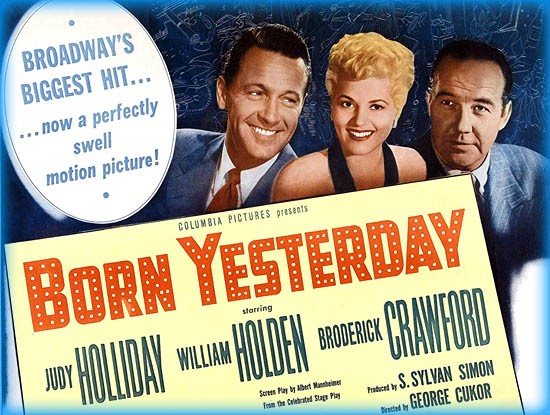
Today’s edition of Reel Classics brings us a delightful comedy that was hugely popular in its day but may not be as well-known today. I hope to change that.
Born Yesterday was released in late 1950 and starred Judy Holliday as Billie Dawn, Broderick Crawford as her wheeling and dealing fiancé Harry Brock, and William Holden as newspaperman Paul Verrall.
Harry Brock comes to Washington D.C. to see if he can find a corruptible congressman to assist him in his financial endeavors. Harry is a wealthy but bullying businessman and far from polite. Billie Dawn is his long-time fiancée who is an ex-showgirl. She comes across as crass and not very bright, and Harry wants to “polish” her up to impress his Washington D.C. contacts. He hires a reporter he meets, Paul Verrall, to “tutor” Billie and to help soften her gruff ways and language. Paul also provides some lessons in U.S. history, literature, and the law to give her a better understanding of her surroundings.
These efforts pay off in ways not anticipated by Harry as Billie comes to see him as the conniving crook he truly is. She begins to think for herself and challenge Harry — much to his dismay. We watch her blossom and learn she is much smarter than what others have perceived. She also finds herself falling in love with the handsome Paul Verrall.
Born Yesterday was adapted from a very popular Broadway play written by Garson Kanin. Kanin also assisted in revising the screenplay for the film (though he was not credited). The play opened in February 1946 and ran for 1,642 performances. The original cast in the play included Judy Holliday as Billie, Paul Douglas as Harry, and Gary Merrill as Paul.
Interestingly, Judy Holliday came to the role by a quirk of fate. The role of Billie was originally written for Jean Arthur. However, just a couple of nights before the play was to open, she decided to drop out of the production. Judy Holliday was brought in to assume the role and worked hard for the next couple of days to prepare for the opening. Obviously, her efforts paid off.
Even with her popularity in the role on Broadway, she was not the first choice of the studio to play the lead in the film adaptation. The head of Columbia Pictures, Harry Cohn, had several other actresses in mind for the role including Rita Hayworth, Celeste Holm, Paulette Goddard, and Ida Lupino. However, Katherine Hepburn worked to create attention for Judy Holliday. They had appeared together in the film Adam’s Rib (1949) along with Spencer Tracy. Hepburn told various gossip columnists that Judy Holliday’s performance in Adam’s Rib took the spotlight from Hepburn and Tracy. These columns did their work, and Harry Cohn became interested in Judy Holliday and offered her the role.
Harry Cohn was not much liked by many of those who worked for him. Both Broderick Crawford and William Holden shared a dislike of Cohn. They both had a fondness for alcohol and as a joke on Cohn would order large Scotches at lunchtime to give him concern about them getting drunk on the set. They also upset him by running up large room service bills while on location in Washington D.C.
The playwright Garson Kanin also shared a dislike for Cohn. In his autobiography, he wrote that he received $1 million for the film rights to his play because Cohn had heard that Kanin had been quoted as saying he “wouldn’t sell the rights to Harry Cohn for any amount-not even a million dollars.” Reportedly Kanin also claimed that the character of the obnoxious Harry Brock was patterned after Harry Cohn, but Cohn never saw that.

Born Yesterday was nominated for five Academy Awards including Best Picture, Best Director (George Cukor), and Best Actress (Judy Holliday). Many were shocked when Judy Holliday received the award as her competition that year included Gloria Swanson (Sunset Boulevard) and Bette Davis (All About Eve).
Judy Holliday played the part of the ditsy blond, but in reality was extremely intelligent. She had an IQ of 172. She was once quoted as saying “You have to be smart to play a dumb blonde over and over and keep the audience’s attention without extraordinary physical equipment.”
Other well-respected films in which she starred include It Should Happen to You (with Peter Lawford and Jack Lemmon), The Solid Gold Cadillac (with Paul Douglas), and Bells are Ringing (with Dean Martin). Unfortunately, Judy Holliday’s career was cut short as she died in 1965 from breast cancer at the age of 43.
Positive reviews came out after the release of the film. The New York Times reviewer wrote, “Just in time to make itself evident as one of the best pictures of this fading year is Columbia’s trenchant screen version of the stage play Born Yesterday ... On the strength of this one appearance, there is no doubt that Miss Holliday will leap into popularity as a leading American movie star.”
The review in The Washington Post stated the film was “an even more beguiling comedy than it was on the stage, and Judy Holliday’s even funnier.”
A review in Harrison’s Reports described it as “an excellent comedy ... One has to see and hear Miss Holliday to fully appreciate the superb delivery of her lines and the fine shadings of her artful mannerisms.”

But lest we forget, this was the 1950’s and the anti-communist folks were active in Hollywood. Writer Garson Kanin and Judy Holliday were linked to political groups that were deemed by some as subversive. In 1951 members of the Anti-Communist Committee of the Catholic War Veterans picketed theaters screening the film because of the allegations against Kanin and Holliday.
In fact, Judy Holliday was called to appear before the House Un-American Activities Committee to testify. Advisors suggested that she take on the character of Billie Dawn and reportedly played the role of the ditsy blonde before the committee. She did not name any names. The committee did not find her to be a threat and she was not blacklisted.
Another interesting fact about Judy Holliday is that when she learned she had cancer she gave up films and focused on a relationship with jazz musician Gerry Mulligan. She began writing lyrics to some of the music he composed. The songs can be found on an album entitled Holliday with Mulligan. It wasn’t released until 1980, many years after her death. She had originally begun her career as a nightclub singer.
Born Yesterday is listed at #24 on the American Film Institute’s “100 Funniest American Movies Of All Time.” In 2012 it was selected by the Library of Congress for preservation in the National Film Registry.
Never miss a thing with our FREE weekly newsletter.

In later years Garson Kanin wanted to do a remake of the film. Reportedly throughout the 1970s and 1980s, he worked on the project with such stars in mind as Bette Midler, Barbara Streisand, and Whoopi Goldberg. He even had thoughts of a musical version of the film with Bernadette Peters or Dolly Parton.
A remake was eventually made (without Kanin) in 1993 with Melanie Griffith, Don Johnson, and John Goodman. This version also had the leading actress nominated for an award—but not the Oscar. Melanie Griffith was nominated for the Razzie Award for Worst Actress. Fortunately for her, she did not win. (Hint: watch the original.)
The Internet Movie Database (IMDb) rates Born Yesterday at 7.5 out of 10. Rotten Tomatoes gives it a critic’s score of 97% and an audience score of 85%. In searching for free streaming sites I was unable to locate any. Unfortunately, the Clark County Public Library does not have a copy on the shelves. (Perhaps if you ask they will obtain a copy).
Information for this Reel Classic review was gathered from Internet Movie Data Base (IMDb), Rotten Tomatoes, Turner Classic Movies (TCM), and Wikipedia.
This is a hilarious comedy worth seeking out. Judy Holliday’s career was ended far too soon by cancer, and for many, she has faded or is unknown. It is my hope that this edition of Reel Classics will raise interest in seeking out her films. Until next time, I leave you with the trailer for Born Yesterday.
