
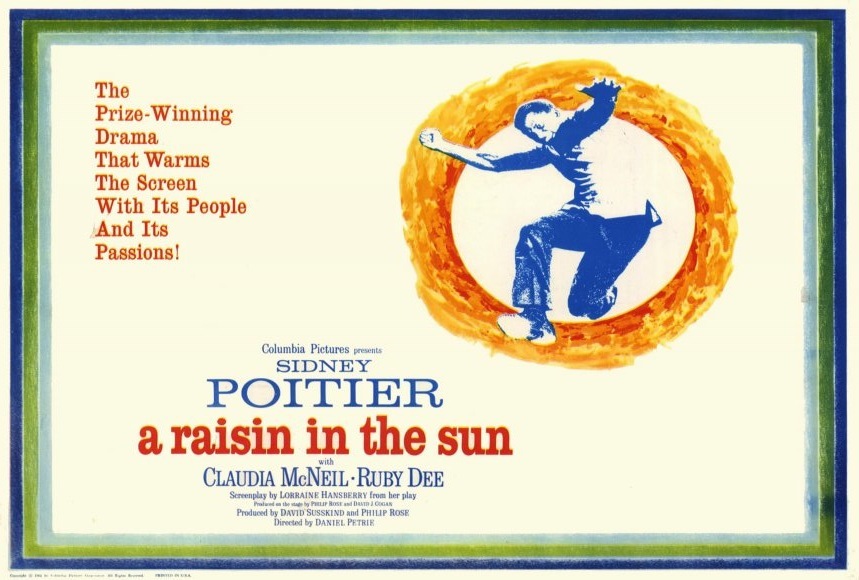
February is Black History Month, and in honor of that, today’s Reel Classic is A Raisin in the Sun, a film released in 1961. It stars Sidney Poitier as Walter Lee Younger, Claudia McNeil as his mother Lena, Ruby Dee as his wife Ruth, and Diana Sands as his sister Beneatha. They portray a family living in a way too small two-bedroom apartment in Chicago. Also living with them is Walter and Ruth’s young son, Travis, who sleeps on the couch.
As the story opens, we learn that Walter’s father has recently passed away and has left an insurance settlement to his wife in the amount of $10,000. Family members have differing views on what to do with the money. Lena wants to use it to buy a house so her family can have a home of their own with bedrooms for all and a backyard for her grandson to play in. Beneatha has dreams to go to medical school and become a doctor. Walter has his own dream—to own a business of his own so he can give up the job of being a chauffeur and driving a rich man around town all day.
This is a story about dreams and how they can motivate folks and how they can create barriers for folks—for not everyone’s dream is the same. The differing dreams of the family members create tension and conflict within the family. Walter believes that owning the business, a liquor store, would provide the family with ongoing financial security and lift them up. Lena and Ruth want a home with more space and envision greater opportunities for the young Travis. Also, Ruth has recently learned that she is pregnant with another child. Beneatha sees this as her only likely chance to go to medical school and realize her dream.
The focus of the story is how these differing dreams and the resulting conflicts can tear away at the ties that bind a family. It also demonstrates how the ties that bind a family can be the strength to keep it together. The film focuses on these contrasting issues within this family.
It is also enhanced by the reality that this is a black family struggling in a racist environment that creates even more barriers to realizing their dreams. Lena finds a house for sale and puts a down payment of $3,000 on it. Her dreams are even further challenged when the neighbors in the white suburb (The Clybourne Park Improvement Association) send a representative to try to convince them not to move into this all-white neighborhood. Lena remains torn between seeing her dream come true for this family and helping her son and daughter realize their own dreams.

The film was based on a play of the same name written by Lorraine Hansberry that opened in New York in 1959. It ran for over five hundred performances and was nominated for the Tony Award for Best Play in 1960. The main cast also appeared in the film version.
The play was the first Broadway play to be written by a Black female. She drew some of the experiences from her own history as a child. Her family bought a house in an all-white suburb and were challenged by the local homeowners association trying to enforce racial restrictions to force them out. She reported that her family had to hire a bodyguard to protect them from their neighbors. She talked of how a mob of white folks gathered in front of her home and threw a concrete block through their front window. She remembered “being spat at, cursed, and pummeled in the daily trek to and from school.”
With the assistance of the National Association for the Advancement of Colored People (NAACP), a lawsuit was filed that eventually went to the Supreme Court (“Hansberry v. Lee”). The Supreme Court found in favor of Hansberry. She was only twenty-six years old when she wrote the play. Asked about how she came to write A Raisin in the Sun, she was quoted as saying, “I wrote it ... one night, after seeing a play I won’t mention, I suddenly became disgusted with a whole body of material about Negroes. Cardboard characters. Cute dialect. Or hip-swinging musicals from exotic scores.”
The title, A Raisin in the Sun, was taken from a poem by Langston Hughes entitled Harlem:
What happens to a dream deferred?
Does it dry up
like a raisin in the sun?
Or fester like a sore–
And then run?
Does it stink like rotten meat?
Or crust and sugar over–
like a syrupy sweet?
Maybe it just sags
like a heavy load.
Or does it explode?
The consequences of a dream deferred are at the heart of this movie.
One of my favorite scenes in the movie was related to Beneatha and her new boyfriend, Asagai. He is a student she meets in one of her classes at school. He is from Nigeria and encourages her to learn more about her African roots. He is also in love with her and wants her to return to Nigeria with him after she completes school. He brings her a present of robes from Nigeria to encourage her interest. The scene involves her putting on the robes and beginning to sing and dance to African rhythms around the kitchen. Walter comes in and sees her, questioning it all at first, then joins in. He says, “The lion waking now, honey ... Wimoweh.” That is a reference to the song “The Lion Sleeps Tonight,” famously sung by both “The Weavers” and “The Tokens.” It also shows an awakening by Beneatha to her roots.

The film was set in Chicago, and producers sent a team there to film some of the exterior scenes. They experienced bigotry while trying to locate settings to film. Reportedly owners of some of the houses that they intended to use refused to let them do so after they learned of the premise of the film. One homeowner, a woman seven months pregnant, received threatening phone calls, and the crew decided to leave. Most of the filming was based in the tiny apartment in which the family lived, and completed back in the studios.
Though the Broadway play was highly acclaimed, the film received no Academy Award nominations. Claudia McNeil and Sidney Poitier did receive Golden Globe nominations for Best Actress and Best Actor. Poitier went on to win the Academy Award for Best Actor in 1963 for his role in Lillies of the Field, and was the first black actor to do so. He also had the distinction of being the first black actor to place his autograph, handprints, and footprints in the cement at Grauman’s Chinese Theatre on June 23, 1967.
One of Beneatha’s suitors was George Murchison, featuring Louis Gossett, Jr. in his first film role. Gossett also reprised his role from the Broadway play. He went on to appear in multiple screen and TV roles, including An Officer and a Gentleman and Roots, the TV mini-series.
A Raisin in the Sun saw multiple revivals on the stage and screen. The play was adapted to TV in 1989 for the PBS series American Playhouse starring Danny Glover and Esther Rolle (Maude and Good Times). In 1996 there was a BBC Radio production, and in 2004, a Broadway revival that included rapper Sean Combs (P Diddy) and Phylicia Rashad (The Cosby Show), who won a Tony Award for her portrayal of Lena.
Never miss a thing with our FREE weekly newsletter.
In 2008 Combs and Rashad reprised their roles for a TV film on ABC for which Rashad received an Emmy nomination. It was also shown at the 2008 Sundance Film Festival. 2014 saw another Broadway revival starring Denzel Washington.
Unfortunately, Lorraine Hansberry did not live to see the ongoing legacy of her riveting play. She died of cancer at the very young age of 34 in January 1965. She was the first Black playwright and youngest American to win the New York Critics’ Circle Award, and was very active in the Civil Rights movement, working with Harry Belafonte, Lena Horne, and James Baldwin.
In 2005 the film was added to the Library of Congress National Film Registry. Rotten Tomatoes gives A Raisin in the Sun a critics’ score of 90% and an audience score of 87%. The Internet Movie Database (IMDb) rates it at 8.0 of 10. I could not find it available on any streaming site for free, but a copy is available on DVD at the Clark County Public Library.
Though made in 1961, the film A Raisin in the Sun explores many issues pertinent to today. It looks at racism and injustice, inadequate housing, struggles for a living wage, abortion, faith, and the strength of family. It remains a powerful statement to this day—explaining the numerous resurrections the story has experienced. I encourage you to view it—be it for the first time or a return to it. It is a powerful story and an excellent presentation for Black History Month.
Information for this Reel Classic review was gathered from Internet Movie Data Base (IMDb), Rotten Tomatoes, Turner Classic Movies (TCM), and Wikipedia.
Be watching for the next edition of Reel Classics, and in the meantime, enjoy the trailer for A Raisin in the Sun below.
