
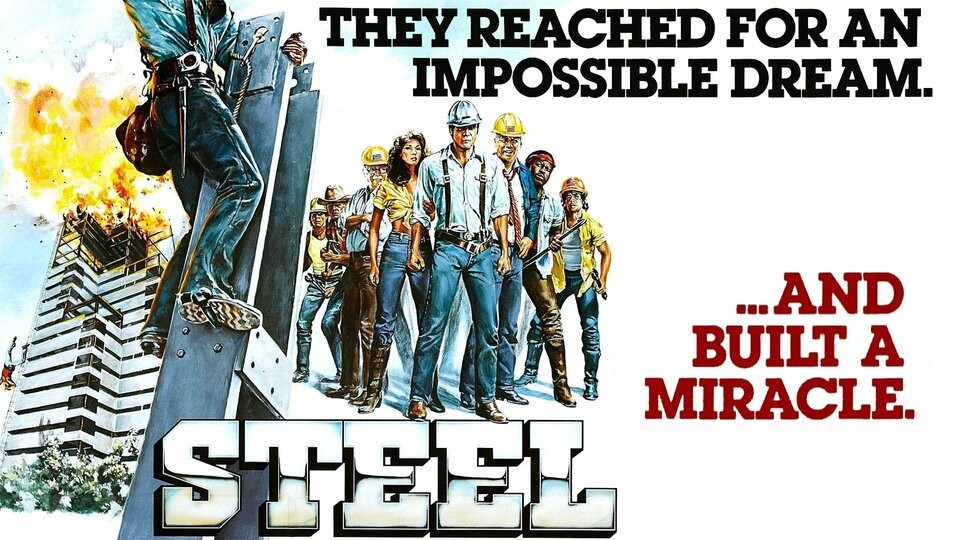
With today’s version of Reel Classics, I am taking a bit of a turn from my usual efforts. All of the films I have reviewed in the past were films I have personally seen and liked.
I must admit I have never seen today’s film, Steel, starring Lee Majors. I received a suggestion several weeks ago from a friend who asked me to consider reviewing this movie, as it was filmed in Lexington, Kentucky, and starred a Kentuckian. He thought folks might be interested in the local connection. I agreed to look at the film, and in doing so, it aroused my curiosity about other films with a Kentucky connection that I might explore in the future. I began researching and found a fairly comprehensive list of such films. With that, I decided that I would do a periodic “Reel Classics — A Kentucky Connection” feature. Today’s film will be the initial entry into that series.
Steel stars Lee Majors and a number of well-known and recognizable actors, including George Kennedy, Art Carney, R. G. Armstrong, Albert Salmi, and Jennifer O’Neill. The setting is Houston, Texas, where we find construction boss Lew Cassidy (George Kennedy) leading a crew to complete the construction of a downtown skyscraper. He is financially strapped and has a three-week deadline to complete the project.
Unfortunately, Lew Cassidy falls from the structure and is killed.
His daughter, Cass Cassidy (Jennifer O’Neill), is bound and determined to see the project completed and to prevent her father’s scheming brother, Eddie Cassidy (Harris Yulin), from taking over the company. She is advised to seek out Mike Catton (Lee Majors) to head up the project. Catton had once been very successful and well-known in the construction trade, but had given it up after an on-site accident left him with a very serious fear of heights. Cass convinces Catton to take on the project to complete the last nine stories of the building in three weeks.
Catton begins by seeking out a crew of former friends and co-workers that he believes can get the work done. Cass is bound and determined to run the business side of the project and some tensions arise between her and Catton. There are also some tensions within the work crew as they question Catton’s desire to supervise from the ground and not climb the beams.
As the project proceeds, the work crew experiences numerous obstacles, including bad weather and faulty equipment. The tensions between Catton and Cass begin to ease as romantic interests between the two begin to rise. Catton also has to confront his fears when he has to climb the skyscraper to help rescue an employee trapped on a collapsing beam during a storm.
The initial part of the film deals with Catton’s efforts to round up the “right men” for the job. He seeks out former co-workers that are excellent in their skills and with whom he is confident they can met the demands of the job in the short period of time they have. This segment is similar to the theme in the Western movie The Magnificent Seven. Thus, one of the taglines for Steel is “The Magnificent Eight!” Some reviews identified this crew in various terms such as “the dream team” and the “wild bunch.”
The second part of the movie is about the challenges in getting the construction completed within the three-week time line and of course the growing romantic relationship between Catton and Cass.

At the time, Lee Majors and Farrah Fawcett were married and operated Fawcett-Majors Productions. Steel was one of six films made by their company. At the time of the filming, Lee Majors was a well-known and popular TV star with roles in Big Valley and The Six Million Dollar Man.
And now for the “Kentucky Connection.” We’ll begin with Lee Majors. Majors was born Harvey Lee Yeary in 1939 in Wyandotte, Michigan. His father died from a work-related accident five months before he was born, and his mother was killed in an auto accident when he was only 16 months old. He was adopted by his uncle and aunt, Harvey and Mildred Yeary, and they moved to Middlesboro, Kentucky.
Growing up in Middlesboro, Majors became very active in school sports and was involved in both track and football at Middlesboro High School. He graduated in 1957 and went to Indiana University, where he played college football. In 1959 he transferred to Eastern Kentucky University and played football until suffering a back injury that ended his football playing aspirations. After the injury, he got more involved in acting and performed in plays at the Pioneer Playhouse in Danville, Kentucky. In 1962 he graduated from EKU with a major in history and physical education. He wanted to be a football coach.
After graduation, he moved to Los Angeles and worked as a parks and recreation director. He also enrolled in acting school and found his way into the film business, changing his name from Harvey Lee Yeary to Lee Majors.
Filming for Steel began in July 1978 in Lexington, Kentucky and at various sites within Fayette County. The construction site was the Kincaid Tower on Vine Street. It was under construction at the time. The film makers utilized the steel framework, the scaffolding, the cranes and other equipment along with the visuals of the skyline from the site to provide a very realistic perspective of such an endeavor.
Utilizing an existing site such as Kincaid Tower also did away with the need to build elaborate sets for the production. There was a set constructed on the roof of the Patterson Office Tower on the campus of the University of Kentucky. Most of the top-floor scenes were filmed there so as to not interfere with the actual Kincaid Tower construction efforts.
Unfortunately, a very tragic accident occurred during the filming. Stuntman A.J. Bakunas died from injuries sustained in a fall from the top of the Kincaid Tower. He was the stunt double for George Kennedy and performed the stunt depicting Lew Cassidy’s death from a fall early in the film. The original scene had been filmed with Bakunas falling from the ninth story of the building with no problem. He possessed the world record for highest free-fall. However, he learned that his record had been surpassed by another stuntman, Dar Robinson, and he wanted to redo the scene from the top of the Kincaid Tower.
Robinson’s record-setting jump was 286 feet, and the jump from the Kincaid Tower would be 323 feet. The second jump was after filming had been wrapped up in Lexington, and Bakunas and Lee Majors traveled back to Lexington to redo the scene. Reportedly, the speed of the fall would reach 115 miles per hour. A huge airbag was set up at the foot of the building and a large group of local citizens as well as local TV station reporters and cameramen stood by to capture the event. The airbag burst upon impact and Bakunas suffered injuries to his hips, shoulders and lungs. He was rushed to a local hospital, where he died from his injuries 15 hours later.
WKYT-TV did a brief story on the incident, and the clip is included below.
The film’s original title, Look Down and Die, was changed to Steel after this tragic incident.

Steel had its world première in the Philippines in July 1979. It opened in the United States in November 1980. It did not do very well at the box office. Critical reviews were also mixed, with some critics characterizing the film as a blue-collar drama and a B‑movie. Some saw it more as a “made for TV” kind of movie. More recent reviews have classified it more as a “cult” film with an audience appreciative of the themes of blue-collar heroism and resilience. The dramatic death of the stuntman has also contributed to the cult appeal. It has reportedly been featured on various podcasts focusing on cult films, including “Quentin Tarantino’s Video Archive.” Such efforts have reintroduced the film to new audiences.
The Internet Movie Database (IMDb) rates Steel at 6 of 10. Rotten Tomatoes had no critics consensus and no Critics Score for the film. The Audience Score was 33%.
In searching my Roku device, I could find no streaming sites, though I did find the movie available for free on YouTube. There is no copy of the DVD at the Clark County Public Library (though I feel certain they will obtain a copy if you request it).
I am sorry to say that I could not find a trailer for the film other than a clip of opening or ending credits. However, as mentioned above, I am including the link to the WKYT news story on the tragic death of A.J. Bakunas.
Never miss a thing with our FREE weekly newsletter.

So here we have our first edition of Reel Classics — A Kentucky Connection. Filmed in Lexington and Fayette County, Kentucky, with a homegrown star from Middlesboro, Ky. There will be more to come in the future, so be on the lookout for that Kentucky Connection. One of the upcoming films even goes so far as to have a Winchester, Kentucky connection.
Information for this Reel Classic review was gathered from sources including the Internet Movie Data Base (IMDb), Rotten Tomatoes, Turner Classic Movies (TCM) and Wikipedia.
Link to WKYT story: https://youtu.be/BeeDimMrY20
Ron Kibbey’s Comedy Classics
If you enjoy these classic movies, please join Ron on the second Tuesday of each month at 6 PM at the Clark County Public Library for “Ron Kibbey’s Comedy Classics.” The evening features a classic comedy film, usually accompanied by a vintage cartoon. Popcorn and drinks are provided. More information about the next film is available on the library’s website and Facebook page, as well as WinCity Voices Facebook page.
