
Ending excessive tariffs and harsh immigration enforcement.
Preserving the Affordable Care Act and reproductive rights.
Enacting election reforms to make it easier for people to vote.
These were some of the things Clark County Democrats told Cherlynn Stevenson they wanted when she brought her Mountain Democrat Listening Tour to Winchester on Saturday, January 31. Stevenson, a candidate for the open 6th District congressional seat, told them they were less likely to get what they wanted unless Democrats flip the House this year.
“Honestly, it’s do or die for us in the midterms, because we have to have the right candidates to ride what is shaping up to be a big blue wave,” she said. “We think we are going to have one, but if we don’t have the right candidates to harness that, we’re in trouble.”
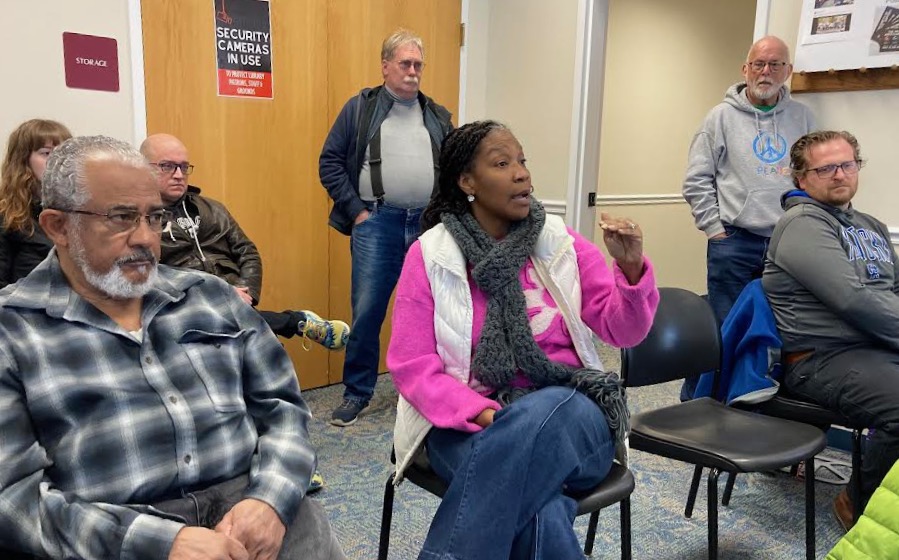
Stevenson started her visit at the Clark County Public Library by saying she wasn’t there to lecture voters, but hear what they had to say. Using rolls of paper and markers, she made three lists: what people want to end, what they want to keep, and what they want to begin.
When she asked what people wanted to end, at least two shouted: “ICE!”
They were referring to Immigration and Customs Enforcement, which has sparked outrage over its rough treatment of undocumented migrants and refugees and its recent killing in Minneapolis of two protesters.
Ronni Tallent, Democratic county chair for Clark, said she would like to see an end to the use of the Justice Department for “personal vendettas.”
Steve Justice said he wanted the Democratic Party to stop being “far left.”
“We need to start being moderate and putting the country first,” he said.
“We need to quit rolling over” for Republicans, Brett Cheuvront said.
Heather Bowman Baber wanted to stop government shutdowns.
Robert Sainte, a local business owner, said he wanted to stop President Trump’s tariffs, which were hurting small businesses. Sainte said he has to buy a part from Norway that costs $2,500, and the Trump administration’s $585 tariff on the product was more than his profit, so he had to raise his product’s price, which has cost him customers. Now, because Trump is miffed that he didn’t get the Nobel Peace Prize, he’s raised tariffs another 10 percent.
“It’s not sustainable, and it’s not just me,” he said. “Anybody that buys anything from [the European Union] or Australia … but especially Canada, you’re just screwed.”
Under what to keep, Ron Kibbey said he wanted to keep the Affordable Care Act and the funding it requires.
Mike Bridges wanted to keep protections for labor unions.
John Rice wanted to protect national parks.
There were many suggestions from the 40 or so attendees about what kinds of things to start: prison reform, pre-kindergarten for all children, a guaranteed living income, and universal health care.
Stevenson said her thinking on health care had changed over time. She was wary of what might happen to a universal insurance system on President Trump’s watch, but thought the country should revisit the idea of a “public option.” That was part of the original Affordable Care Act proposal, but it was removed at the insistence of insurance companies and congressional Republicans.
“We know that other countries that have universal health care have much better health outcomes than we do, and they’re spending far less money per person than we do, so something has to give,” the candidate said.
On the subject of election reform, several suggestions included expanding early voting and keeping polls open longer.
“We need to stop people from voting straight party,” said Cheuvront, referring to the practice of checking one box on a ballot to vote for all the Republicans or all the Democrats without considering the merits of individual candidates in each race. “That’s what happens here,” he said.
Stevenson said Kentucky is one of only six states that allow straight-ticket voting, and it was interesting that the issue came up in Clark County, she said, because the county’s former Republican state representative, Les Yates, filed a bill to do away with it.
“And what happened? His own party primaried him and got rid of him,” she said.
“I come from Wisconsin, and we had open primaries, which allowed independents to vote,” said Rory Houlihan, who is running for state representative as a Democrat.

“Doesn’t that allow another party to sandbag the primary because [they] want a weaker opponent?” Bridges asked.
An option Bridges and Houlihan agreed on was ranked choice voting, which allows voters to rank candidates in order of preference. Alaska and Maine already use ranked-choice voting, but the GOP’s Make Elections Great Again legislation introduced last month would end it for federal elections.
When the issue of term limits came up, Stevenson urged caution.
“I served in the state House for six years. In my last two years, I served in leadership. And it was honestly about then that I finally felt that I knew what I was doing,” she said.
It takes time, she explained, to gain expertise and establish relationships that make a legislator effective.
“So if we were to have term limits at some point, I think they should be a little longer than most people think about because institutional knowledge is important,” she said.
Robin Kunkel, a candidate for the Winchester Board of Commissioners, asked what Stevenson thought about siting solar production on prime farmland, and Rick Beach, a former city commissioner, suggested it would be better to place them on abandoned strip mine sites.
Stevenson mentioned that Adam Edelen, a former Democratic state auditor, is currently building solar farms on mountaintop removal sites. Unfortunately, Stevenson said, the Kentucky legislature has made it more difficult to develop solar and easier for those who want to produce coal.
Stevenson, a coal miner’s daughter from Hindman, said those who suggest that Appalachian coal will make a big comeback are selling a bill of goods.
“Listen, I come from Eastern Kentucky. Coal put food in my belly and kept the lights on in my house. However, we all know … that coal is diminishing,” she said.
The easily mineable mountain seams are gone, and those that are left are deeper, harder, and more expensive to mine. And the coal that’s left is hardly marketable, unlike the rich, soft coal that once fueled America.
Rather than giving people “false hope,” she said, it’s important to diversify energy production. She said she favors former President Obama’s “everything” approach — carbons such as coal, oil, and natural gas, but also green alternatives such as wind, solar, and water.
Some of those present talked about the need to educate people about the issues, rather than “dumbing down” politics.
“There is a part of our community that doesn’t have a clue,” said Ros Gay. “They’re not interested in it or anything else. But it affects them.”
Stevenson encouraged Democrats to inform voters. The best candidates, she said, aren’t always the ones with the most yard signs or money, but the best solutions and values.
“The values that shaped me I learned on front porches, in union halls, at church suppers and around the kitchen table,” she said. “We don’t believe that petty partisan politics should ever get in the way of commonsense solutions because we will always put people over politics.”
Stevenson said she believes more people are “in the middle than out on the ends,” even if those on the ends tend to be the loudest.
She said, “those of us in the middle want to work together, we want compromise. It’s what people expect of us.”
Although Stevenson now lives in the Bluegrass region and represented it in the Kentucky House, where she flipped a seat that had long been held by Republicans, she calls herself a “mountain Democrat” because of her Appalachian roots and values.
“We are fighters … and this is a moment when we have to fight without fear,” she said.
Never miss a thing with our weekly newsletter.
“If we pull together, we can win,” she vowed.
More information about Stevenson’s campaign is available at www.cherlynnstevenson.com
