
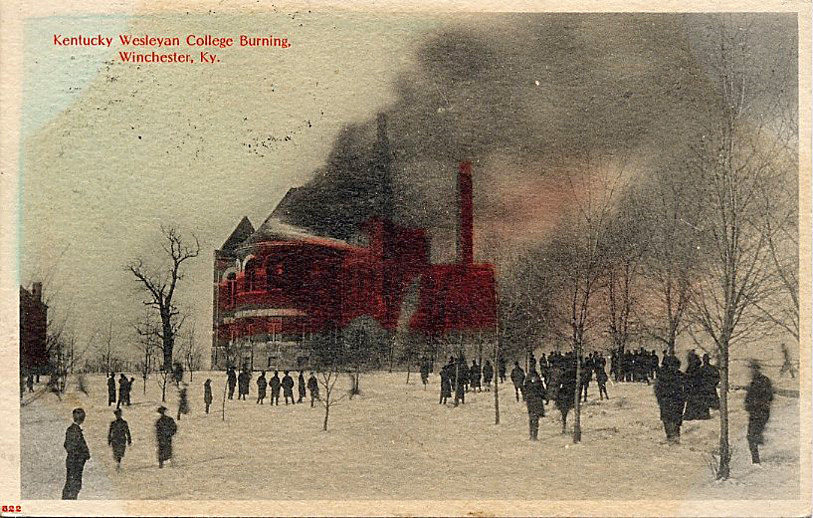
Older citizens can recall when Winchester was a bustling college town. Kentucky Wesleyan’s sixty-one-year residence here ended in 1951. The cultural and economic losses to the city and county when the school moved to Owensboro are immeasurable. But, as I heard one say, “We stole the college from Millersburg, and then Owensboro stole it from us.” After spending a few days at home researching the college, I thought it might be worthwhile to share a bit of its history.
The Methodist Episcopal Church established Kentucky Wesleyan College at Millersburg in 1858. The divisive issue of slavery delayed opening the school until after the Civil War. Classes finally began in the fall of 1866. The original mission was to train Methodist ministers, but soon expanded to include liberal arts education. By 1886, the school was struggling. Enrollment had fallen and finances were in shambles. The Kentucky Methodist Conference invited proposals from other cities that were more generous and offered better access for students.
Calling on its leading citizens, Winchester raised $35,000, donated five acres of land and touted its superior location for the school. While Millersburg was situated on a branch line railroad, Winchester had two major railroads and would soon add a third.
Church fathers approved the move, but Millersburg challenged the decision. They lost their suit in Bourbon Circuit Court, and the decision was upheld at the Court of Appeals. Their appeal to the U.S. Supreme Court never got a hearing. The college packed up and moved to Winchester for the 1890–1891 school year.
Student classes were held in the old Governor Clark mansion while a new three-story college building was under construction. President D. W. Batson and three other professors composed the faculty for 125 students. Opened for the fall semester of 1891, the new administration building also housed classrooms, offices, laboratory and library. In 1892 the school approved accepting women for enrollment, thus becoming the first coed college in Kentucky. A men’s dormitory, Clark Hall, was added in 1894.

Disaster struck on Tuesday, February 14, 1905. With the temperature dipping below zero and the college furnaces going full blast, fire broke out in one of the wooden cold-air returns about 9 o’clock in the morning. Windows, broken by the heat, allowed air in to fuel the blaze, and two thousand bushels of coal in the basement caught fire adding to the fury. In spite of the weather, huge crowds gathered at the scene. The building was reduced to a smoldering ruin.
Before the fire was out, the Winchester Commercial Club had met and resolved to assist in finding temporary quarters for the college and to support the speedy erection of a new building. Classes reconvened on Thursday. The community raised $24,000 to go with $20,000 from the insurance. With the funding in hand, bids were awarded in May for a three-story, colonial-style college building. All the work went to local contractors except structural iron work. The finished building opened in May 1906.
Kentucky Wesleyan continued its recovery with a $15,000 grant from the Andrew Carnegie Foundation for a new library. Other improvements included a girl’s dormitory (1917), a second men’s dorm (1922) and gym (1925). The student population averaged around two hundred.
Never miss a thing with our FREE weekly newsletter.
All was not well at Wesleyan, however. The college had endured years of financial stress. The Methodists had three colleges to support—Kentucky Wesleyan, Union in Barbourville, and Lindsey-Wilson in Columbia. The most the church ever contributed totaled $31,800 in 1946, which was split three ways. Bishop Watkins opined that “We have trough enough for one horse and three are trying to eat of that.” In 1950, the church voted to move Kentucky Wesleyan to Owensboro, where citizens pledged $1,000,000 for the school.
That year, William C. Caywood, editor of the Winchester Sun, penned a thoughtful article about the move, published in the Filson Club Historical Quarterly. He warned that Owensboro’s pledge “must be followed by a perpetual flow of cash—an experience Wesleyan has never known.” Caywood was realistic about the need for the move:
“Sentimentalists who might be disposed to over-valuing the tradition, lore, history and good-will are to be reminded that it long since has been accepted as fact that ample endowment and a steady flow of five- and six-figure donations are more important to sustenance. The ivy-covered college strong in its tradition and weak in its treasury belongs to the glory of the past. Privately-owned and church-supported colleges of today are costly luxuries dependent upon the wavering generosity of the respective constituents.”

Kentucky Wesleyan has indeed flourished in Owensboro. They now have an endowment of $37,000,000 and enrolled 864 students for the 2024–25 school year. As a bonus, they have produced outstanding athletic teams that included winning eight Division II national championships in basketball.
All that remains of Wesleyan in Winchester is the Spencer Gymnasium and the Carnegie Library.