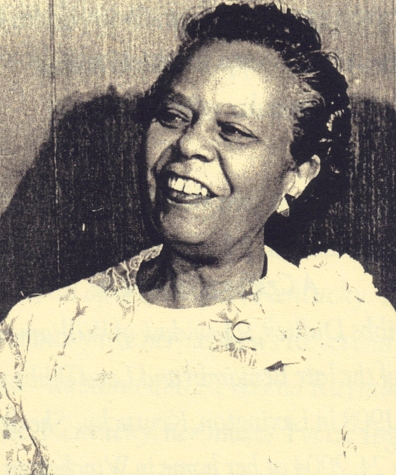

Early on a Wednesday morning, October 4, 1939, Jennie Didlick boarded a bus in Winchester for the commute to her job in Lexington, where she taught fourth grade at Booker T. Washington School. The back seat on the bus was “reserved for colored.” Jennie took a seat in the next row up because she said she “always became ill from riding on the long jump seat.”
About three miles out of Winchester, the driver stopped and took on a group of new passengers. Wanting her seat for two white passengers, he ordered Jennie to move to the rear. She declined. He then took her purse and briefcase and set them outside the bus. He came back to Jennie, grabbed her arm and shoulder, and forcibly put her off the bus. She had to wait beside the road until she could get a car to take her to her Lexington classroom.
Jennie had the presence to contact a white lawyer whom her father had worked for. They filed suit in Fayette Circuit Court (Jennie Bibbs Didlick v. Southeastern Greyhound Lines), seeking $2,500 for “humiliation and mental anguish.”
Jennie recalled the trial in a 1986 interview. “We called a number of white witnesses who testified in my favor. The only dissenting witness was the driver, who said I refused to move. I said I didn’t refuse to move, rather I refused to sit in the back seat.”
Counsel for the defendant argued that the bus company reserved the right to seat passengers as it saw fit. An all-white jury didn’t buy it. They awarded judgment to the plaintiff for $200. Jennie said she and her lawyer split the settlement.
Much more fanfare was attached to a similar case 16 years later in Montgomery, Alabama (1955). When a bus driver ordered Rosa Parks to give up her seat for white passengers, she refused. The driver called the police and had her arrested. Her trial lasted thirty minutes. She was fined $10. Parks appealed her conviction, formally challenging the legality of racial segregation.
News of her arrest inspired the “Montgomery bus boycott,” which continued for 381 days, severely damaging the bus company’s revenues. Opposing attorneys managed to stall Rosa’s appeal in state courts. Meanwhile, the city repealed its law requiring segregation on public buses after the U.S. Supreme Court ruled in Browder v. Gayle that it was unconstitutional.
While Rosa Parks’s actions had greater national consequences, both Jennie and Rosa displayed the same courage in facing up to white authority. Both defied practices they knew to be unfair. And both succeeded in their challenge of the system.
Never miss a thing with our FREE weekly newsletter.
Jennie Bibbs Didlick was as talented as she was courageous. Born to Benjamin and Lena Burns Bibbs, in Lexington, Jennie graduated from Howard University and obtained her Master’s degree at the University of Kentucky. She taught at Constitution and Booker T. Washington Elementary Schools and later served as principal at the latter. Jennie married William “Pie” Didlick, well known in Winchester as one of the founders of Little League Baseball. Both are buried at Hillcrest Cemetery on Venable Road in Clark County.
You can learn more about Jennie by listening to her oral history interview recorded in the Black People in Lexington Oral History Project.
According to the interview synopsis,
“Mrs. Didlick recalls growing up in the African American community, the importance of the family and the role the churches played in that society. Her mother took in laundry and was the disciplinarian in the family, and her father worked for the University of Kentucky. She recounts the family memories of slavery, the educational background of her family and its history. She recounts experiences with discrimination in white-owned businesses, her lack of participation in the civil rights movement, the socioeconomic division present in the African American community, and the segregated housing conditions still in effect in Winchester in 1986.”