
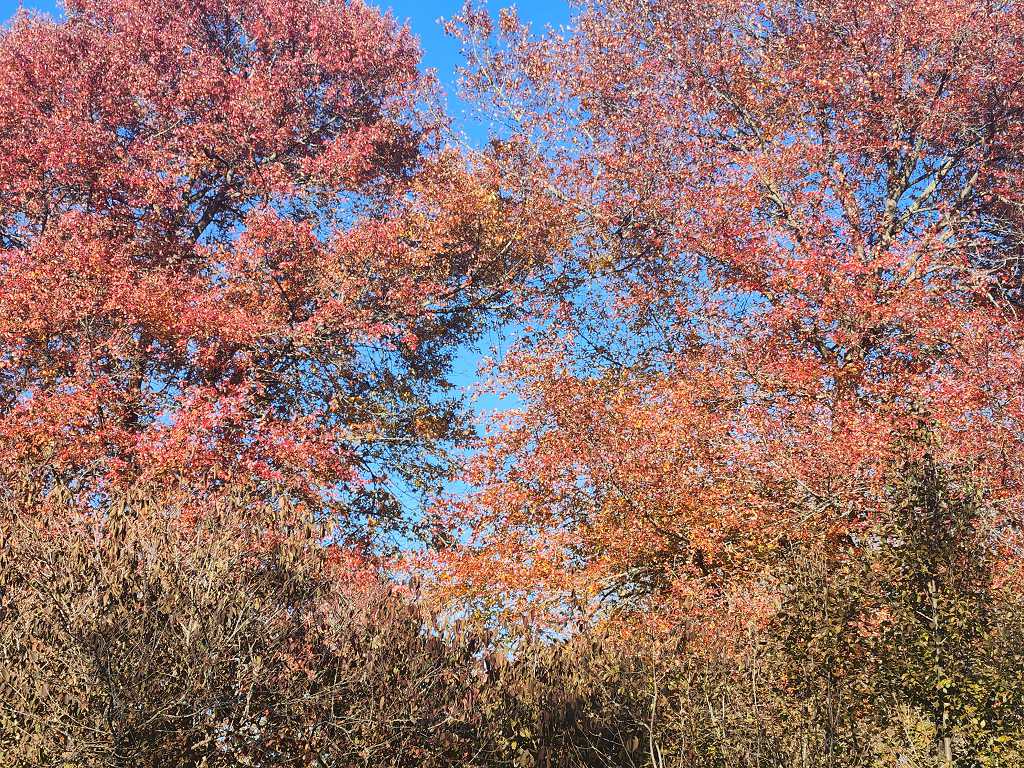
I feel the call to rest. Late summer has been a long, dry time in central Kentucky. Funny how the first large storm happened on the first day of fall, like the weather knew they needed to bring a little balance to truly herald a changing of the season.
The trees are hearing the call as well. They had steadfastly held onto their leaves during the drought, getting a little drier and browner with every passing day. However, since the rains have finally come, so have the dark hours. The trees have made some sort of cost-benefit analysis regarding the energy to keep their leaves versus what they were producing. Or maybe they know that dropping leaves protects their roots from winter exposure and erosion while also nourishing the creatures of the soil for a fertile spring growing season. Or maybe they know nothing is lost or wasted—just shared to come back around again.

Human books and studies don’t know a fraction of the secrets of trees. One of the most interesting “discoveries” Western science knows now is that trees share resources as an act of collective and mutual care and survival. However, I deeply believe that when we stop and pause for a moment, our bodies already know this perfectly, because our poetry sometimes knows that “we can’t see the forest for the trees.”
Never miss a thing with our weekly newsletter. Click here to subscribe now!
A forest is not just made up of a single species or genetic line of trees—even managed forests planted for the sole purpose of producing products. Because even in that monoculture, a forest is still a tunneling ant colony, hammering woodpeckers, fugitive chipmunks, brawly bears, tiny ephemeral flowers, resilient moss, and microscopic microbes! They know-know that they are a part of something bigger—like the forest know-knows that she is a part of something bigger—like the Earth know-knows that they are a part of something bigger. And I know-know that all humans deeply know-know that they are a part of something bigger.

Reaching this place of listening to the knowing is both natural and very difficult. What is a birthright or innate ability has been crowded out by a modern society organized to constantly, loudly, and urgently demand our attention. We are compelled to react and respond because our survival depends on it. But while an individual human is able to endure the systemic noise of the way we live, humankind is hurting, and in the end our collective—humans and the forest we live in—is in serious jeopardy. The situation seems insurmountable. However, it is precisely learning to listen to the knowing that will help us all.
How do we get back to knowing? As the kids these days say, “go touch grass.” The world, the environment we are a part of, has never stopped knowing. We can learn by observation, and it is as simple as watching a bird fly or insects scattering when you lift a rock, or sitting beneath a tree.
How long can you look at a rock? Can you look at it for longer than five seconds? Ten? Thirty? A minute? Can you describe and find something new about it as the moments pass? It’s very hard! But I promise you will reach a point where it clicks, you lock in, and you can touch something beautiful about the collective Earthly experience.
Practicing can be very easy; it just takes noticing. It’s the moment you savor the wind on your face or the way warmth radiates into your body from a sun-warmed rock. It’s you savoring the feel of a pet’s fur or noticing the way your breath feels in the back of your throat. From there, try to notice how you treat the people around you, if you’re not accidentally holding your breath or after a happy encounter with a breeze. They may respond by treating you with more kindness, and that synergy ripples outward from that single moment of connection. This may seem insignificant, but a single leaf helps feed an entire tree, and that tree is a part of an entire forest.

If you’d like to connect more with trees, check out Tree Week Clark County from October 10 to 18. There are art activities, a hike, walks, and ways to gather around the theme of trees. Learn more here (https://www.facebook.com/TreeWeekClarkCounty)
