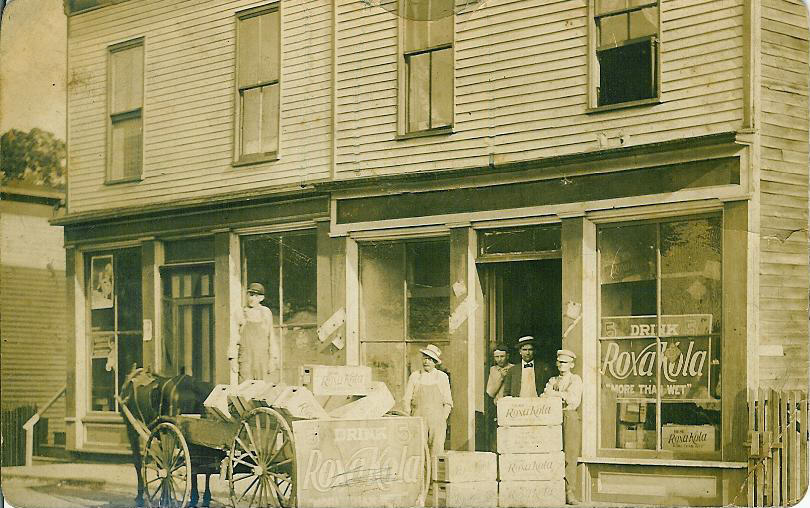
With three rail lines coming through the city in the late 1890s, Winchester experienced a building boom. Business opportunities brought a number of visionary men to Clark County seeking to make their fortunes. One of these was Lee Wainscott, soft drink inventor and founder of the highly successful Ale-8-One Bottling Co. He was born in 1867 in Owenton, Kentucky, the son of George and Elizabeth Wainscott. His parents gave him the name “Lee,” to which he later added the initial “G.” It was said he wanted to be referred to as “G. Lee Wainscott.” Lee had a fascinating career, of which we can only touch on the highlights here.
Wainscott graduated from Transylvania University with a degree in civil engineering, worked briefly for the Lexington & Eastern Railroad then went to Texas for a time. His locating in Winchester was serendipitous. His father had been a hotel keeper in Owenton and Georgetown before coming to Winchester to run the Rees House (it stood on the site of the Brown-Proctor Building). When George’s health began to fail in 1896, he called on his son Lee to take over management. George died soon after, and Lee ran the Rees House for two years before going into the coal and lumber business with his cousin Joseph Lindsay (later sheriff and judge in Clark County).
In 1899 Lee purchased a storehouse and lot on Main Street, just south of the C&O Railroad. The building was located on the west side of Main across from Depot Street. It was here in 1902 that Wainscott started making candy and bottling soda water.

He soon introduced a number of fruit-flavored drinks. Then in 1906, he began bottling and selling Roxa Kola. After the drink became popular in the area, Wainscott started selling the syrup to other bottlers. There were Roxa Kola bottling plants in Lexington, Irvine, Beattyville, Georgetown, Cynthiana, and Carlisle. Each had their own licensed territory.
Roxa Kola’s success attracted the attention of the Coca-Cola Company, who had their own bottlers in the area. From the time Coca-Cola was trademarked (1887) until they sued the Carlisle Bottling Works for Roxa Kola’s trademark infringement (1929), the industry giant had never lost a case out of the dozens they filed. This would prove to be the exception. Wainscott was called upon to provide the defense. He and his lawyers did a marvelous job.
Never miss a thing with our FREE weekly newsletter.
The case ultimately turned upon the fact that Coca-Cola bottlers had operated in the same territory for years without any complaints against Roxa Kola. Then Charles Mitchell, a Lexington bottler, got into a squabble with Wainscott after their empty bottles got mixed up. The complaint was heard in the U.S. District Court at Lexington and was dismissed by the federal judge. Coca-Cola took the case to the U.S. Court of Appeals and lost there too.
In 1909 Wainscott tore down his original factory and put up a new three-story building. Deliveries were originally by wagon, but starting in 1912, they were made by Wainscott’s fleet of trucks. (He is credited with having the first truck in Winchester.)
In 1910 Wainscott organized the Kentucky State Bottlers’ Association at the Seelbach Hotel in Louisville. He was elected their first secretary-treasurer and later served as president. He was active in their annual exposition at the Kentucky State Fair as well as the National Bottlers’ Expositions.
The conclusion of this two-part story will appear next week.