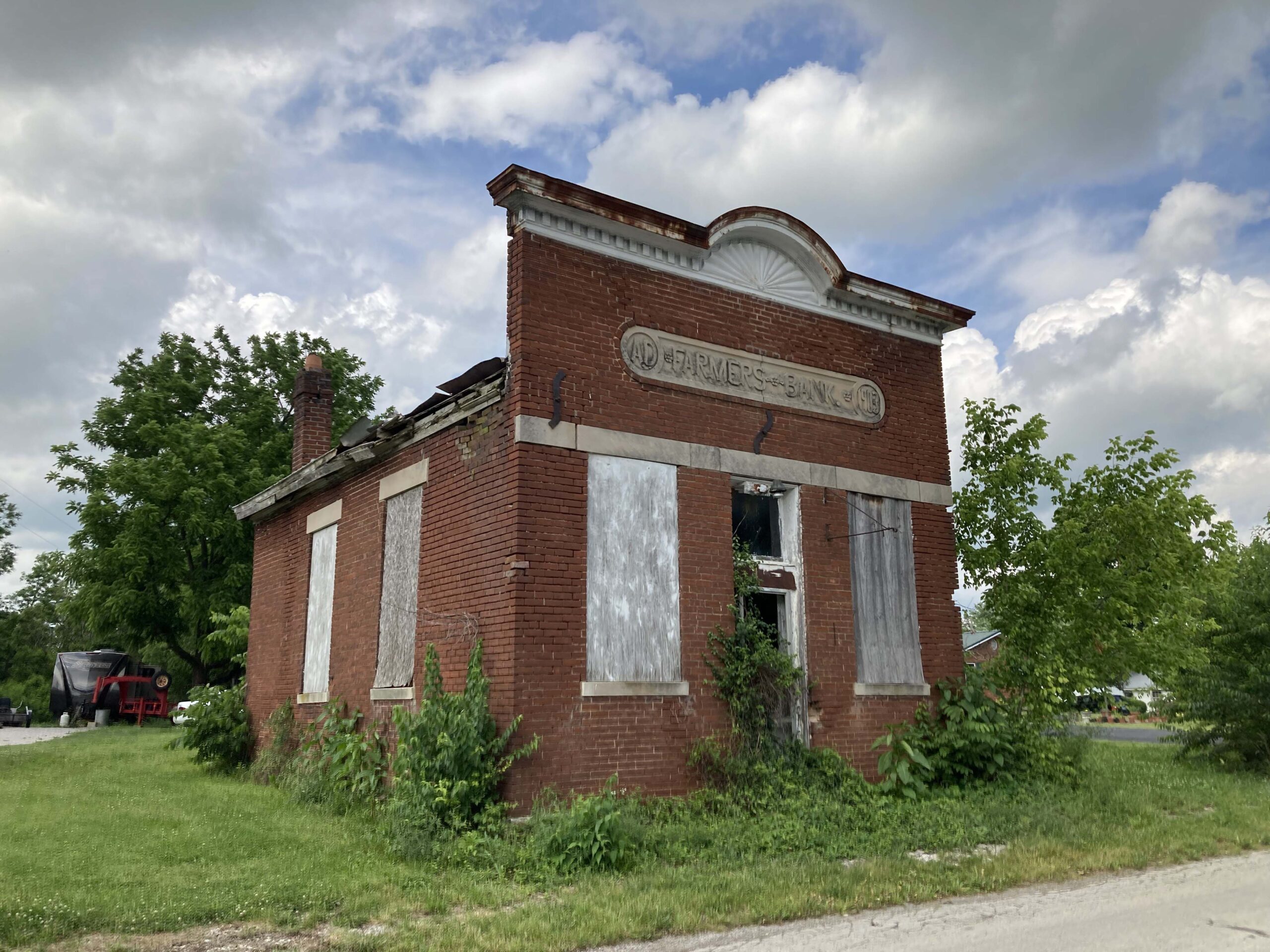

Last week, while Clare and I were taking our granddaughter to horse camp in Bourbon County, we passed through the old village of Clintonville. Stopping at the intersection and noticing the photogenic bank building on Austerlitz Road, I took the photograph above. I recalled the bank had a tragic history and decided that Clintonville would be an interesting topic, even though it’s not in Clark County. (It is only a mile north of the county line, however.)
The place was settled in the late 18th century and was originally called Stipp’s Cross Roads after early settlers, John and George Stipp. The name Clintonville came from the local Masonic chapter, organized in 1825 as the “De Witt Clinton Lodge.” The crossroads was a thriving place well before the Civil War. It had a tavern, two distilleries, a hemp factory, a blacksmith shop, two doctors, a saddler’s shop, a cigar factory, a ten-pin alley, and four saloons. The post office there lasted for over a century (1831−1958).
The Farmers Bank was established in 1903 by William F. Heathman, a Clark County native who also served as the bank’s first president. One night in May 1924 unknown persons attempted to break into the bank’s vault. They used an acetylene torch to cut through the lock on the entrance door and then attempted to blow the safe with nitroglycerin. They breached the outer safe door but could not get the inner door open. A neighbor sounded the alarm and the burglars fled, leaving all their tools behind.
The following month saw an attempted armed robbery at the bank in broad daylight. About 9:30 a.m. one morning, four men rolled up in a stolen Cadillac, and three of them entered the bank. Only two occupants were inside at the time, Frank Buchanan, a bank director, and Walter Gibson, the cashier. When ordered to put their hands up, Buchanan refused and grappled with one of the armed men, getting shot in the process. Gibson retrieved a weapon and fired on the fleeing gang. Buchanan died at the scene; two of the would-be robbers were wounded but all four got away.

Within days the fugitives were identified as Newport men with shady pasts. Following their arrests, all four were tried and convicted in Bourbon Circuit Court. The driver of the getaway car, Robert Mullen, was sentenced to life in prison. Elmer Hall, George Farrell and Richard Newhouse received the death sentence and were executed the following year.
Farmers Bank closed shortly after the tragedy. According to a local, William Ware, “it was used as a residence for approximately 30 years, a Baptist church for another 20 plus years, and then became a clogging studio for nine years.”
Clintonville is a quieter place these days. They have Nannie Pearl’s Clintonville Store, a volunteer fire department, two churches — and a handsome abandoned bank building.